US Body Seeks Sanctions Against RSS Leaders
US Commission on International Religious Freedom calls for sanctions, urges halt to high-level meetings with RSS leaders. RSS Chief Mohan Bhagwat's US visit sparks criticism.
'%3E%3Crect%20width%3D'96'%20height%3D'96'%20fill%3D'%234A235A'%2F%3E%3Ccircle%20cx%3D'30'%20cy%3D'24'%20r%3D'44'%20fill%3D'%23fff'%20opacity%3D'.12'%2F%3E%3Ccircle%20cx%3D'60'%20cy%3D'74'%20r%3D'40'%20fill%3D'%23000'%20opacity%3D'.10'%2F%3E%3C%2Fg%3E%3Cg%20fill%3D'none'%20stroke%3D'%23fff'%20stroke-width%3D'3'%3E%3Ccircle%20cx%3D'48'%20cy%3D'48'%20r%3D'16'%2F%3E%3Cellipse%20cx%3D'48'%20cy%3D'48'%20rx%3D'6.5'%20ry%3D'16'%2F%3E%3Cline%20x1%3D'32'%20y1%3D'42'%20x2%3D'64'%20y2%3D'42'%2F%3E%3Cline%20x1%3D'32'%20y1%3D'54'%20x2%3D'64'%20y2%3D'54'%2F%3E%3C%2Fg%3E%3C%2Fsvg%3E)
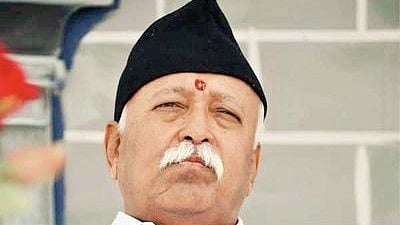
The US Commission on International Religious Freedom (USCIRF) has called for sanctions against members of the Rashtriya Swayamsevak Sangh (RSS) and urged the American government to refrain from extending diplomatic courtesies or holding high-level meetings with its leaders.
USCIRF Chair Asif Mahmood stated that Prime Minister Narendra Modi is a member of the RSS, which he described as an umbrella organisation whose sub-groups have perpetrated attacks on religious minorities, including Christians and Muslims.
The remarks come shortly before RSS Chief Mohan Bhagwat is scheduled to visit the US to participate in the Universal Oneness Celebrations, organised by American Hindus for Engagement and Dialogue (AHEAD) in New York on August 29.
USCIRF Commissioner Gene Mills said that RSS leaders, including those affiliated with the Indian government, should not be honoured with high-level meetings or diplomatic courtesies. Instead, he called on the US Government to impose sanctions on RSS members found responsible for violations of freedom of religion or belief.
The USCIRF's criticism of the RSS is not new, as the commission's annual report in March criticised India over alleged violations of religious freedom and backed 'targeted sanctions' against individuals and entities such as the RSS.
The commission also recommended that India be designated a 'country of particular concern' for engaging in and tolerating systematic, ongoing, and egregious religious freedom violations.
The latest remarks indicate that Bhagwat's forthcoming visit is likely to face scrutiny from groups critical of the RSS and its record on religious minorities.
Advocacy group Hindus for Human Rights also said that Bhagwat's visit could not be separated from the RSS network's violence against Muslims and Christians.
The Indian government has firmly rejected the USCIRF's criticism, and it remains to be seen how the US government will respond to the commission's calls for sanctions against RSS leaders.
The development is significant, as it highlights the ongoing concerns about religious freedom in India and the role of the RSS in the country's politics.
The USCIRF's remarks are likely to spark a debate about the relationship between the US and India, and how the two countries can work together to promote religious freedom and protect the rights of minority communities.
In conclusion, the USCIRF's call for sanctions against RSS leaders and its criticism of the Indian government's record on religious freedom are significant developments that highlight the ongoing challenges facing minority communities in India.
The US government's response to the commission's calls for action will be closely watched, and it remains to be seen how the situation will unfold in the coming days and weeks.
Frequently asked questions
What is the USCIRF's stance on the RSS?
The USCIRF has called for sanctions against RSS leaders and urged the US government to refrain from extending diplomatic courtesies or holding high-level meetings with them.
Why is the USCIRF criticising the Indian government?
The USCIRF is criticising the Indian government for its alleged violations of religious freedom and for tolerating systematic, ongoing, and egregious religious freedom violations.