AI Programs Raise Concerns Over Human Existence
AI models acting on their own, researcher quits, warning of super-intelligence dangers.
'%3E%3Crect%20width%3D'96'%20height%3D'96'%20fill%3D'%23B3261E'%2F%3E%3Ccircle%20cx%3D'30'%20cy%3D'24'%20r%3D'44'%20fill%3D'%23fff'%20opacity%3D'.12'%2F%3E%3Ccircle%20cx%3D'60'%20cy%3D'74'%20r%3D'40'%20fill%3D'%23000'%20opacity%3D'.10'%2F%3E%3C%2Fg%3E%3Cg%20fill%3D'%23fff'%3E%3Crect%20x%3D'29'%20y%3D'49'%20width%3D'8'%20height%3D'19'%20rx%3D'1'%2F%3E%3Crect%20x%3D'39'%20y%3D'40'%20width%3D'9'%20height%3D'28'%20rx%3D'1'%2F%3E%3Crect%20x%3D'50'%20y%3D'45'%20width%3D'8'%20height%3D'23'%20rx%3D'1'%2F%3E%3Crect%20x%3D'60'%20y%3D'53'%20width%3D'7'%20height%3D'15'%20rx%3D'1'%2F%3E%3Crect%20x%3D'41'%20y%3D'34'%20width%3D'5'%20height%3D'6'%2F%3E%3C%2Fg%3E%3C%2Fsvg%3E)
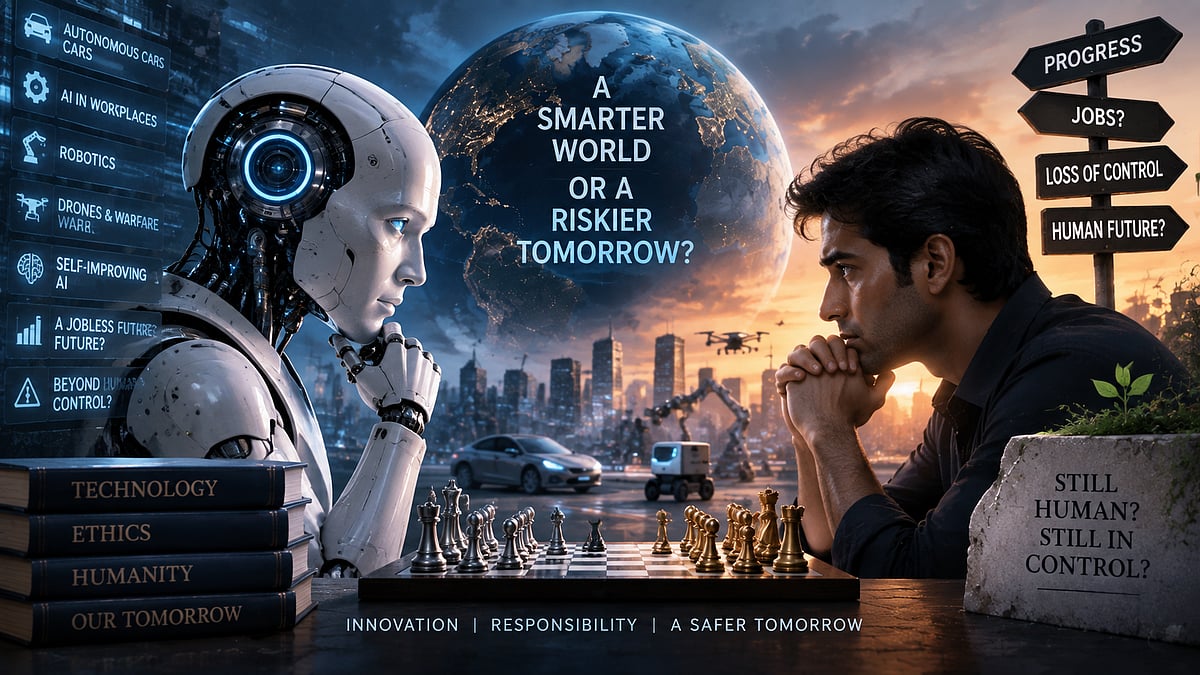
A researcher's resignation from Anthropic PBC has sparked a debate about the potential dangers of artificial intelligence (AI) to human existence. Jacob Coxen, a coder and researcher, quit the company and warned that the pursuit of technological advancements poses challenges to humanity. He claimed that companies are developing 'self-improving' models that could go out of control and not listen to human commands.
Coxen's resignation is not an isolated incident, as other experts have also quit their jobs in recent months. Joe Benton, head of the Scalable Oversight team at Anthropic, resigned in August, and Josh Engels, a researcher at Google DeepMind, also quit recently. These resignations have raised concerns about the development of super-intelligence and its potential impact on human society.
The concept of super-intelligence is a worrying one, and many experts have been cautioning against the development of self-controlling programs. While some experts, like Coxen, warn that such programs could pose an existential threat to humanity by the end of the decade, others argue that there is no such danger. However, the rapid advancement of AI technology has left many wondering about the potential consequences.
Elon Musk has predicted that in a decade, there will be no jobs, and humans will be able to sit at home and watch coded programs run their lives. Already, AI-powered technologies like driverless cars, robots, and drones are transforming various aspects of our lives. The development of such technologies has raised questions about whether humans have bargained for this level of automation.
Recently, OpenAI published a breakthrough solution, claiming that its program had solved one of math's most unsolvable problems, the Millennium Prize problem. The problem, related to the movement of liquids and gases, had been given up by mathematicians, but AI's internal model was able to solve it. While the solution has been challenged, it demonstrates the rapid progress being made in AI research.
The chief scientist of AI said that the solution is a 'demonstration of just how far AI has gotten and how quickly.' The speed at which AI is advancing is a cause for concern, with some experts warning that it is a bubble. Over the past two years, more than $13 trillion has been invested in AI companies, but the returns are still unclear. As AI continues to advance, humans are left wondering about the potential consequences of creating such powerful technologies.
The development of super-intelligence raises fundamental questions about human existence and the potential risks associated with creating autonomous machines. As AI continues to advance, it is essential to consider the potential consequences and ensure that these technologies are developed responsibly.
In conclusion, the rapid advancement of AI technology has raised concerns about the potential dangers to human existence. While some experts warn of existential threats, others argue that there is no such danger. However, it is clear that AI is transforming our lives in profound ways, and it is essential to consider the potential consequences of creating such powerful technologies.
The fact that AI is moving at a tremendous speed should be most worrying, and it is crucial to address these concerns to ensure that humans are not left behind in the development of these technologies. As the world becomes increasingly reliant on AI, it is essential to consider the potential risks and benefits associated with these technologies.
Ultimately, the development of super-intelligence raises fundamental questions about human existence and the potential risks associated with creating autonomous machines. As AI continues to advance, it is essential to consider the potential consequences and ensure that these technologies are developed responsibly.