Bombay HC Sets Aside Mira Road Housing Society De-Registration
Court rules against builder, citing own illegalities. Mira Road society to remain registered.
'%3E%3Crect%20width%3D'96'%20height%3D'96'%20fill%3D'%23B3261E'%2F%3E%3Ccircle%20cx%3D'30'%20cy%3D'24'%20r%3D'44'%20fill%3D'%23fff'%20opacity%3D'.12'%2F%3E%3Ccircle%20cx%3D'60'%20cy%3D'74'%20r%3D'40'%20fill%3D'%23000'%20opacity%3D'.10'%2F%3E%3C%2Fg%3E%3Cg%20fill%3D'%23fff'%3E%3Crect%20x%3D'29'%20y%3D'49'%20width%3D'8'%20height%3D'19'%20rx%3D'1'%2F%3E%3Crect%20x%3D'39'%20y%3D'40'%20width%3D'9'%20height%3D'28'%20rx%3D'1'%2F%3E%3Crect%20x%3D'50'%20y%3D'45'%20width%3D'8'%20height%3D'23'%20rx%3D'1'%2F%3E%3Crect%20x%3D'60'%20y%3D'53'%20width%3D'7'%20height%3D'15'%20rx%3D'1'%2F%3E%3Crect%20x%3D'41'%20y%3D'34'%20width%3D'5'%20height%3D'6'%2F%3E%3C%2Fg%3E%3C%2Fsvg%3E)
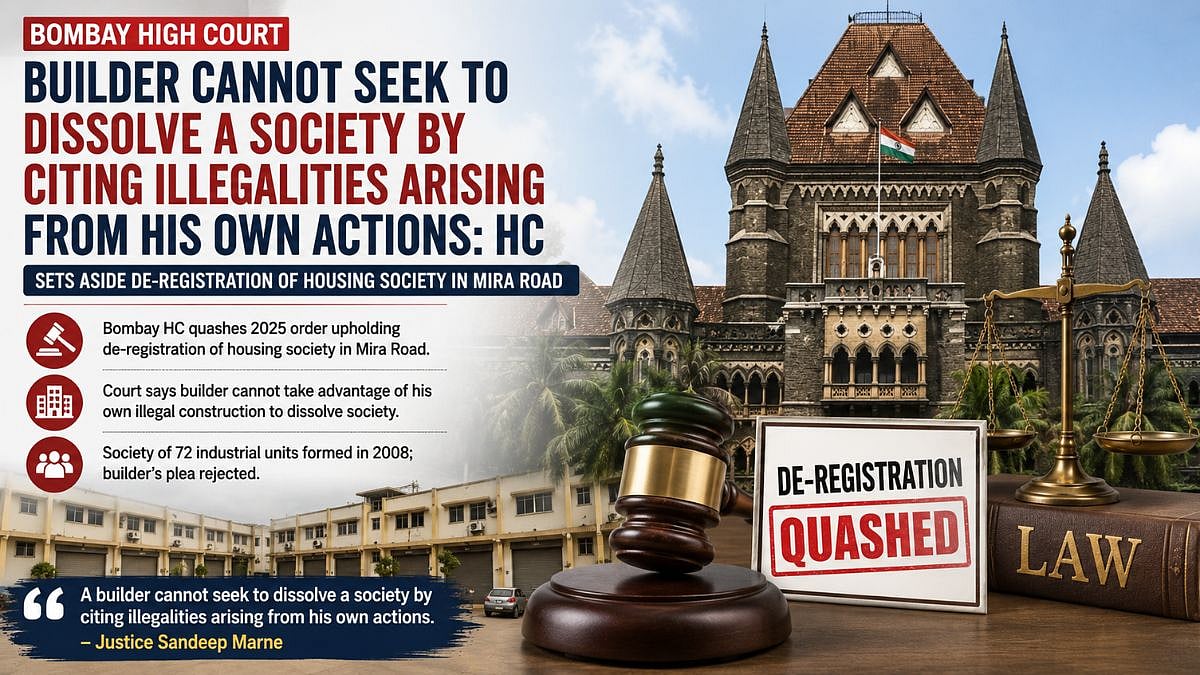
The Bombay High Court has set aside the de-registration of a co-operative housing society in Mira Road, in a significant ruling that holds a builder cannot seek to dissolve a society by citing illegalities arising from his own actions.
On August 7, 2026, Justice Sandeep Marne quashed a 2025 order of the Maharashtra Co-operation Minister that upheld the de-registration of the Hatkesh Udyog Nagar Industrial Premises Co-operative Housing Society. The society comprises 72 industrial units near the Mira Road end of Ghodbunder Road.
The court was hearing a petition filed by members of the society, who challenged the minister's order affirming an earlier decision of the Divisional Joint Registrar to cancel the society's registration. The members argued that dismantling the society, registered in 2008, would disrupt the management of the industrial estate and lead to total chaos.
The dispute dates back to 2015 when Paresh Vora, proprietor of Hatkesh Builders, sought the society's de-registration. He cited discrepancies in the registration proposal, including a mismatch in the number of industrial units and overwriting in certain documents, besides alleging illegal construction.
However, the society members contended that the alleged illegalities were the builder's own doing. The High Court observed that while there appeared to be discrepancies in some registration documents, the background in which the proposal was submitted also had to be taken into account.
The court found that the builder had continued construction and sold industrial units without obtaining the necessary development permissions, relying only on a no-objection certificate issued by the Ghodbunder Gram Panchayat. It also noted that the land had not been converted to non-agricultural use as required by law.
Justice Marne said the builder had carried out unauthorised construction and was now attempting to secure the society's de-registration by pointing to his own illegalities. He further noted that although the first units were sold in 1979, the builder had done precious little over nearly three decades to form the society and now wanted it dissolved for an obvious oblique motive.
The court ruled that the builder could not be allowed to benefit from his own wrong, and set aside the de-registration order. In the peculiar facts of the case, the discrepancies in the registration documents could be ignored.
This ruling is significant for co-operative housing societies in Mumbai, as it sets a precedent for builders who attempt to dissolve societies by citing their own illegalities. The decision will likely have far-reaching implications for the management of industrial estates and the rights of society members.
The Mira Road society will now remain registered, and its members can continue to manage the industrial estate without disruption. The ruling is a victory for the society members, who had challenged the de-registration order and argued that it would lead to total chaos.
In conclusion, the Bombay High Court's decision is a significant milestone in the ongoing dispute between the builder and the society members. It highlights the importance of holding builders accountable for their actions and ensuring that they do not benefit from their own wrongdoings.
The court's ruling will likely be closely watched by co-operative housing societies and builders across Mumbai, as it sets a precedent for similar cases in the future. The decision is a testament to the judiciary's commitment to upholding the law and protecting the rights of society members.
Frequently asked questions
What was the Bombay High Court's ruling on the Mira Road housing society de-registration?
The court set aside the de-registration order, holding that the builder cannot cite his own illegalities to dissolve the society.
What were the grounds for the builder's application for de-registration?
The builder cited discrepancies in the registration proposal and alleged illegal construction.