Supreme Court Pushes For Warning Labels On Packaged Foods
Supreme Court considers front-of-pack warning labels on packaged foods high in salt, sugar and fat. Concerned about public health, especially children.
'%3E%3Crect%20width%3D'96'%20height%3D'96'%20fill%3D'%23B3261E'%2F%3E%3Ccircle%20cx%3D'30'%20cy%3D'24'%20r%3D'44'%20fill%3D'%23fff'%20opacity%3D'.12'%2F%3E%3Ccircle%20cx%3D'60'%20cy%3D'74'%20r%3D'40'%20fill%3D'%23000'%20opacity%3D'.10'%2F%3E%3C%2Fg%3E%3Cg%20fill%3D'%23fff'%3E%3Crect%20x%3D'29'%20y%3D'49'%20width%3D'8'%20height%3D'19'%20rx%3D'1'%2F%3E%3Crect%20x%3D'39'%20y%3D'40'%20width%3D'9'%20height%3D'28'%20rx%3D'1'%2F%3E%3Crect%20x%3D'50'%20y%3D'45'%20width%3D'8'%20height%3D'23'%20rx%3D'1'%2F%3E%3Crect%20x%3D'60'%20y%3D'53'%20width%3D'7'%20height%3D'15'%20rx%3D'1'%2F%3E%3Crect%20x%3D'41'%20y%3D'34'%20width%3D'5'%20height%3D'6'%2F%3E%3C%2Fg%3E%3C%2Fsvg%3E)
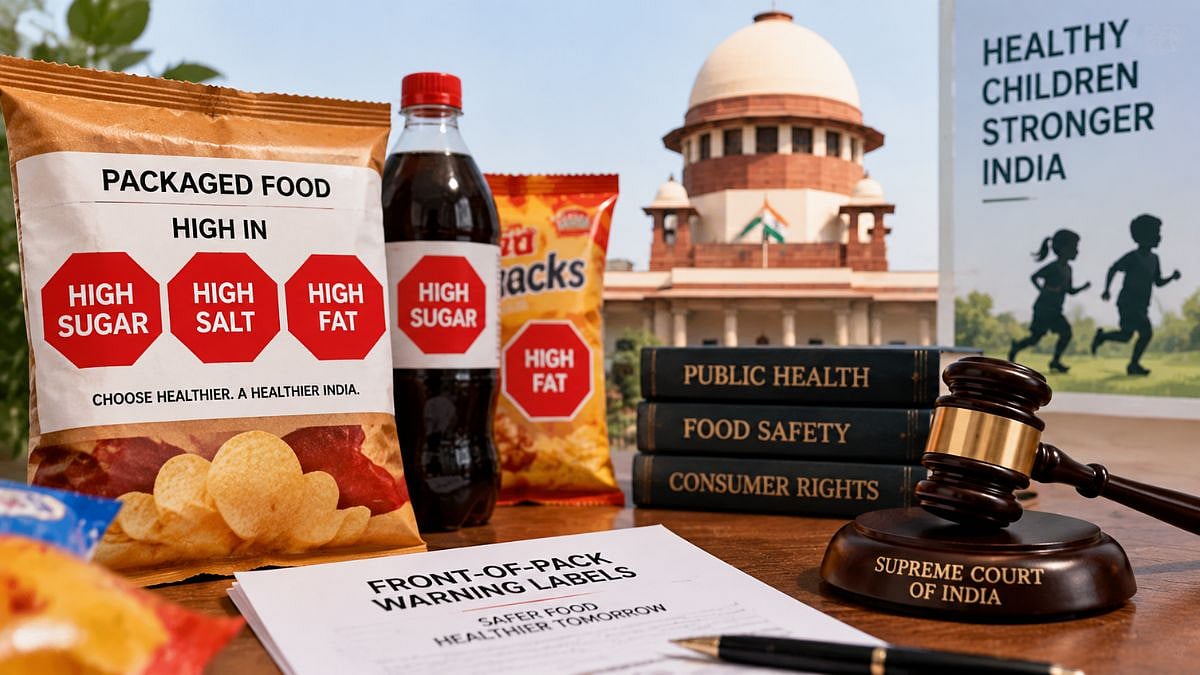
The Supreme Court on Thursday expressed concern over public health, particularly that of growing children, as it considered the issue of front-of-pack warning labels on packaged foods high in salt, sugar and fat.
A bench of Justices JB Pardiwala and K Vinod Chandran said all stakeholders concerned with food safety should consider the issue in the “national interest”. The court said it would pass a detailed order seeking information from stakeholders in the “serious matter”.
The court's concern is rooted in the potential health risks associated with consuming high amounts of salt, sugar, and fat, especially for children. The bench noted that details about the contents of packaged food products are provided on the rear of packets, but this information may not be easily accessible or understandable to consumers.
The Food Safety and Standards Authority of India (FSSAI) was questioned by the court about guidelines for identifying packaged foods high in sugar, salt or fat. The FSSAI had earlier proposed a prominent red front-of-pack warning label for food products high in added saturated fat, sugar and salt.
Senior advocate Maninder Singh, appearing for the FSSAI, submitted that internationally, two conditions are required to be displayed on the rear of a packet. He said the content has to be shown for a quantity of 100 grams and per serving.
Senior advocate Devadatt Kamat, appearing for an intervenor, submitted that the government was putting the Kurkure snack product on the same pedestal as nutritional foods such as eggs and salted cashew. He argued that ultra-processed foods should carry a stronger warning.
The court took the suggestions on record and said it would pass an order to be uploaded in a day or two. The matter has been posted for further hearing on September 28.
The proposal for front-of-pack warning labels is aimed at providing consumers with a simple, prominent and easily comprehensible warning about food products high in specified nutrients of concern. This move is expected to help consumers make informed choices about their diet and reduce the risk of health problems associated with consuming high amounts of salt, sugar, and fat.
The issue of front-of-pack warning labels is not new, and several countries have already implemented such labeling systems. The court's consideration of this issue is a significant step towards promoting public health and reducing the burden of diet-related health problems in India.
In conclusion, the Supreme Court's push for front-of-pack warning labels on packaged foods is a welcome move that prioritizes public health, especially that of growing children. The court's order is expected to provide clarity on the guidelines for identifying packaged foods high in sugar, salt or fat and pave the way for a more informed and healthier food culture in India.
The proposed warning labels are expected to have a significant impact on the food industry, with manufacturers likely to reformulate their products to avoid the warning labels. This, in turn, is expected to lead to a reduction in the amount of salt, sugar, and fat in packaged foods, making them healthier for consumers.
Overall, the Supreme Court's consideration of front-of-pack warning labels is a crucial step towards promoting public health and reducing the risk of diet-related health problems in India.
Frequently asked questions
What is the purpose of front-of-pack warning labels on packaged foods?
The purpose of front-of-pack warning labels is to provide consumers with a simple, prominent and easily comprehensible warning about food products high in specified nutrients of concern, such as added saturated fat, sugar and salt.
Which foods will be required to carry warning labels?
Foods that are high in any two or more of the following nutrients of concern: added saturated fat, added sugar and salt, based on the thresholds specified under the Dietary Guidelines for Indians.