India Cuts Social Media Content Removal Deadline to 3 Hours
New rules mandate faster removal of unlawful content and labelling of AI-generated content.
'%3E%3Crect%20width%3D'96'%20height%3D'96'%20fill%3D'%23B3261E'%2F%3E%3Ccircle%20cx%3D'30'%20cy%3D'24'%20r%3D'44'%20fill%3D'%23fff'%20opacity%3D'.12'%2F%3E%3Ccircle%20cx%3D'60'%20cy%3D'74'%20r%3D'40'%20fill%3D'%23000'%20opacity%3D'.10'%2F%3E%3C%2Fg%3E%3Cg%20fill%3D'%23fff'%3E%3Crect%20x%3D'29'%20y%3D'49'%20width%3D'8'%20height%3D'19'%20rx%3D'1'%2F%3E%3Crect%20x%3D'39'%20y%3D'40'%20width%3D'9'%20height%3D'28'%20rx%3D'1'%2F%3E%3Crect%20x%3D'50'%20y%3D'45'%20width%3D'8'%20height%3D'23'%20rx%3D'1'%2F%3E%3Crect%20x%3D'60'%20y%3D'53'%20width%3D'7'%20height%3D'15'%20rx%3D'1'%2F%3E%3Crect%20x%3D'41'%20y%3D'34'%20width%3D'5'%20height%3D'6'%2F%3E%3C%2Fg%3E%3C%2Fsvg%3E)
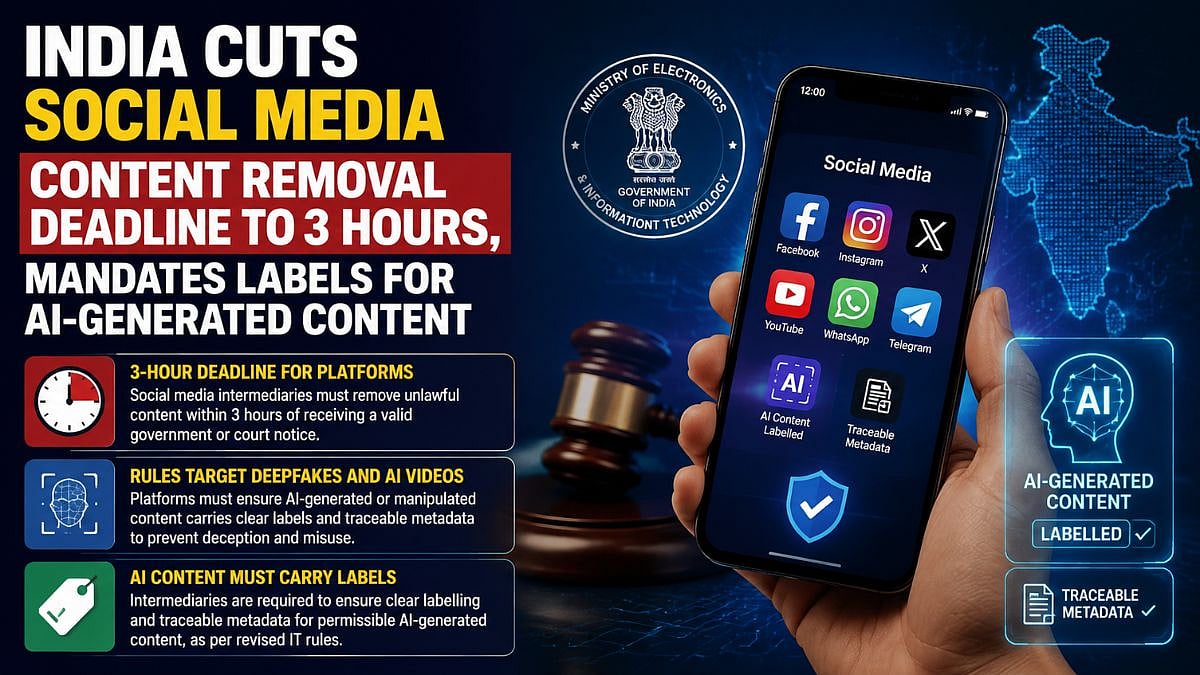
The Ministry of Electronics and Information Technology (MeitY) has reduced the deadline for social media platforms to remove unlawful information from 36 hours to three hours. This change is part of the revised Information Technology (IT) Rules, which aim to address the growing threat posed by deepfakes and AI-generated content.
The new rules require social media intermediaries to act on a valid government or court notice seeking the removal of unlawful content within three hours. This significantly reduces the earlier 36-hour window available to platforms for complying with such notices.
In addition to the reduced deadline, the revised rules also mandate clearer labelling of AI-generated content. Social media platforms are required to ensure that AI-generated content carries clear labels and traceable metadata, allowing users to easily identify synthetically generated material and prevent deception or misuse.
The focus on deepfakes and AI-generated content is a key aspect of the revised rules. The ministry has issued directions aimed at addressing the growing threat posed by these types of content, which can be used to spread misinformation and deceive users.
The revised rules are part of the Information Technology (IT) Rules amended by the government in February. The changes are intended to improve the regulation of social media platforms and protect users from harmful and unlawful content.
The reduction in the deadline for removing unlawful content and the introduction of labelling requirements for AI-generated content are significant steps towards improving the safety and transparency of social media platforms. These changes will help to prevent the spread of misinformation and protect users from deception and misuse.
The new rules will have a significant impact on social media platforms operating in India, and will require them to take a more proactive approach to removing unlawful content and labelling AI-generated content. This is a positive step towards creating a safer and more transparent online environment for users in India.
In the context of India's growing digital landscape, these changes are an important step towards regulating social media platforms and protecting users. The Indian government has been actively working to improve the regulation of social media platforms, and these revised rules are a key part of this effort.
Overall, the revised rules are a significant development in the regulation of social media platforms in India, and will have a positive impact on the safety and transparency of online content.
The new rules will help to build trust among users and will ensure that social media platforms are held accountable for the content they host. This is a crucial step towards creating a safe and transparent online environment, and will have a lasting impact on the way social media platforms operate in India.
The reduction in the deadline for removing unlawful content and the introduction of labelling requirements for AI-generated content are important steps towards improving the regulation of social media platforms. These changes will help to prevent the spread of misinformation and protect users from deception and misuse, and will have a significant impact on the way social media platforms operate in India.
In conclusion, the revised rules are a significant development in the regulation of social media platforms in India, and will have a positive impact on the safety and transparency of online content. The changes will help to build trust among users and will ensure that social media platforms are held accountable for the content they host.
Frequently asked questions
What is the new deadline for social media platforms to remove unlawful content in India?
The new deadline is 3 hours, reduced from the earlier 36 hours.
What are the new rules regarding AI-generated content on social media platforms in India?
The revised rules mandate clear labelling and traceable metadata for AI-generated content, allowing users to easily identify synthetically generated material.