Doorway Effect Causes Temporary Memory Lapses
Ever forgotten why you entered a room? It's a common phenomenon.
'%3E%3Crect%20width%3D'96'%20height%3D'96'%20fill%3D'%23C2185B'%2F%3E%3Ccircle%20cx%3D'30'%20cy%3D'24'%20r%3D'44'%20fill%3D'%23fff'%20opacity%3D'.12'%2F%3E%3Ccircle%20cx%3D'60'%20cy%3D'74'%20r%3D'40'%20fill%3D'%23000'%20opacity%3D'.10'%2F%3E%3C%2Fg%3E%3Cpath%20fill%3D'%23fff'%20d%3D'M48%2031%20l4.6%2010.2%2011.2%201%20-8.4%207.5%202.5%2011%20-9.9%20-5.8%20-9.9%205.8%202.5%20-11%20-8.4%20-7.5%2011.2%20-1%20z'%2F%3E%3C%2Fsvg%3E)
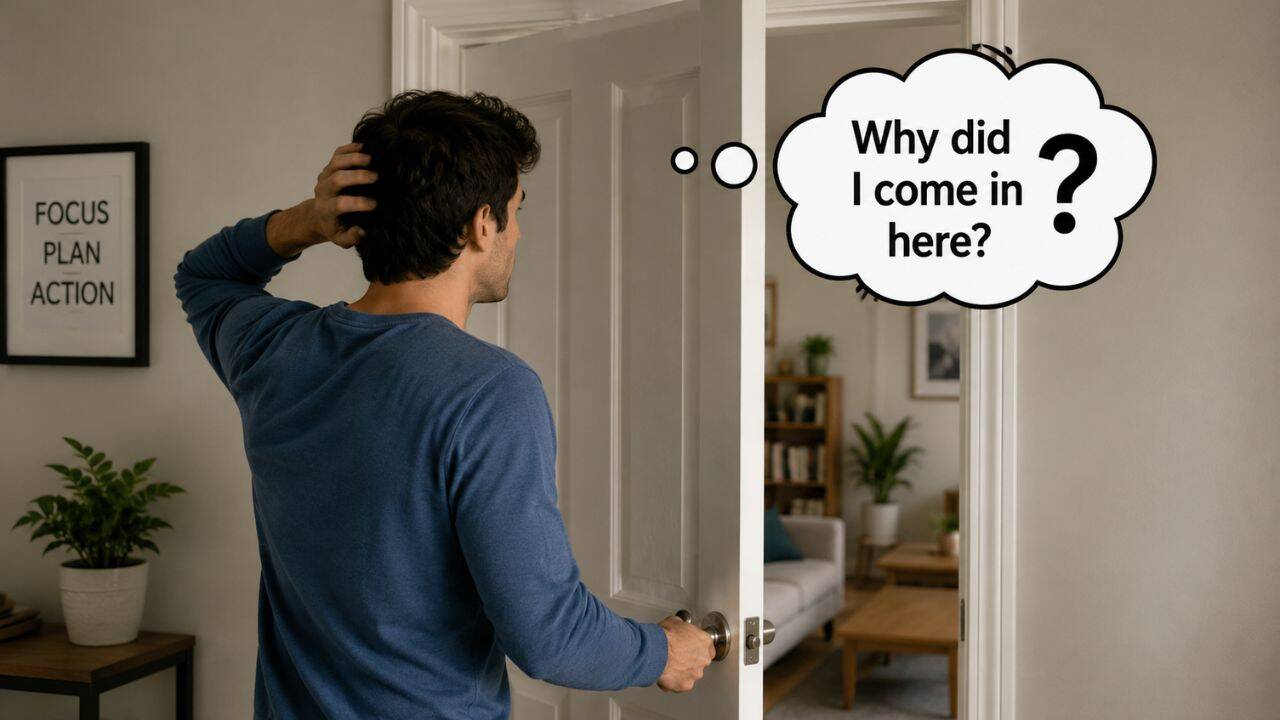
Have you ever walked into a room and suddenly forgotten why you were there in the first place? This common experience is known as the doorway effect, a temporary memory lapse that occurs when entering a new room. It's a normal process that happens as the brain updates its mental model of the environment, organizing experiences into distinct events.
The doorway effect is not a result of a faulty memory, but rather a result of how the brain processes information. When we enter a new room, our brain has to update its mental model of the environment, which can cause a shift in attention. This shift in attention, combined with the limitations of working memory, can lead to a temporary forgetfulness of our original intention.
Research has shown that the doorway effect is a universal experience, affecting people of all ages and backgrounds. It's not a result of age-related memory decline or any underlying medical condition, but rather a result of how the brain processes information. The brain's ability to organize experiences into distinct events is essential for learning and memory, but it can also lead to temporary memory lapses.
So, what can we do to overcome the doorway effect? One strategy is to retrace our steps, literally. By walking back to the previous room or location, we can restore the context of our original intention and retrieve the forgotten thought. This technique can be effective because it helps to recreate the mental model of the environment that we had before entering the new room.
The doorway effect is a fascinating example of how the brain processes information and organizes experiences into distinct events. It's a reminder that our brains are constantly working to make sense of the world around us, and that sometimes, this process can lead to temporary memory lapses.
In addition to retracing our steps, there are other strategies that can help to overcome the doorway effect. For example, we can try to repeat our intention to ourselves as we enter the new room, or we can leave a reminder note in a conspicuous place. These strategies can help to compensate for the limitations of working memory and attention, and reduce the likelihood of temporary memory lapses.
The doorway effect is a common experience that can be frustrating at times, but it's also a reminder of the amazing complexity and adaptability of the human brain. By understanding how the brain processes information and organizes experiences into distinct events, we can develop strategies to overcome temporary memory lapses and improve our overall memory and cognitive function.
In conclusion, the doorway effect is a normal brain process that can cause temporary memory lapses when entering a new room. It's a result of how the brain updates its mental model of the environment and organizes experiences into distinct events. By retracing our steps, repeating our intention, and using other strategies, we can overcome the doorway effect and improve our overall memory and cognitive function.
The study of the doorway effect has implications for our understanding of human memory and cognition, and can inform the development of strategies to improve memory and cognitive function in a variety of contexts. It's a fascinating area of research that can help us to better understand the complex and dynamic processes that underlie human cognition and behavior.
Overall, the doorway effect is a common experience that can be frustrating at times, but it's also a reminder of the amazing complexity and adaptability of the human brain. By understanding how the brain processes information and organizes experiences into distinct events, we can develop strategies to overcome temporary memory lapses and improve our overall memory and cognitive function.