Gen Z Redefines Spirituality Beyond Religion
Gen Z adults view spirituality as self-awareness and inner peace. It's not limited to religion.
'%3E%3Crect%20width%3D'96'%20height%3D'96'%20fill%3D'%23B3261E'%2F%3E%3Ccircle%20cx%3D'30'%20cy%3D'24'%20r%3D'44'%20fill%3D'%23fff'%20opacity%3D'.12'%2F%3E%3Ccircle%20cx%3D'60'%20cy%3D'74'%20r%3D'40'%20fill%3D'%23000'%20opacity%3D'.10'%2F%3E%3C%2Fg%3E%3Cg%20fill%3D'%23fff'%3E%3Crect%20x%3D'29'%20y%3D'49'%20width%3D'8'%20height%3D'19'%20rx%3D'1'%2F%3E%3Crect%20x%3D'39'%20y%3D'40'%20width%3D'9'%20height%3D'28'%20rx%3D'1'%2F%3E%3Crect%20x%3D'50'%20y%3D'45'%20width%3D'8'%20height%3D'23'%20rx%3D'1'%2F%3E%3Crect%20x%3D'60'%20y%3D'53'%20width%3D'7'%20height%3D'15'%20rx%3D'1'%2F%3E%3Crect%20x%3D'41'%20y%3D'34'%20width%3D'5'%20height%3D'6'%2F%3E%3C%2Fg%3E%3C%2Fsvg%3E)
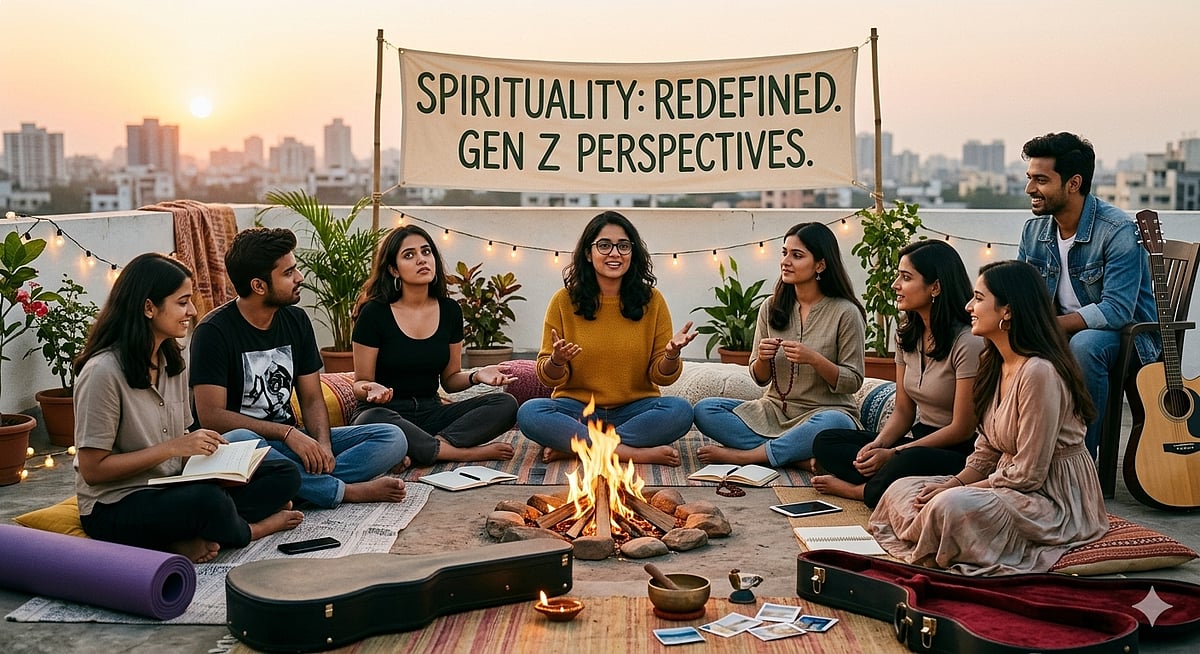
For Generation Z adults, spirituality has taken on a new meaning. Growing up in a world filled with endless notifications, social media pressure, and career anxiety, many Gen Z adults are redefining what spirituality means to them.
It is no longer just about rituals or organized religion, but about self-awareness, inner peace, and finding meaning in a chaotic world. According to Jayaati Behere, a 25-year-old Cambridge alumna, Gen Z is naturally drawn to spirituality because they are constantly surrounded by noise.
This noise often leads young people to question who they are, what truly matters, and whether the things they chase genuinely fulfill them. For Behere, spirituality offers a space to pause, reflect, and discover who they are beyond the labels that define them.
For some Gen Z adults, like Anushka Tiwari, 23, spirituality remains closely linked to faith. She describes it as being self-aware, living in the present moment, and connecting with the Almighty, while practicing surrender and gratitude.
However, others see spirituality beyond religion. Advocate Madhavi Moyde, 26, calls it finding inner peace amid life's chaos and says it teaches gratitude, kindness, and acceptance. Postgraduate Shrishti Choudhary, 23, similarly believes that being spiritual does not necessarily mean being religious, but rather understanding oneself, protecting one's peace, finding meaning in life, and feeling connected to something greater.
Some Gen Z adults occupy a space between atheism and belief. Senior sub-editor Shivangani Saini, 25, says she likes to call herself an atheist, but honestly, she doesn't think she truly is. While she may not believe in God traditionally, she feels there could be something beyond what she can see.
Student Shubham Thorat also says he does not fully believe in God but no longer denies the possibility, adding that what matters most is respecting different beliefs. Not everyone, however, finds value in spirituality. Journalist Anamika Pathak, 25, an atheist and nihilist, sees spirituality and religion as human attempts to give meaning to existence and prefers accepting that uncertainty rather than seeking a higher purpose.
Entrepreneur Rajesh Jaiswal is more dismissive, saying he is not spiritual and that humor, cooking, animals, and travel have helped him through life, while spirituality feels like an empty term.
Together, these voices reveal a generation less interested in fixed definitions and more willing to explore belief, doubt, purpose, and uncertainty on its own terms. This shift in perspective on spirituality highlights the diversity and complexity of Gen Z's views on faith, self-awareness, and inner peace.
As a result, it is clear that Gen Z's understanding of spirituality is not limited to traditional religious practices, but rather encompasses a broader range of experiences and beliefs. This redefinition of spirituality reflects the generation's desire for authenticity, self-awareness, and connection in a rapidly changing world.
In conclusion, Gen Z's perspective on spirituality is a reflection of their unique experiences, values, and beliefs. It is a testament to their openness to exploring new ideas, questioning traditional norms, and seeking meaning and purpose in their lives.
As the world continues to evolve, it will be interesting to see how Gen Z's understanding of spirituality continues to shape and influence their lives and the lives of those around them.
The significance of this shift in perspective on spirituality lies in its potential to impact not only individual lives but also the broader cultural and social landscape. By embracing a more inclusive and diverse understanding of spirituality, Gen Z may be able to create a more compassionate, empathetic, and meaningful world.
Frequently asked questions
What does spirituality mean to Gen Z adults?
To Gen Z adults, spirituality means self-awareness, inner peace, and finding meaning in a chaotic world, beyond traditional religious practices.
Do all Gen Z adults believe in spirituality?
No, not all Gen Z adults believe in spirituality, with some identifying as atheists or nihilists and finding meaning in other aspects of life.