Honeybees' Brain Circuits Control Social Behaviour
Scientists discover brain circuits controlling honeybees' social behaviour. Bees coordinate work without leaders.
'%3E%3Crect%20width%3D'96'%20height%3D'96'%20fill%3D'%23B3261E'%2F%3E%3Ccircle%20cx%3D'30'%20cy%3D'24'%20r%3D'44'%20fill%3D'%23fff'%20opacity%3D'.12'%2F%3E%3Ccircle%20cx%3D'60'%20cy%3D'74'%20r%3D'40'%20fill%3D'%23000'%20opacity%3D'.10'%2F%3E%3C%2Fg%3E%3Cg%20fill%3D'%23fff'%3E%3Crect%20x%3D'29'%20y%3D'49'%20width%3D'8'%20height%3D'19'%20rx%3D'1'%2F%3E%3Crect%20x%3D'39'%20y%3D'40'%20width%3D'9'%20height%3D'28'%20rx%3D'1'%2F%3E%3Crect%20x%3D'50'%20y%3D'45'%20width%3D'8'%20height%3D'23'%20rx%3D'1'%2F%3E%3Crect%20x%3D'60'%20y%3D'53'%20width%3D'7'%20height%3D'15'%20rx%3D'1'%2F%3E%3Crect%20x%3D'41'%20y%3D'34'%20width%3D'5'%20height%3D'6'%2F%3E%3C%2Fg%3E%3C%2Fsvg%3E)
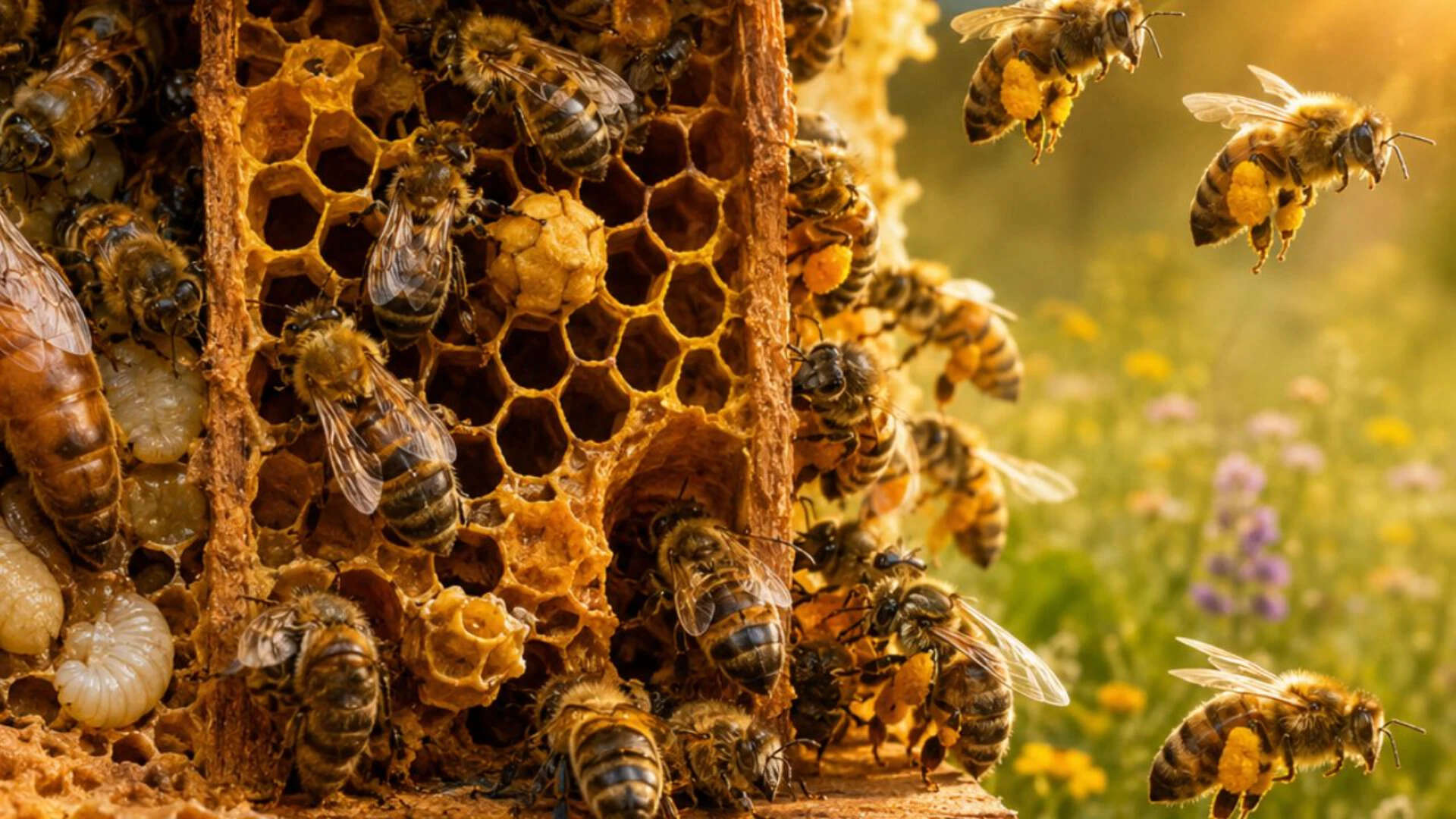
Honeybee colonies have long been known to organise work without any leader assigning tasks, a phenomenon that has fascinated scientists for years. Recently, researchers have made a groundbreaking discovery that sheds light on how this complex social behaviour is coordinated.
It appears that specific brain circuits play a crucial role in controlling the process. By manipulating the activity of a gene-linked neural circuit, researchers were able to make older worker bees return to caring for the queen, a job that is usually done only by younger bees.
This finding is significant because it offers new insight into how bees coordinate their social behaviour. In a honeybee colony, different bees perform different tasks at different stages of their lives. Younger bees typically care for the queen and the brood, while older bees focus on foraging and defending the colony.
The researchers' discovery suggests that the brain circuits responsible for controlling these tasks are highly flexible and can be manipulated. This has important implications for our understanding of how complex social behaviour is coordinated in insects.
Honeybees are highly social creatures that live in complex colonies with a strict division of labour. The colony is made up of a single queen bee, thousands of worker bees, and a few hundred drones. The worker bees perform a variety of tasks, including caring for the queen, building the hive, and foraging for food.
The ability of honeybees to coordinate their social behaviour without a central controller is a remarkable example of self-organisation. It has been studied extensively in the fields of biology, sociology, and computer science, and has inspired new approaches to distributed problem-solving and artificial intelligence.
The discovery of the brain circuits controlling honeybees' social behaviour is an important step forward in our understanding of this complex phenomenon. It has the potential to inspire new technologies and strategies for coordinating complex systems, and could have significant implications for fields such as robotics and artificial intelligence.
In conclusion, the discovery of the brain circuits controlling honeybees' social behaviour is a significant breakthrough that offers new insights into the complex social behaviour of these insects. It has the potential to inspire new technologies and strategies for coordinating complex systems, and could have significant implications for fields such as robotics and artificial intelligence.
Frequently asked questions
How do honeybees coordinate their social behaviour?
Honeybees coordinate their social behaviour through specific brain circuits that control the tasks performed by different bees at different stages of their lives.
What is the significance of the discovery of brain circuits in honeybees?
The discovery of brain circuits in honeybees offers new insights into how complex social behaviour is coordinated in insects and has the potential to inspire new technologies and strategies for coordinating complex systems.