Delhi Protest Sees Students Using Abusive Language
Students protest NEET paper leak, sparking debate on abusive language use.
'%3E%3Crect%20width%3D'96'%20height%3D'96'%20fill%3D'%231A5276'%2F%3E%3Ccircle%20cx%3D'30'%20cy%3D'24'%20r%3D'44'%20fill%3D'%23fff'%20opacity%3D'.12'%2F%3E%3Ccircle%20cx%3D'60'%20cy%3D'74'%20r%3D'40'%20fill%3D'%23000'%20opacity%3D'.10'%2F%3E%3C%2Fg%3E%3Cg%20fill%3D'%23fff'%3E%3Cpath%20d%3D'M31%2041%20L48%2031%20L65%2041%20Z'%2F%3E%3Crect%20x%3D'33'%20y%3D'43'%20width%3D'4'%20height%3D'17'%2F%3E%3Crect%20x%3D'41'%20y%3D'43'%20width%3D'4'%20height%3D'17'%2F%3E%3Crect%20x%3D'51'%20y%3D'43'%20width%3D'4'%20height%3D'17'%2F%3E%3Crect%20x%3D'59'%20y%3D'43'%20width%3D'4'%20height%3D'17'%2F%3E%3Crect%20x%3D'30'%20y%3D'62'%20width%3D'36'%20height%3D'4'%20rx%3D'1'%2F%3E%3C%2Fg%3E%3C%2Fsvg%3E)
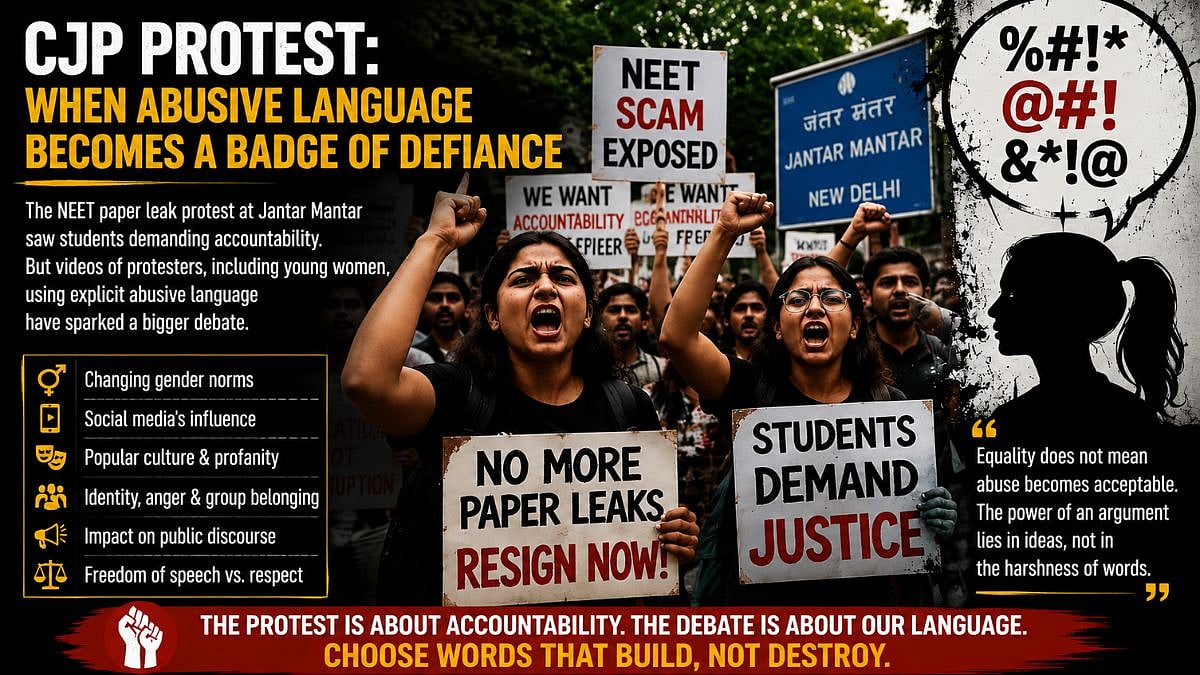
A recent protest at Delhi's Jantar Mantar over the alleged NEET paper leak saw thousands of students gather to express their anger over repeated examination irregularities. The demonstration, which included a large number of young women, was expected to be remembered for its demand for accountability and the resignation of the Union Education Minister. However, another aspect of the protest generated intense debate - the use of explicit abusive language by several protesters, including young women, during speeches and interviews.
The incident has raised questions about why abusive language is becoming increasingly common among young women. Is it a sign of changing gender norms, the influence of social media, or evidence that public discourse itself is becoming more aggressive? Scholars studying language and gender have argued that most abusive expressions in Indian languages are deeply rooted in patriarchy, with the harshest insults targeting women's bodies, sexuality, or family relationships.
Traditionally, men used such language against other men to establish dominance or display masculinity. However, what appears to be changing today is not the vocabulary but the identity of those using it. A section of Generation Z increasingly treats profanity as gender-neutral, with young women now using expressions once confined to male hostels, political rallies, sports grounds, and workplaces.
For many, this language is seen as a sign of confidence and equality rather than vulgarity. The argument is that if men can use abusive language without being morally judged, why should women be held to different standards? However, equal freedom does not necessarily mean that every form of expression deserves celebration. A vocabulary historically created to demean women does not lose its misogynistic roots simply because women begin using it.
Social media has accelerated this transformation, with platforms rewarding outrage, confrontation, and shock value. A measured argument may attract little attention, while an aggressive slogan or abusive remark can become viral within hours. Young users quickly learn that provocative language can garner more attention and likes.
The use of abusive language by young women during the protest has sparked a debate about the changing face of student activism and the influence of social media on public discourse. While some see it as a sign of confidence and equality, others argue that it perpetuates a culture of aggression and misogyny.
The incident highlights the need for a nuanced discussion about language, gender, and power. It is essential to recognize that women should not face stricter moral scrutiny than men, but also that equal freedom does not mean celebrating every form of expression. The words and language we use have the power to shape our social norms and values, and it is crucial to consider the impact of our words on others.
In conclusion, the use of abusive language by young women during the protest is a complex issue that requires a thoughtful and nuanced discussion. It is essential to consider the historical context of abusive language, the influence of social media, and the impact of our words on others. By doing so, we can work towards creating a more inclusive and respectful public discourse.
The incident has also raised questions about the role of social media in shaping public discourse. While social media can be a powerful tool for mobilizing people and raising awareness about social issues, it can also perpetuate a culture of aggression and outrage. It is essential to recognize the potential risks and consequences of using social media to promote abusive language and to consider alternative ways of engaging in public discourse.
Ultimately, the use of abusive language by young women during the protest is a symptom of a broader societal issue. It reflects a culture that values aggression and outrage over respectful and inclusive dialogue. By addressing this issue and promoting a more nuanced and thoughtful discussion about language, gender, and power, we can work towards creating a more just and equitable society.
In the context of the protest, the use of abusive language by young women highlights the need for a more thoughtful and inclusive approach to student activism. While it is essential to demand accountability and justice, it is also crucial to consider the impact of our words and actions on others. By doing so, we can create a more positive and respectful public discourse that promotes social change and inclusivity.
The incident has sparked a necessary debate about the changing face of student activism and the influence of social media on public discourse. It highlights the need for a more nuanced and thoughtful discussion about language, gender, and power, and the importance of promoting a culture of respect and inclusivity.
Frequently asked questions
What was the protest at Delhi's Jantar Mantar about?
The protest was about the alleged NEET paper leak and demanded accountability and the resignation of the Union Education Minister.
Why are young women using abusive language?
The use of abusive language by young women is seen as a sign of confidence and equality, but also raises questions about the influence of social media and the perpetuation of a culture of aggression and misogyny.