Mumbai Beach Handles 95% of India's International Data
India's digital growth relies on a small stretch of coastline, leaving it vulnerable to disruptions. A report found 13 undersea cables come ashore near Versova.
'%3E%3Crect%20width%3D'96'%20height%3D'96'%20fill%3D'%23B3261E'%2F%3E%3Ccircle%20cx%3D'30'%20cy%3D'24'%20r%3D'44'%20fill%3D'%23fff'%20opacity%3D'.12'%2F%3E%3Ccircle%20cx%3D'60'%20cy%3D'74'%20r%3D'40'%20fill%3D'%23000'%20opacity%3D'.10'%2F%3E%3C%2Fg%3E%3Cg%20fill%3D'%23fff'%3E%3Crect%20x%3D'29'%20y%3D'49'%20width%3D'8'%20height%3D'19'%20rx%3D'1'%2F%3E%3Crect%20x%3D'39'%20y%3D'40'%20width%3D'9'%20height%3D'28'%20rx%3D'1'%2F%3E%3Crect%20x%3D'50'%20y%3D'45'%20width%3D'8'%20height%3D'23'%20rx%3D'1'%2F%3E%3Crect%20x%3D'60'%20y%3D'53'%20width%3D'7'%20height%3D'15'%20rx%3D'1'%2F%3E%3Crect%20x%3D'41'%20y%3D'34'%20width%3D'5'%20height%3D'6'%2F%3E%3C%2Fg%3E%3C%2Fsvg%3E)
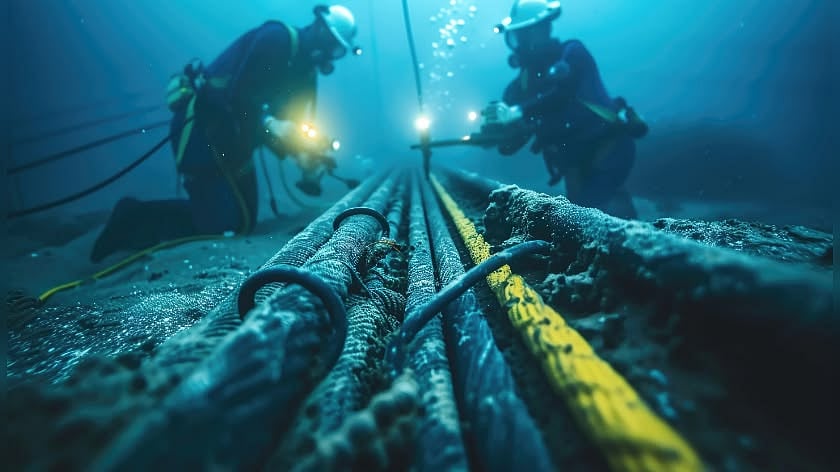
India's remarkable digital growth is being underpinned by a piece of infrastructure that is dangerously concentrated in one small stretch of coastline. Nearly all of India's international bandwidth passes through one beach in Mumbai.
At least 13 of India's 18 undersea intercontinental cables come ashore within a six-kilometre radius near Versova in Mumbai. Between them, these cables handle up to 95 percent of the country's international data traffic to Europe, Africa and West Asia.
Anwesha Sen of the Takshashila Institution warned that this geographic clustering leaves the network dangerously exposed. A simultaneous cut to several of these cables - whether by accident or design - could disrupt the bulk of India's bandwidth flowing westward.
Cable systems are built with rerouting capacity, so a cut would not black out the internet entirely. Traffic could shift to other landing points such as Chennai and Kochi. However, even a modest slowdown in data speeds could prove expensive for banks, stock exchanges, cloud providers and government networks with AI systems.
India has become one of the largest internet markets on the planet, with the country crossing a billion broadband subscribers by late 2025. Yet despite accounting for roughly a fifth of global data consumption, India is connected to just 3 percent of the world's submarine cables.
The country holds only around 21 cable landing stations, against nearly 1,900 such sites planned or operating worldwide. Experts argue that the country urgently needs many more landing stations to reduce its reliance on a single stretch of coastline.
Ageing cables and faults add to the risk of disruptions. A Takshashila Institution paper found that 11 of India's 18 international cables are already more than 20 years old, edging toward the roughly 25-year lifespan such systems are built for.
Amajit Gupta, group CEO of Lightstorm, acknowledged that a large share of India's cables are nearing the end of their economic life, calling it a legitimate concern. Deliberate sabotage isn't the primary threat, either. Globally, cable systems suffer an estimated 150-200 faults a year, the large majority caused by fishing activity, ship anchors, natural hazards and equipment failure rather than attacks.
The concentration of undersea cables in one small area leaves India's digital economy vulnerable to disruptions. Experts warn that the country needs to diversify its connectivity to reduce its reliance on a single stretch of coastline.
In conclusion, India's digital growth is being underpinned by a fragile piece of infrastructure. The country needs to take steps to reduce its reliance on a single stretch of coastline and diversify its connectivity to ensure the continued growth of its digital economy.
The Indian government and private companies are working on new projects to connect India with the rest of the world. Meta's 'Project Waterworth' aims to connect India with the world's longest undersea cable. However, more needs to be done to address the issue of concentration of undersea cables in one small area.
Frequently asked questions
What percentage of India's international data passes through one Mumbai beach?
95% of India's international data passes through one Mumbai beach
How many undersea cables come ashore near Versova?
At least 13 undersea cables come ashore near Versova