Nepal Communal Violence Kills 3, Injures 25
Clashes between Hindu and Muslim groups in Nepal's southern plains leave 3 dead and 25 injured. The violence exposes a deeper political crisis and fault lines in the country.
'%3E%3Crect%20width%3D'96'%20height%3D'96'%20fill%3D'%234A235A'%2F%3E%3Ccircle%20cx%3D'30'%20cy%3D'24'%20r%3D'44'%20fill%3D'%23fff'%20opacity%3D'.12'%2F%3E%3Ccircle%20cx%3D'60'%20cy%3D'74'%20r%3D'40'%20fill%3D'%23000'%20opacity%3D'.10'%2F%3E%3C%2Fg%3E%3Cg%20fill%3D'none'%20stroke%3D'%23fff'%20stroke-width%3D'3'%3E%3Ccircle%20cx%3D'48'%20cy%3D'48'%20r%3D'16'%2F%3E%3Cellipse%20cx%3D'48'%20cy%3D'48'%20rx%3D'6.5'%20ry%3D'16'%2F%3E%3Cline%20x1%3D'32'%20y1%3D'42'%20x2%3D'64'%20y2%3D'42'%2F%3E%3Cline%20x1%3D'32'%20y1%3D'54'%20x2%3D'64'%20y2%3D'54'%2F%3E%3C%2Fg%3E%3C%2Fsvg%3E)
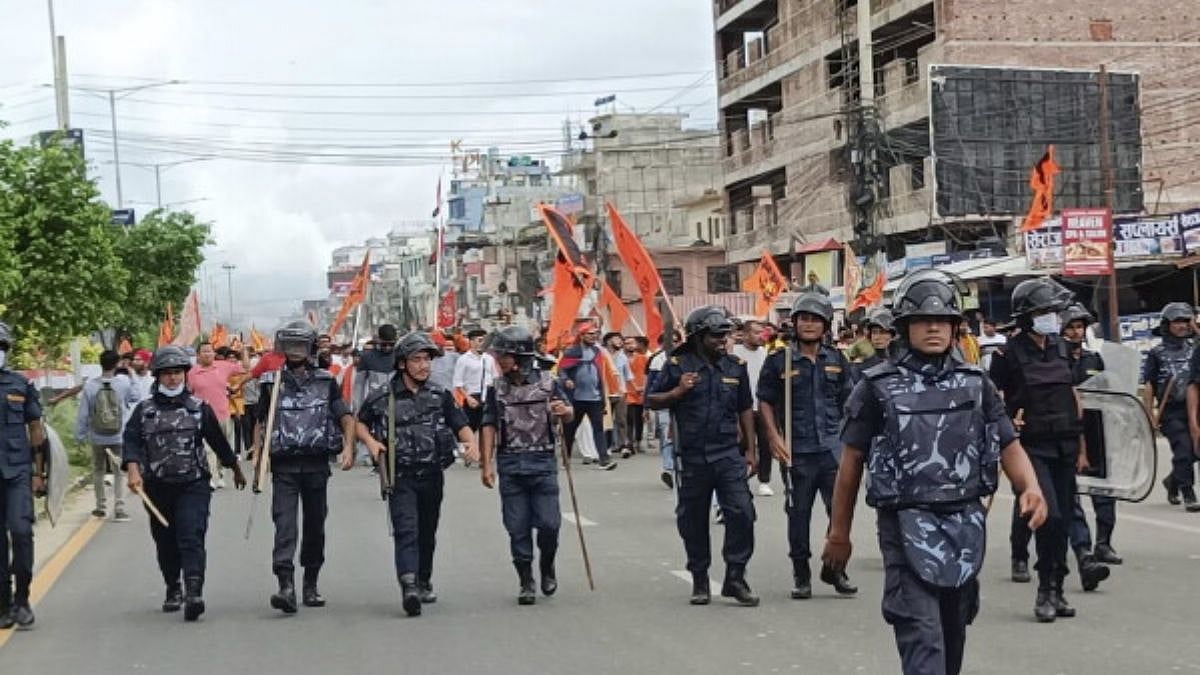
Nepal's recent communal violence is more than a local law-and-order failure. The clashes in Sunsari and Siraha, triggered by a dispute during a Hindu religious event, left at least three people dead and around 25 injured. The violence was contained, but it exposed a dangerous fault line in a country traditionally known for coexistence.
The violence began in Sunsari on July 26, but Prime Minister Balendra Shah remained largely silent, allowing a local dispute over religious flags and loud music to spread into other parts of the Madhesh region. Three people were killed and scores injured before curfews and security deployment brought the situation under control.
The government's delayed response and excessive reliance on security measures have raised questions about Shah's ability to manage crises at the national level. The government initially treated the episode as a conventional law-and-order problem rather than recognising its rapidly emerging communal and political dimensions.
The deeper danger is that the government's hesitation has reinforced doubts about Shah's ability to manage crises, particularly when his government is already facing criticism over delayed responses, executive overreach, and weak institutional coordination. The danger of instability therefore extends beyond communal relations: if the government cannot reassure both communities, control inflammatory mobilisation, and restore confidence in state institutions, the Hindu Rashtra-versus-secularism debate could become increasingly polarised.
The immediate trigger may have been a dispute over music, religious flags, and processions, but such incidents rarely become violent without underlying mistrust. Competition over public space and religious expression can therefore acquire a communal colour quickly. Social media has added another accelerant, with rumours, provocative videos, and unverified claims travelling faster than the administration can respond.
Nepal's immediate challenge is thus not merely to restore peace on the streets but to prevent communal mistrust from becoming a permanent political fault line. The government needs to address the underlying issues and reassure both communities to prevent further violence.
The violence has also exposed a serious weakness in Shah's fledgling government, with at least 17 incidents of Hindu-Muslim tensions in the Tarai belt in the past eight years. The government's failure to contain the communal violence quickly has raised questions about its ability to manage crises and restore confidence in state institutions.
In conclusion, Nepal's communal violence is a symptom of a deeper political crisis, and the government needs to address the underlying issues to prevent further violence and instability. The country's tradition of coexistence is at risk, and the government must take immediate action to reassure both communities and restore confidence in state institutions.
The situation in Nepal is a reminder that communal violence can have far-reaching consequences and that governments must be proactive in addressing underlying issues to prevent further violence. The international community must also be vigilant and support efforts to promote peace and stability in the region.
Nepal's future depends on its ability to manage its communal relations and prevent mistrust from becoming a permanent political fault line. The government must take immediate action to address the underlying issues and reassure both communities to prevent further violence and instability.
The country's stability is at risk, and the government must take all necessary measures to restore peace and confidence in state institutions. The world is watching, and Nepal must take this opportunity to promote peace and stability in the region.
In the end, Nepal's communal violence is a wake-up call for the government to address the underlying issues and reassure both communities. The country's future depends on it, and the government must take immediate action to prevent further violence and instability.
Frequently asked questions
What triggered the communal violence in Nepal?
A dispute during a Hindu religious event in Sunsari and Siraha triggered the violence.
How many incidents of Hindu-Muslim tensions have occurred in Nepal in the past 8 years?
At least 17 incidents of Hindu-Muslim tensions have occurred in the Tarai belt in the past 8 years.