India's Current Account Deficit Hits $4.2 Billion in Q1 FY27
India's current account deficit widens, merchandise trade deficit increases, services exports rise
'%3E%3Crect%20width%3D'96'%20height%3D'96'%20fill%3D'%230B6E4F'%2F%3E%3Ccircle%20cx%3D'30'%20cy%3D'24'%20r%3D'44'%20fill%3D'%23fff'%20opacity%3D'.12'%2F%3E%3Ccircle%20cx%3D'60'%20cy%3D'74'%20r%3D'40'%20fill%3D'%23000'%20opacity%3D'.10'%2F%3E%3C%2Fg%3E%3Cg%20fill%3D'none'%20stroke%3D'%23fff'%20stroke-width%3D'3.2'%20stroke-linecap%3D'round'%20stroke-linejoin%3D'round'%3E%3Cpolyline%20points%3D'31%2C59%2041%2C49%2049%2C54%2063%2C37'%2F%3E%3Cpolyline%20points%3D'55%2C37%2063%2C37%2063%2C45'%2F%3E%3C%2Fg%3E%3C%2Fsvg%3E)
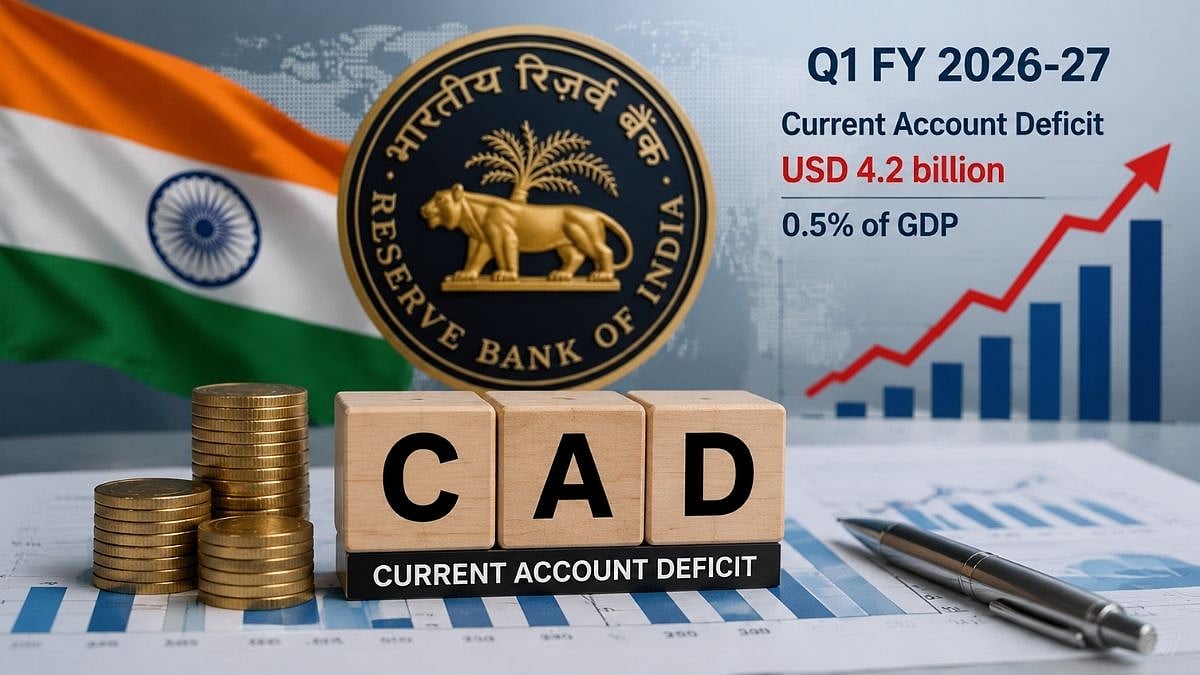
India's current account deficit has widened to $4.2 billion, or 0.5% of GDP, in the first quarter of the current fiscal year. This is an increase from $3.4 billion, or 0.4% of GDP, in the same period last year, according to data released by the Reserve Bank of India.
The merchandise trade deficit has also increased to $86.1 billion in the April-June period of 2026-27, up from $68.9 billion in the first quarter of 2025-26. However, net services receipts have risen to $51.6 billion in Q1 2026-27 from $47.9 billion a year ago.
The increase in services exports is attributed to major categories such as computer services, other business services, and transportation services. Personal transfer receipts, mainly representing remittances by Indians employed overseas, have also risen to $42.9 billion in Q1 2026-27 from $33.2 billion in Q1 2025-26.
Foreign direct investment (FDI) has recorded a net inflow of $6.1 billion in the first quarter, higher than $5.2 billion in the comparable period of the last financial year. This increase in FDI is a positive sign for the Indian economy.
The widening current account deficit is a concern for the Indian economy, as it can lead to a decrease in foreign exchange reserves and put pressure on the rupee. However, the increase in services exports and remittances is a positive sign, as it can help to offset the trade deficit.
The Reserve Bank of India's data also highlights the importance of services exports and remittances in balancing the trade deficit. The Indian government has been taking steps to promote services exports and increase foreign investment, which is expected to have a positive impact on the economy.
In the context of the Indian economy, the current account deficit is a key indicator of the country's trade and investment position. A widening deficit can have implications for the country's foreign exchange reserves and the value of the rupee.
Overall, the data released by the Reserve Bank of India suggests that while the current account deficit has widened, there are also positive signs in terms of services exports and remittances. The Indian government will need to continue to take steps to promote exports and increase foreign investment to balance the trade deficit and promote economic growth.
The significance of this data lies in its implications for the Indian economy and its trade position. The widening current account deficit is a concern, but the increase in services exports and remittances is a positive sign. The Indian government will need to carefully monitor the trade deficit and take steps to promote exports and increase foreign investment to promote economic growth.
In conclusion, the data released by the Reserve Bank of India highlights the complexities of the Indian economy and the need for careful monitoring and management of the trade deficit. While there are concerns about the widening current account deficit, there are also positive signs in terms of services exports and remittances. The Indian government will need to continue to take steps to promote exports and increase foreign investment to promote economic growth and stability.
Frequently asked questions
What is India's current account deficit in Q1 FY27?
India's current account deficit is $4.2 billion, or 0.5% of GDP, in Q1 FY27.
What is the merchandise trade deficit in Q1 2026-27?
The merchandise trade deficit is $86.1 billion in Q1 2026-27.