NHAI Launches Modern Toilets Near Toll Plazas
NHAI to invest in modern toilets with IoT monitoring, India struggles with public sanitation
'%3E%3Crect%20width%3D'96'%20height%3D'96'%20fill%3D'%23B3261E'%2F%3E%3Ccircle%20cx%3D'30'%20cy%3D'24'%20r%3D'44'%20fill%3D'%23fff'%20opacity%3D'.12'%2F%3E%3Ccircle%20cx%3D'60'%20cy%3D'74'%20r%3D'40'%20fill%3D'%23000'%20opacity%3D'.10'%2F%3E%3C%2Fg%3E%3Cg%20fill%3D'%23fff'%3E%3Crect%20x%3D'29'%20y%3D'49'%20width%3D'8'%20height%3D'19'%20rx%3D'1'%2F%3E%3Crect%20x%3D'39'%20y%3D'40'%20width%3D'9'%20height%3D'28'%20rx%3D'1'%2F%3E%3Crect%20x%3D'50'%20y%3D'45'%20width%3D'8'%20height%3D'23'%20rx%3D'1'%2F%3E%3Crect%20x%3D'60'%20y%3D'53'%20width%3D'7'%20height%3D'15'%20rx%3D'1'%2F%3E%3Crect%20x%3D'41'%20y%3D'34'%20width%3D'5'%20height%3D'6'%2F%3E%3C%2Fg%3E%3C%2Fsvg%3E)
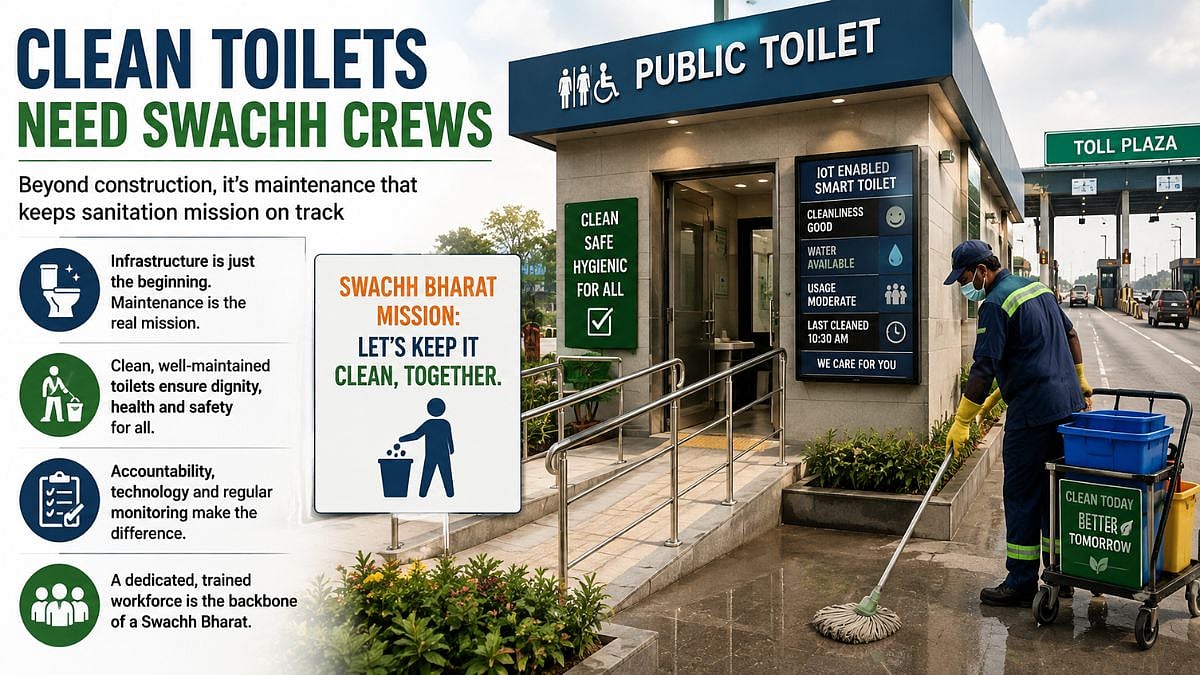
The National Highways Authority of India (NHAI) has launched an initiative to install modernised toilets near toll plazas, equipped with Internet of Things (IoT) monitoring systems. This move comes as the Swachh Bharat Mission (SBM) faces challenges in maintaining public toilets in urban areas.
The SBM, which has spent Rs 18,543 crore on urban sanitation works over 11 years, claims to have built 37,766 public toilets. However, many of these toilets have been dismantled or replaced with old-style facilities, leaving a significant gap in accessible sanitation facilities.
The absence of accessible urinals has been a major issue, particularly for service professionals and gig workers who are out in the field throughout the day. This has led to people using secluded corners and parked vehicles as makeshift toilets, which is a poor outcome for a flagship programme like the SBM.
The NHAI's initiative aims to provide better sanitation facilities for highway users, with a focus on maintenance and user feedback. The authority plans to invest in modern toilets with standardized designs, which will be equipped with IoT monitoring systems to ensure they are clean and well-maintained.
However, the success of this initiative will depend on the execution and maintenance of these toilets. Public sanitation in India is often hindered by a lack of dedicated maintenance apparatus, and the presence of politically influential individuals who expect bribes to allow toilets to be installed.
India has also experimented with advanced technologies to reinvent the toilet, including systems that reduce or eliminate flushing and separate liquid and solid waste automatically. However, these experiments have not yet produced dramatic, scalable results to transform sanitation.
The SBM's failure to insist on a stakeholder for maintenance in every city and town has been a major issue. The focus on creating more visible structures has not led to a positive toilet culture, particularly in communities where the responsibility to clean up is enmeshed in entrenched caste politics.
The NHAI's initiative is a step in the right direction, but it will require a sustained effort to maintain and improve these toilets. A secular apparatus that works like a company, using modern tools and technologies, is necessary to achieve a positive toilet culture in India.
The success of this initiative will have a significant impact on public health and hygiene in India. With the NHAI's focus on maintenance and user feedback, there is hope that these modern toilets will provide a better sanitation experience for highway users. However, it will require a collective effort from the government, private sector, and civil society to achieve a significant improvement in public sanitation in India.
In conclusion, the NHAI's initiative to install modern toilets near toll plazas is a welcome move, but it will require a sustained effort to maintain and improve these toilets. The success of this initiative will depend on the execution and maintenance of these toilets, and it will require a collective effort from all stakeholders to achieve a positive toilet culture in India.
The initiative is also a reminder that public sanitation is a critical issue in India, and it requires a comprehensive approach to address the challenges. The government, private sector, and civil society must work together to provide better sanitation facilities and maintain them properly. Only then can India achieve a significant improvement in public sanitation and provide a better quality of life for its citizens.
The NHAI's initiative is a step in the right direction, and it is hoped that it will inspire other initiatives to improve public sanitation in India. With the focus on maintenance and user feedback, there is hope that these modern toilets will provide a better sanitation experience for highway users and contribute to a positive toilet culture in India.
In the end, the success of the NHAI's initiative will depend on the collective effort of all stakeholders. It is a challenging task, but it is not impossible. With the right approach and a sustained effort, India can achieve a significant improvement in public sanitation and provide a better quality of life for its citizens.
Frequently asked questions
What is the NHAI's initiative to improve public sanitation?
The NHAI has launched an initiative to install modernised toilets near toll plazas, equipped with Internet of Things (IoT) monitoring systems.
What are the challenges faced by the Swachh Bharat Mission in maintaining public toilets?
The SBM faces challenges in maintaining public toilets, including a lack of dedicated maintenance apparatus and the presence of politically influential individuals who expect bribes to allow toilets to be installed.