Nepal Refuses to Choose Between India and China
Nepal prioritizes national interest, maintains strong ties with both India and China.
'%3E%3Crect%20width%3D'96'%20height%3D'96'%20fill%3D'%234A235A'%2F%3E%3Ccircle%20cx%3D'30'%20cy%3D'24'%20r%3D'44'%20fill%3D'%23fff'%20opacity%3D'.12'%2F%3E%3Ccircle%20cx%3D'60'%20cy%3D'74'%20r%3D'40'%20fill%3D'%23000'%20opacity%3D'.10'%2F%3E%3C%2Fg%3E%3Cg%20fill%3D'none'%20stroke%3D'%23fff'%20stroke-width%3D'3'%3E%3Ccircle%20cx%3D'48'%20cy%3D'48'%20r%3D'16'%2F%3E%3Cellipse%20cx%3D'48'%20cy%3D'48'%20rx%3D'6.5'%20ry%3D'16'%2F%3E%3Cline%20x1%3D'32'%20y1%3D'42'%20x2%3D'64'%20y2%3D'42'%2F%3E%3Cline%20x1%3D'32'%20y1%3D'54'%20x2%3D'64'%20y2%3D'54'%2F%3E%3C%2Fg%3E%3C%2Fsvg%3E)
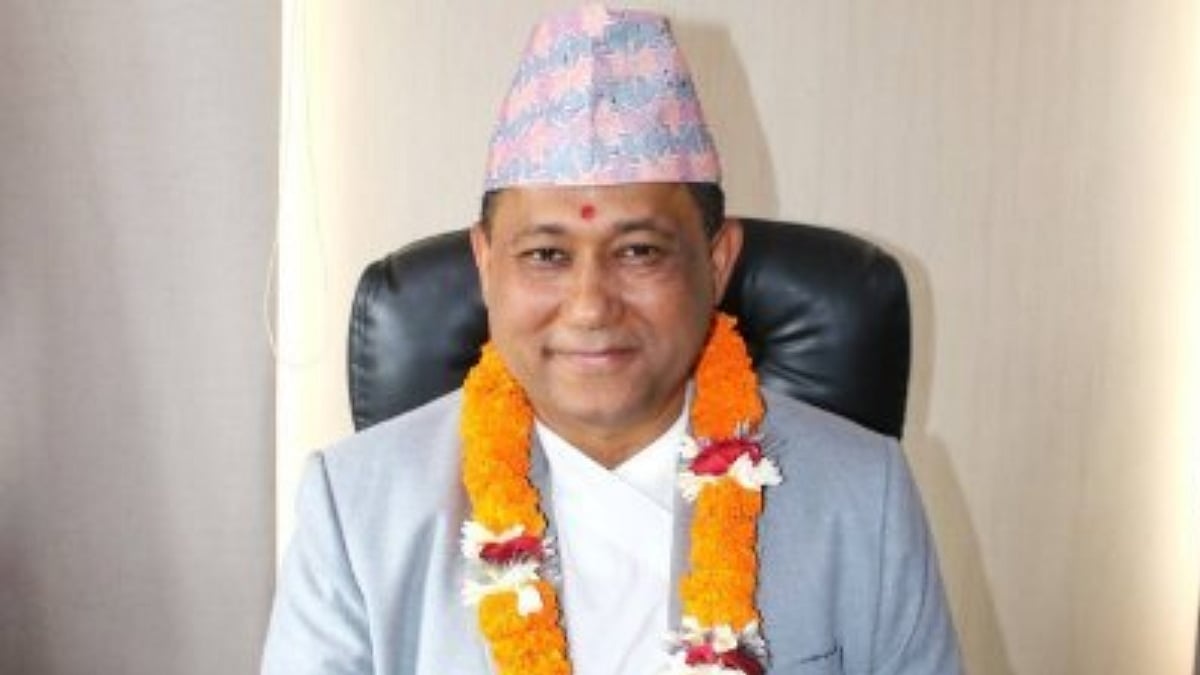
Nepal's Foreign Minister Shisir Khanal stated that the country will continue to maintain strong and independent relationships with both India and China, without replacing one with the other. Khanal emphasized that Nepal's foreign policy is guided by its national interest.
Speaking at the Anviksha India-Nepal Dialogue in Kathmandu, Khanal used a family analogy to highlight the importance of Nepal's relationships with its two powerful neighbors. He stressed that Nepal views its ties with India and China as distinct relationships with their own historical and civilisational significance.
Khanal responded to a question about Kathmandu's policy of maintaining a balance between India and China, saying that Nepal's approach is not about choosing sides but about protecting its own national interests. He compared the country's diplomatic relationships to relationships within a family, saying each has its own history, significance, and merit.
The foreign minister also pushed back against the perception that Nepal has come increasingly under China's influence. He acknowledged Nepal's close relationship with Beijing but highlighted the long history of trade and economic engagement between the two countries.
Khanal stressed the enormous economic importance of India to Nepal, pointing out that around two-thirds of Nepal's total trade is with India. He described India as the single largest trading partner for the Himalayan nation and expressed his desire to see increased economic presence from India.
Khanal also sought to play down the significance of China's Belt and Road Initiative (BRI) in Nepal, pointing to what he described as a lack of financial returns from the initiative. Nepal signed a BRI framework agreement with China in 2017 and an implementation agreement last year, but Khanal said the country had received no money for BRI projects over the past decade.
Nepal's decision to maintain strong ties with both India and China is significant, given the country's strategic location between the two nations. The move is expected to have implications for regional trade and economic relationships.
In terms of trade, Nepal's relationship with India is particularly important. The two countries have a long history of trade and economic engagement, with India being Nepal's largest trading partner. Nepal's trade with India accounts for around two-thirds of its total trade, making it a crucial partner for the country's economic development.
On the other hand, Nepal's relationship with China is also significant, particularly in terms of infrastructure development. China has invested heavily in Nepal's infrastructure, including roads, bridges, and hydropower projects. However, Khanal's comments suggest that Nepal is seeking to diversify its relationships and reduce its dependence on any one country.
Overall, Nepal's decision to prioritize its national interest and maintain strong ties with both India and China is a significant development in the region. It reflects the country's desire to balance its relationships with its two powerful neighbors and to protect its own national interests.
The move is also expected to have implications for regional security and stability. Nepal's strategic location between India and China makes it an important player in regional affairs. By maintaining strong ties with both countries, Nepal is seeking to promote regional stability and security.
In conclusion, Nepal's foreign policy is guided by its national interest, and the country is seeking to maintain strong and independent relationships with both India and China. This approach is expected to have significant implications for regional trade, economic relationships, and security.
Frequently asked questions
What is Nepal's foreign policy approach towards India and China?
Nepal's foreign policy is guided by its national interest, and the country is seeking to maintain strong and independent relationships with both India and China.
What is the significance of Nepal's relationship with India?
India is Nepal's largest trading partner, and the two countries have a long history of trade and economic engagement, with Nepal's trade with India accounting for around two-thirds of its total trade.