7 Technologies To Decide Next Big War
Cyberattacks, drones, AI, and lasers may shape future wars. Nations are integrating technologies for advantage.
'%3E%3Crect%20width%3D'96'%20height%3D'96'%20fill%3D'%234A235A'%2F%3E%3Ccircle%20cx%3D'30'%20cy%3D'24'%20r%3D'44'%20fill%3D'%23fff'%20opacity%3D'.12'%2F%3E%3Ccircle%20cx%3D'60'%20cy%3D'74'%20r%3D'40'%20fill%3D'%23000'%20opacity%3D'.10'%2F%3E%3C%2Fg%3E%3Cg%20fill%3D'none'%20stroke%3D'%23fff'%20stroke-width%3D'3'%3E%3Ccircle%20cx%3D'48'%20cy%3D'48'%20r%3D'16'%2F%3E%3Cellipse%20cx%3D'48'%20cy%3D'48'%20rx%3D'6.5'%20ry%3D'16'%2F%3E%3Cline%20x1%3D'32'%20y1%3D'42'%20x2%3D'64'%20y2%3D'42'%2F%3E%3Cline%20x1%3D'32'%20y1%3D'54'%20x2%3D'64'%20y2%3D'54'%2F%3E%3C%2Fg%3E%3C%2Fsvg%3E)
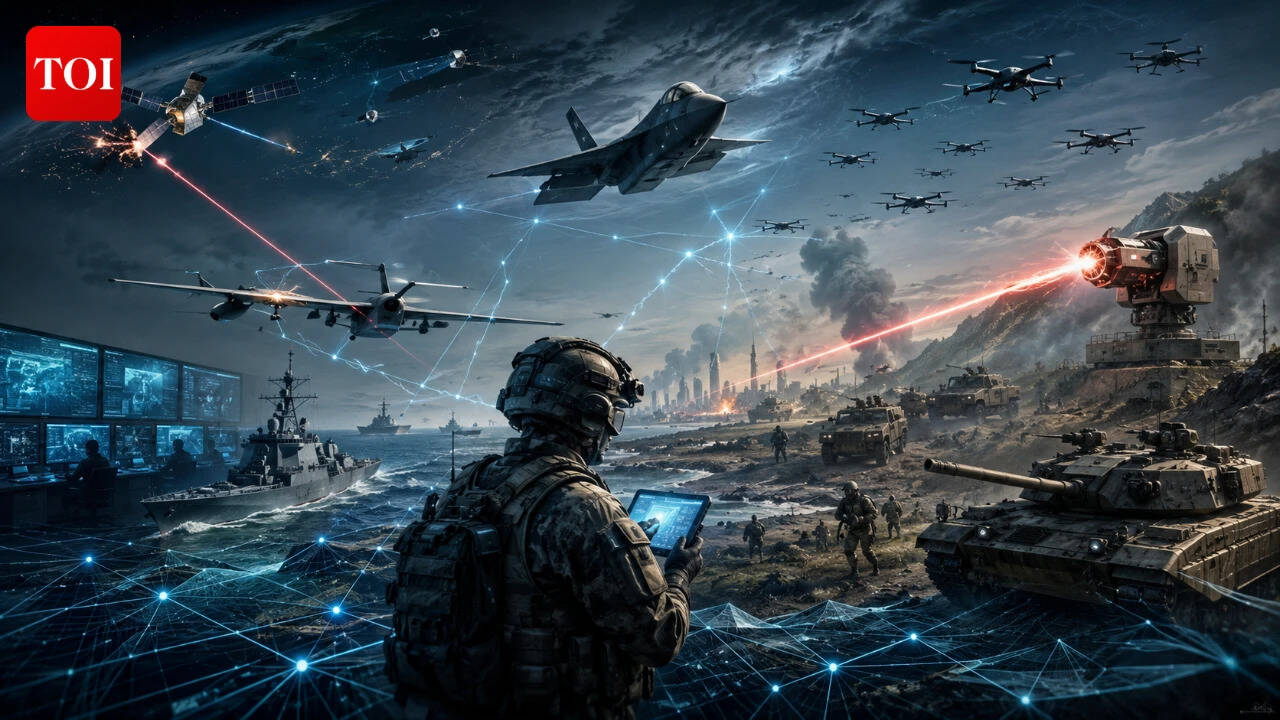
The next major war may begin with silent cyberattacks and autonomous drone swarms, marking a significant shift in the nature of modern conflict. Artificial intelligence and networked systems are making weapons faster and deadlier, giving nations with advanced technologies a decisive advantage.
Hypersonic missiles, capable of traveling at over five times the speed of sound, offer new defensive and offensive capabilities. Laser weapons, which can destroy targets with precision and speed, are also being developed by several nations.
Electronic warfare, which involves disrupting or disabling an enemy's communication and navigation systems, is becoming increasingly critical in modern conflict. Satellite capabilities, including reconnaissance and communication satellites, are also playing a key role in modern warfare.
Nations are integrating these diverse technologies into unified fighting machines, creating complex systems that can respond quickly and effectively to changing circumstances on the battlefield. This integration of technologies is making weapons systems more effective and giving nations with advanced technologies a significant advantage.
The development of these technologies is driving a new arms race, as nations seek to acquire and integrate the latest advancements into their military capabilities. This arms race is likely to continue, with significant implications for global security and the nature of future conflicts.
The use of autonomous systems, such as drone swarms, is also becoming more prevalent. These systems can be used for reconnaissance, surveillance, and combat, and are being developed by several nations.
In addition to these technologies, the use of cyberattacks is also becoming more common. These attacks can be used to disrupt or disable an enemy's communication and navigation systems, and can be launched from anywhere in the world.
The integration of these technologies into unified fighting machines is creating new challenges and opportunities for nations. As the development of these technologies continues, it is likely that the nature of future conflicts will be significantly different from those of the past.
The implications of these technologies are far-reaching, and will likely have a significant impact on global security. As nations continue to develop and integrate these technologies, it is likely that the next major war will be fought with a combination of cyberattacks, autonomous systems, and advanced weaponry.
Frequently asked questions
What technologies could decide the next big war?
The next big war may be decided by technologies such as cyberattacks, autonomous drone swarms, artificial intelligence, hypersonic missiles, laser weapons, electronic warfare, and satellite capabilities.
Why are nations integrating diverse technologies into unified fighting machines?
Nations are integrating diverse technologies into unified fighting machines to create complex systems that can respond quickly and effectively to changing circumstances on the battlefield, giving them a decisive advantage.