Police Clash with Protesters Near Parliament
Protesters march towards Parliament, police use force to stop them.
'%3E%3Crect%20width%3D'96'%20height%3D'96'%20fill%3D'%231A5276'%2F%3E%3Ccircle%20cx%3D'30'%20cy%3D'24'%20r%3D'44'%20fill%3D'%23fff'%20opacity%3D'.12'%2F%3E%3Ccircle%20cx%3D'60'%20cy%3D'74'%20r%3D'40'%20fill%3D'%23000'%20opacity%3D'.10'%2F%3E%3C%2Fg%3E%3Cg%20fill%3D'%23fff'%3E%3Cpath%20d%3D'M31%2041%20L48%2031%20L65%2041%20Z'%2F%3E%3Crect%20x%3D'33'%20y%3D'43'%20width%3D'4'%20height%3D'17'%2F%3E%3Crect%20x%3D'41'%20y%3D'43'%20width%3D'4'%20height%3D'17'%2F%3E%3Crect%20x%3D'51'%20y%3D'43'%20width%3D'4'%20height%3D'17'%2F%3E%3Crect%20x%3D'59'%20y%3D'43'%20width%3D'4'%20height%3D'17'%2F%3E%3Crect%20x%3D'30'%20y%3D'62'%20width%3D'36'%20height%3D'4'%20rx%3D'1'%2F%3E%3C%2Fg%3E%3C%2Fsvg%3E)
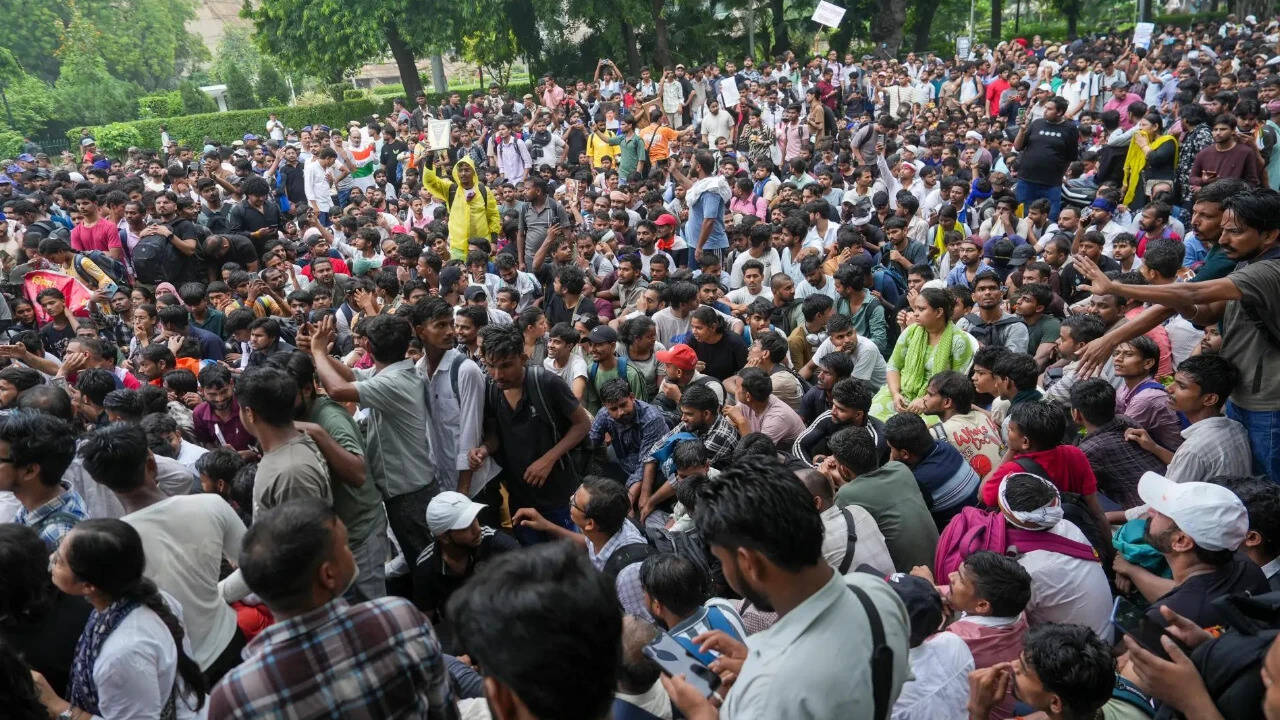
A major confrontation erupted near Jantar Mantar in New Delhi on Monday as protesters attempted to march towards Parliament despite prohibitory orders being in place. The protesters, part of the 'Chalo Sansad' march organized by the CJP, were met with a strong police response, including the use of lathis.
The march was intended to coincide with the Monsoon Session of Parliament, which has seen a significant tightening of security across the New Delhi district. The protesters were seeking to draw attention to their demands, which include examination reforms.
Key figures such as Chandra Shekhar Azad and Prakash Raj extended their support to the agitators, adding weight to the protest. Despite the clashes, the CJP has indicated that it remains open to talks with the government on the issue of examination reforms.
The 'Chalo Sansad' march was a significant event, with a large number of protesters gathering near Jantar Mantar. The police and RAF personnel were deployed in large numbers to prevent the protesters from reaching Parliament.
The use of force by the police has been criticized by some, who argue that it was excessive and unnecessary. However, the police have stated that they were forced to act in order to maintain law and order.
The CJP has been vocal about its demands for examination reforms, and the 'Chalo Sansad' march was seen as an attempt to pressure the government into taking action. The organization has stated that it is willing to engage in talks with the government, but has also made it clear that it will continue to protest until its demands are met.
The Monsoon Session of Parliament has seen a number of protests and demonstrations, with various groups seeking to draw attention to their causes. The 'Chalo Sansad' march was one of the most significant, and highlighted the ongoing tensions between the government and civil society organizations.
In the context of Indian politics, the 'Chalo Sansad' march is significant because it highlights the growing discontent among certain sections of society. The march also underscores the importance of peaceful protest and the need for the government to engage with civil society organizations.
The incident has sparked a wider debate about the role of protest in Indian democracy, with some arguing that it is an essential part of the democratic process, while others see it as a threat to law and order. As the situation continues to unfold, it remains to be seen how the government will respond to the CJP's demands and how the organization will continue to push for examination reforms.
In conclusion, the 'Chalo Sansad' march and the subsequent clash between protesters and police highlights the ongoing tensions between the government and civil society organizations in India. The incident has significant implications for Indian democracy and underscores the need for peaceful protest and dialogue between the government and civil society organizations.