Hair Transplant Failures: Common Mistakes to Avoid
Hair transplants can fail due to poor growth, unnatural hairlines, and visible donor damage. Patients should be aware of common mistakes to make informed decisions.
'%3E%3Crect%20width%3D'96'%20height%3D'96'%20fill%3D'%231B5E20'%2F%3E%3Ccircle%20cx%3D'30'%20cy%3D'24'%20r%3D'44'%20fill%3D'%23fff'%20opacity%3D'.12'%2F%3E%3Ccircle%20cx%3D'60'%20cy%3D'74'%20r%3D'40'%20fill%3D'%23000'%20opacity%3D'.10'%2F%3E%3C%2Fg%3E%3Cg%3E%3Ccircle%20cx%3D'48'%20cy%3D'48'%20r%3D'15'%20fill%3D'%23fff'%2F%3E%3Cpath%20d%3D'M43%2034%20Q50%2048%2043%2062'%20fill%3D'none'%20stroke%3D'%238a94a6'%20stroke-width%3D'2.4'%2F%3E%3Cpath%20d%3D'M47%2033%20Q54%2048%2047%2063'%20fill%3D'none'%20stroke%3D'%238a94a6'%20stroke-width%3D'1.8'%20stroke-dasharray%3D'1.5%203'%2F%3E%3C%2Fg%3E%3C%2Fsvg%3E)
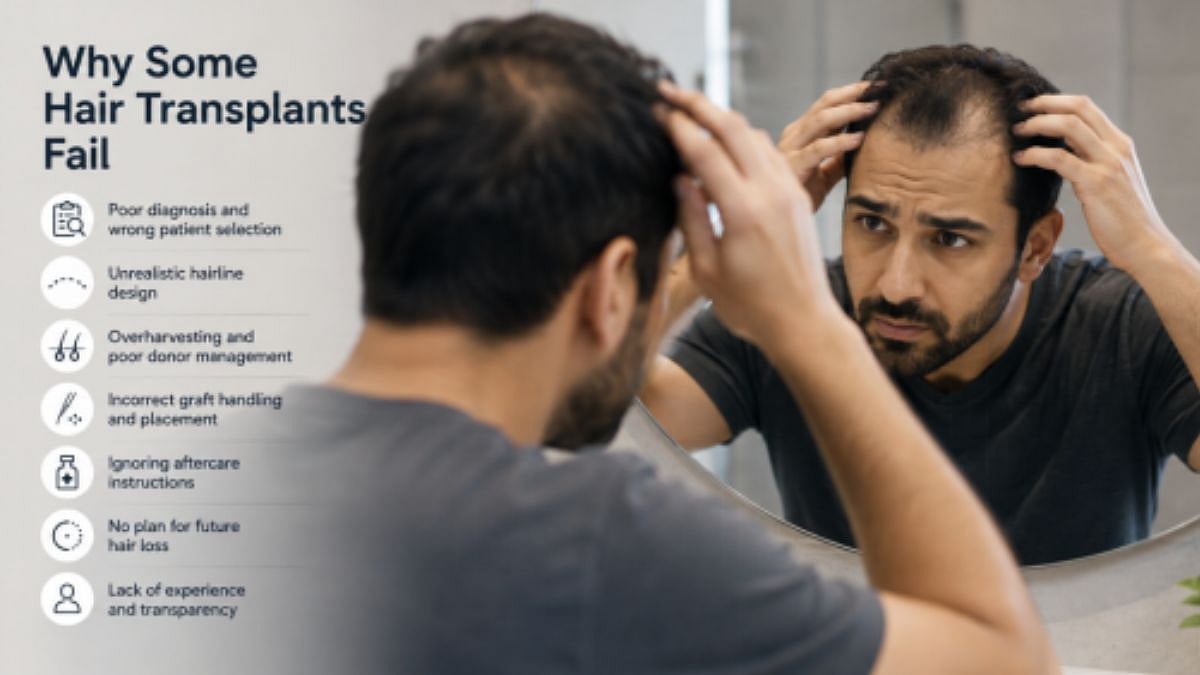
A successful hair transplant can restore a natural-looking hairline and improve coverage in areas affected by permanent hair loss. However, transplantation is not a guaranteed route to perfect density. Some patients experience poor growth, an unnatural hairline, visible donor damage, or continued thinning around the transplanted area.
The difference between a disappointing transplant and a successful one is rarely determined by a single factor. Diagnosis, patient selection, hairline design, donor management, surgical skill, graft handling, aftercare, and long-term planning all contribute to the final result. Understanding the common reasons for failure can help patients make safer decisions before undergoing the procedure.
A hair transplant may be considered unsuccessful when it does not produce a cosmetically acceptable or medically sustainable result. Failure does not always mean that none of the transplanted follicles grew. A patient may have reasonable graft growth but remain dissatisfied because the hairline looks artificial, the density is uneven, or the donor area has been visibly damaged.
Problems associated with an unsuccessful transplant may include very low or uneven graft growth, a straight, plug-like, or unnatural hairline, hair growing at incorrect angles, patchy recipient-area density, excessive thinning in the donor area, visible scarring, infection, or prolonged inflammation. A gap developing behind the transplanted hairline, continued loss of surrounding natural hair, or a result that does not match what was promised can also be indicative of a failed transplant.
One of the most common patient concerns occurs a few weeks after surgery when transplanted hair begins to fall out. This does not necessarily mean that the transplant has failed. The visible hair shafts commonly shed between approximately two and eight weeks after surgery. The follicles may remain beneath the skin before producing new growth. Early hair can begin appearing after several months, while more meaningful results commonly become visible between six and twelve months.
Patients should therefore avoid judging the result within the first few weeks or months. A slow timeline may still be normal, but the surgical team should evaluate persistent redness, severe pain, discharge, unusual scarring, or a continued absence of growth beyond the expected period.
Choosing a clinic only by price is a common mistake patients make. Hair transplantation is often advertised using a per-graft price or discounted package, making it easy to compare clinics as though they are selling identical procedures. However, they are not. A quote may differ significantly in terms of the quality of care, surgical expertise, and aftercare provided.
To avoid failed hair transplants, patients should prioritize finding a qualified and experienced surgeon who can provide personalized care and attention to detail. By understanding the common reasons for failure and making informed decisions, patients can increase their chances of achieving a successful and natural-looking hair transplant.
In conclusion, a hair transplant is a significant investment, and patients should be aware of the potential risks and complications. By choosing a reputable clinic, following post-operative instructions, and having realistic expectations, patients can minimize the risk of a failed transplant and achieve a successful outcome.
The significance of this issue lies in the fact that hair transplants are becoming increasingly popular, and patients need to be aware of the potential pitfalls to make informed decisions. By understanding the common mistakes to avoid, patients can take the first step towards achieving a successful and natural-looking hair transplant.
Ultimately, a successful hair transplant requires a combination of technical skill, artistic vision, and attention to detail. Patients should prioritize finding a qualified and experienced surgeon who can provide personalized care and attention to detail to achieve the best possible results.
Frequently asked questions
What are the common reasons for a failed hair transplant?
Common reasons for a failed hair transplant include poor growth, unnatural hairlines, visible donor damage, and continued thinning around the transplanted area.
How long does it take to see the results of a hair transplant?
The results of a hair transplant can take several months to a year to become visible, with early hair growth appearing after a few months and more meaningful results becoming visible between six and twelve months.