Sri Lankan Cricketer's Identity Used in Forged Passport
Mahadev app kingpin Saurabh Chandrakar allegedly used fake passport with Ajantha Mendis' name to enter Oman. Investigation underway.
'%3E%3Crect%20width%3D'96'%20height%3D'96'%20fill%3D'%231B5E20'%2F%3E%3Ccircle%20cx%3D'30'%20cy%3D'24'%20r%3D'44'%20fill%3D'%23fff'%20opacity%3D'.12'%2F%3E%3Ccircle%20cx%3D'60'%20cy%3D'74'%20r%3D'40'%20fill%3D'%23000'%20opacity%3D'.10'%2F%3E%3C%2Fg%3E%3Cg%3E%3Ccircle%20cx%3D'48'%20cy%3D'48'%20r%3D'15'%20fill%3D'%23fff'%2F%3E%3Cpath%20d%3D'M43%2034%20Q50%2048%2043%2062'%20fill%3D'none'%20stroke%3D'%238a94a6'%20stroke-width%3D'2.4'%2F%3E%3Cpath%20d%3D'M47%2033%20Q54%2048%2047%2063'%20fill%3D'none'%20stroke%3D'%238a94a6'%20stroke-width%3D'1.8'%20stroke-dasharray%3D'1.5%203'%2F%3E%3C%2Fg%3E%3C%2Fsvg%3E)
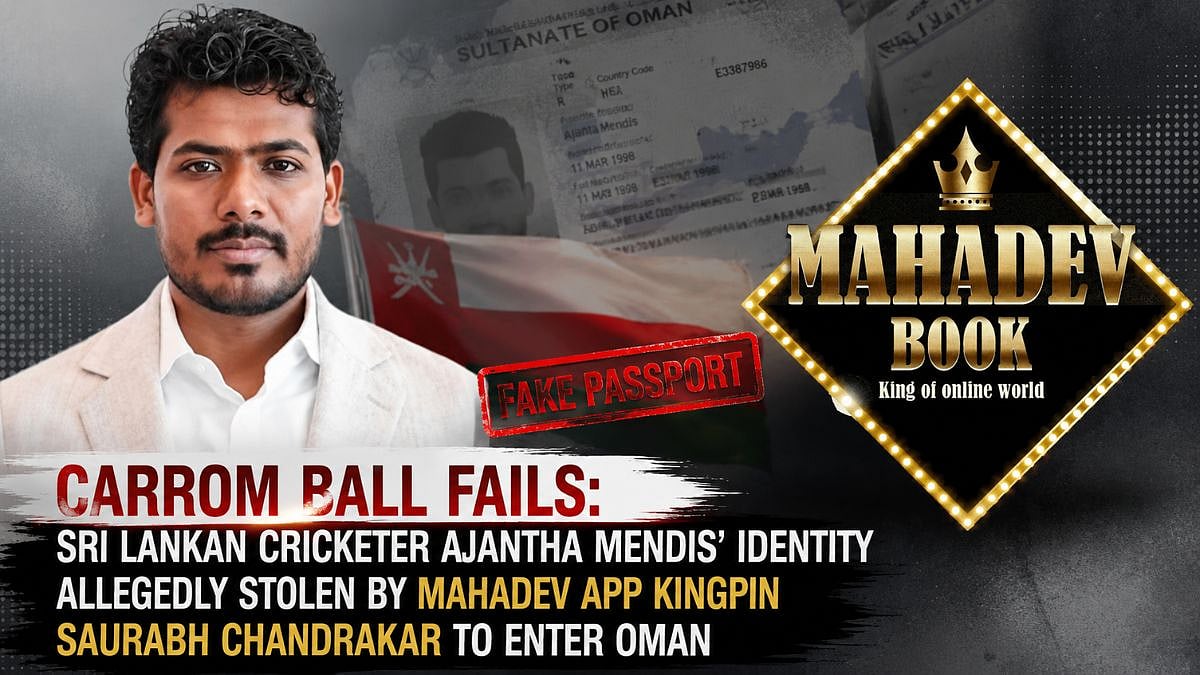
A shocking revelation has emerged in the investigation of Mahadev Online Book promoter Saurabh Chandrakar, who allegedly used a forged Indonesian passport to travel to Oman. The fake passport carried a name nearly identical to that of former Sri Lankan international cricketer Ajantha Mendis, with only the letter 'h' omitted.
According to officials familiar with the investigation, Chandrakar allegedly travelled to Oman using the forged passport, which carried his photograph but identified him as an Indonesian national born on March 11, 1998. The passport, with the number E3387986, was allegedly prepared in the UAE nearly two years before Chandrakar's detention.
Investigators suspect that the forged passport was one of several counterfeit passports available to Chandrakar, who used it to leave the United Arab Emirates and evade Indian law enforcement. The Royal Oman Police subsequently detained him after he allegedly entered Oman on the fake passport.
The reason behind the choice of Ajantha Mendis' name for the fake passport remains unclear. Officials are examining whether the alias was assigned by a passport-forging network, chosen by Chandrakar himself, or selected because the name is familiar across South Asia and the Gulf.
Ajantha Mendis, a former Sri Lankan mystery spinner, has no connection with the case. He rose to prominence with his match-winning spell against India in the 2008 Asia Cup final and represented Sri Lanka in Tests, One-Day Internationals, and T20 Internationals. His internationally recognized name was allegedly appropriated to create a convincing false identity for overseas travel.
The forged passport case could complicate India's efforts to secure Chandrakar's extradition. Under Omani law, local criminal proceedings relating to the alleged forged passport are expected to run their course before any extradition request can be considered. Indian authorities have already initiated the extradition process through diplomatic channels under the India-Oman Extradition Treaty.
The investigation is ongoing, and officials are working to determine the extent of the passport-forging network and how Chandrakar obtained the fake passport. The case highlights the complexities of international law enforcement and the challenges of tracking down individuals who use fake identities to evade detection.
The use of a fake passport with a name similar to that of a well-known cricketer has raised questions about the vulnerability of international travel documents and the need for stricter security measures to prevent identity theft.
In the meantime, Chandrakar remains in detention in Oman, and Indian authorities are working to bring him back to the country to face charges related to the Mahadev Online Book promotion.
The case has significant implications for India's efforts to combat cybercrime and online betting. The Mahadev app has been linked to several cases of online betting and fraud, and Chandrakar's extradition is seen as a key step in bringing those responsible to justice.
As the investigation continues, officials are working to unravel the complex web of fake identities and passport-forging networks that have been used to evade law enforcement. The case serves as a reminder of the importance of international cooperation in combating cybercrime and the need for stricter security measures to prevent identity theft and online fraud.
In conclusion, the forged passport case involving Saurabh Chandrakar and the use of Ajantha Mendis' name has highlighted the complexities of international law enforcement and the challenges of tracking down individuals who use fake identities to evade detection. The case has significant implications for India's efforts to combat cybercrime and online betting, and officials are working to bring those responsible to justice.