India Sees Rise in AI-Powered Factories
AI-powered factories gain traction, promising higher productivity and export competitiveness.
'%3E%3Crect%20width%3D'96'%20height%3D'96'%20fill%3D'%23B3261E'%2F%3E%3Ccircle%20cx%3D'30'%20cy%3D'24'%20r%3D'44'%20fill%3D'%23fff'%20opacity%3D'.12'%2F%3E%3Ccircle%20cx%3D'60'%20cy%3D'74'%20r%3D'40'%20fill%3D'%23000'%20opacity%3D'.10'%2F%3E%3C%2Fg%3E%3Cg%20fill%3D'%23fff'%3E%3Crect%20x%3D'29'%20y%3D'49'%20width%3D'8'%20height%3D'19'%20rx%3D'1'%2F%3E%3Crect%20x%3D'39'%20y%3D'40'%20width%3D'9'%20height%3D'28'%20rx%3D'1'%2F%3E%3Crect%20x%3D'50'%20y%3D'45'%20width%3D'8'%20height%3D'23'%20rx%3D'1'%2F%3E%3Crect%20x%3D'60'%20y%3D'53'%20width%3D'7'%20height%3D'15'%20rx%3D'1'%2F%3E%3Crect%20x%3D'41'%20y%3D'34'%20width%3D'5'%20height%3D'6'%2F%3E%3C%2Fg%3E%3C%2Fsvg%3E)
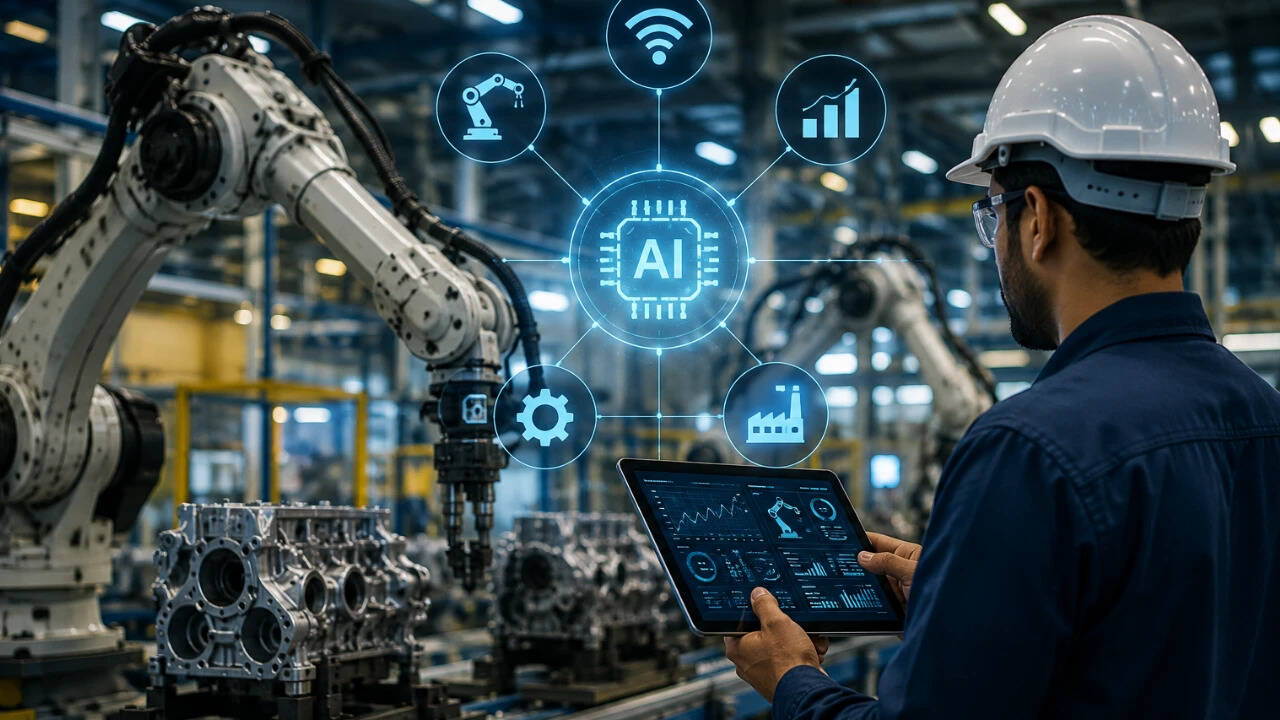
India is witnessing a significant shift in the manufacturing sector, with a growing number of factories adopting artificial intelligence (AI) to enhance productivity and competitiveness.
This trend marks a transition from traditional automation to more advanced, intelligent production systems. The move towards AI-powered factories is expected to have a profound impact on the industry, with potential benefits including increased efficiency, improved product quality, and enhanced export competitiveness.
Manufacturers are investing heavily in AI technologies, such as machine learning and robotics, to create the 'factory of the future'. This concept refers to a highly automated and interconnected production system that can adapt to changing market demands and customer needs.
The adoption of AI-powered factories is being driven by the need to stay competitive in a rapidly changing global market. Indian manufacturers are under pressure to reduce costs, improve quality, and increase productivity in order to remain viable. AI technologies offer a potential solution to these challenges, enabling factories to operate more efficiently and effectively.
However, the shift towards AI-powered factories also raises important questions about the impact on jobs and skills. As machines and algorithms take on more tasks, there is a risk that certain jobs may become redundant. This highlights the need for workers to acquire new skills and adapt to the changing demands of the industry.
Furthermore, the increased use of AI and connected technologies in factories also raises concerns about cybersecurity. As production systems become more interconnected, they may become more vulnerable to cyber threats and data breaches. Manufacturers will need to invest in robust cybersecurity measures to protect their operations and prevent potential disruptions.
In the context of India's manufacturing sector, the rise of AI-powered factories is a significant development. The country has ambitious plans to become a major manufacturing hub, with the government launching initiatives such as 'Make in India' to attract investment and promote industrial growth. The adoption of AI technologies is seen as a key factor in achieving these goals, enabling Indian manufacturers to compete more effectively with global rivals.
Overall, the trend towards AI-powered factories in India is a complex and multifaceted phenomenon, offering both opportunities and challenges. As the industry continues to evolve, it will be important to address the potential risks and consequences of this shift, while also harnessing the benefits of AI to drive growth and competitiveness.
The rise of AI-powered factories is likely to have a profound impact on India's economy and society, with potential implications for employment, skills development, and industrial policy. As the country continues to navigate this transition, it will be important to prioritize investment in education and training, as well as cybersecurity and other critical areas.
In conclusion, the growth of AI-powered factories in India is a significant development that promises to transform the manufacturing sector. While there are challenges to be addressed, the potential benefits of this trend are substantial, and it is likely to play a key role in driving India's industrial growth and competitiveness in the years to come.
Frequently asked questions
What is the 'factory of the future' concept?
The 'factory of the future' refers to a highly automated and interconnected production system that can adapt to changing market demands and customer needs.
What are the potential benefits of AI-powered factories?
The potential benefits of AI-powered factories include increased efficiency, improved product quality, and enhanced export competitiveness.