Supreme Court Stays Cow Slaughter Ban in Tamil Nadu
Tamil Nadu government gets interim relief, Supreme Court stays Madras HC order
'%3E%3Crect%20width%3D'96'%20height%3D'96'%20fill%3D'%231A5276'%2F%3E%3Ccircle%20cx%3D'30'%20cy%3D'24'%20r%3D'44'%20fill%3D'%23fff'%20opacity%3D'.12'%2F%3E%3Ccircle%20cx%3D'60'%20cy%3D'74'%20r%3D'40'%20fill%3D'%23000'%20opacity%3D'.10'%2F%3E%3C%2Fg%3E%3Cg%20fill%3D'%23fff'%3E%3Cpath%20d%3D'M31%2041%20L48%2031%20L65%2041%20Z'%2F%3E%3Crect%20x%3D'33'%20y%3D'43'%20width%3D'4'%20height%3D'17'%2F%3E%3Crect%20x%3D'41'%20y%3D'43'%20width%3D'4'%20height%3D'17'%2F%3E%3Crect%20x%3D'51'%20y%3D'43'%20width%3D'4'%20height%3D'17'%2F%3E%3Crect%20x%3D'59'%20y%3D'43'%20width%3D'4'%20height%3D'17'%2F%3E%3Crect%20x%3D'30'%20y%3D'62'%20width%3D'36'%20height%3D'4'%20rx%3D'1'%2F%3E%3C%2Fg%3E%3C%2Fsvg%3E)
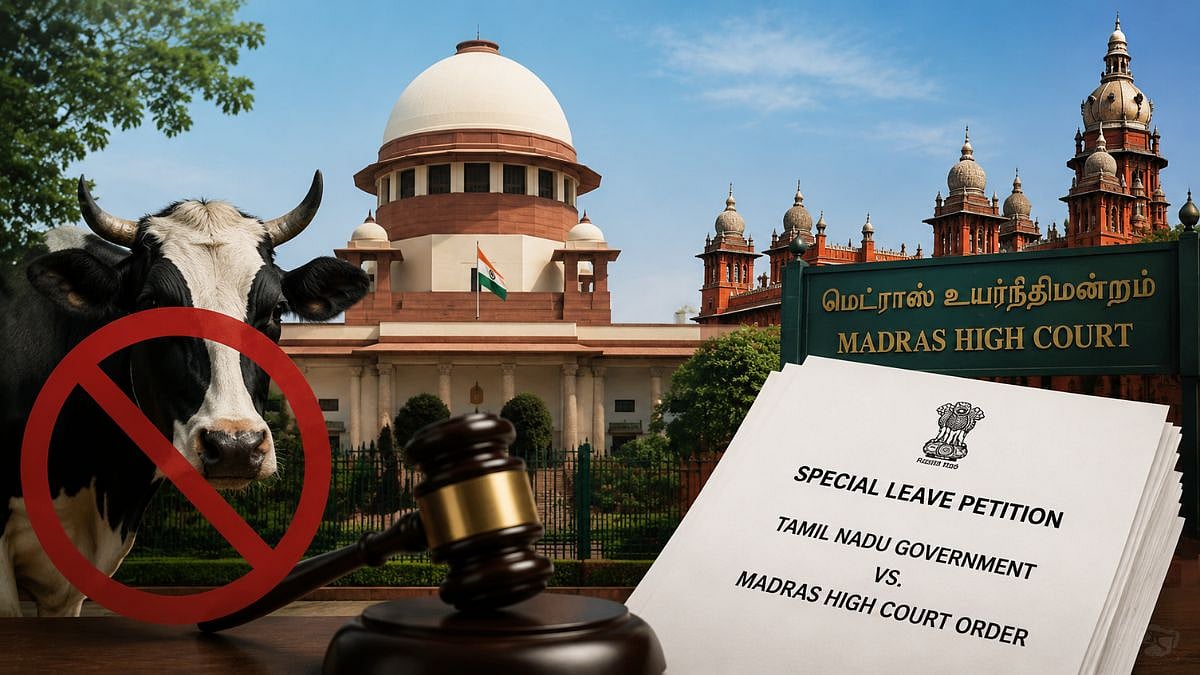
The Supreme Court on Monday passed an interim order staying the Madras High Court's directive to ban cow slaughter in Tamil Nadu. The order was issued in response to a special leave petition filed by the Tamil Nadu government, led by Chief Minister Vijay, against the High Court's May 27 direction.
The Madras High Court had ordered the state government to ensure that no cow or calf was slaughtered in the state on the eve of Bakrid or on any other day, based on a 1976 government order that prohibited cow slaughter in the interest of milk production and improvement of the rural economy.
However, the Tamil Nadu government argued that the High Court's order was contrary to the Tamil Nadu Animal Preservation Act, 1958, which permits the slaughter of cows above the age of 10 years that are unfit for work or breeding, subject to certification by the competent authority.
A bench consisting of Justices Vikram Nath and Sandeep Mehta observed that the last paragraph of the High Court's order, which directed the state-wide ban, prima facie required 'correction'. The bench issued notice on the special leave petition filed by the Tamil Nadu government and stayed the High Court's order, providing interim relief to the state government.
The Tamil Nadu government had filed the special leave petition in the Supreme Court after the Madras High Court passed the order directing the Chief Secretary and the Director General of Police to ensure that no cow or calf was slaughtered anywhere in the state.
The Supreme Court's order is a significant development in the case, as it allows the Tamil Nadu government to continue with its existing policies on cow slaughter. The state government had argued that the High Court's order was not in line with the existing laws and regulations in the state.
The Tamil Nadu Animal Preservation Act, 1958, is a key legislation that governs the slaughter of animals in the state. The law permits the slaughter of cows above the age of 10 years that are unfit for work or breeding, subject to certification by the competent authority.
The Supreme Court's decision to stay the High Court's order is likely to have significant implications for the state government and the livestock industry in Tamil Nadu. The court's order will be closely watched by stakeholders, including farmers, livestock traders, and animal rights activists.
In the larger context, the Supreme Court's decision highlights the complexities of animal welfare laws and regulations in India. The country has a diverse range of laws and regulations governing animal slaughter, and the Supreme Court's order is likely to have implications for other states as well.
The Supreme Court's order is also significant because it underscores the importance of balancing animal welfare concerns with the needs of the livestock industry. The court's decision to stay the High Court's order suggests that the existing laws and regulations in Tamil Nadu are sufficient to balance these competing interests.
In conclusion, the Supreme Court's decision to stay the Madras High Court's order on cow slaughter in Tamil Nadu is a significant development that highlights the complexities of animal welfare laws and regulations in India. The order is likely to have significant implications for the state government, the livestock industry, and animal rights activists, and underscores the importance of balancing competing interests in this area.