Assad Brothers Sentenced To Death For War Crimes
Syrian court sentences Assad and brother to death, cousin also sentenced.
'%3E%3Crect%20width%3D'96'%20height%3D'96'%20fill%3D'%234A235A'%2F%3E%3Ccircle%20cx%3D'30'%20cy%3D'24'%20r%3D'44'%20fill%3D'%23fff'%20opacity%3D'.12'%2F%3E%3Ccircle%20cx%3D'60'%20cy%3D'74'%20r%3D'40'%20fill%3D'%23000'%20opacity%3D'.10'%2F%3E%3C%2Fg%3E%3Cg%20fill%3D'none'%20stroke%3D'%23fff'%20stroke-width%3D'3'%3E%3Ccircle%20cx%3D'48'%20cy%3D'48'%20r%3D'16'%2F%3E%3Cellipse%20cx%3D'48'%20cy%3D'48'%20rx%3D'6.5'%20ry%3D'16'%2F%3E%3Cline%20x1%3D'32'%20y1%3D'42'%20x2%3D'64'%20y2%3D'42'%2F%3E%3Cline%20x1%3D'32'%20y1%3D'54'%20x2%3D'64'%20y2%3D'54'%2F%3E%3C%2Fg%3E%3C%2Fsvg%3E)
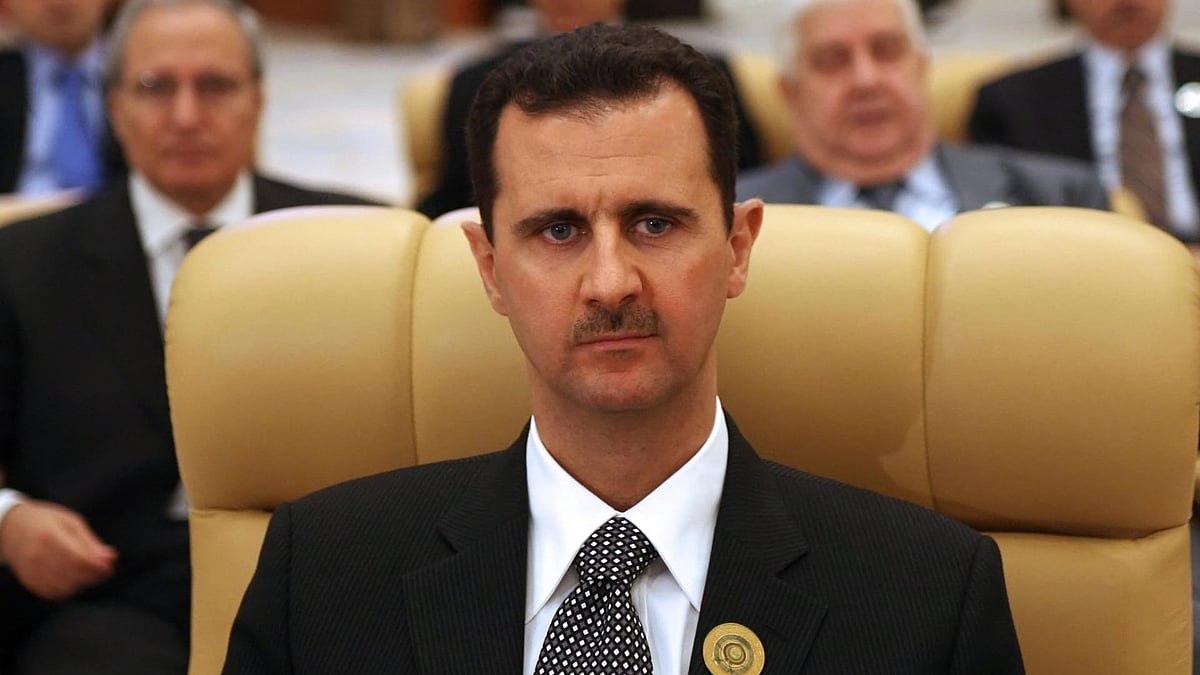
A Syrian court has sentenced former President Bashar Assad and his brother Maher to death in absentia for crimes against humanity and war crimes committed during Syria's 14-year conflict. The conflict, which started in 2011, has left approximately half a million people dead.
The sentencing was carried out in a Syrian court on Tuesday, with Assad's maternal cousin Atef Najib also receiving a death sentence for his role in the crackdown in the southern province of Daraa. Najib, a former Syrian army brigadier general, headed the Political Security Branch in Daraa under Assad's rule.
Najib was present in the courtroom, wearing a prisoner's uniform and standing inside a cage, as the judge pronounced the sentence. The courtroom was heavily secured, with tight security measures in place.
Assad and his brother Maher fled to Russia in December 2014, after insurgents marched into Damascus. They have been living in exile since then, and were therefore sentenced in absentia.
The sentencing of Assad and his brother is a significant development in the ongoing efforts to hold those responsible for war crimes and crimes against humanity in Syria accountable. The conflict in Syria has been one of the deadliest and most devastating in recent history, with widespread human rights abuses and atrocities committed by all parties involved.
The international community has been calling for accountability and justice for the victims of the conflict, and this sentencing is seen as a step towards achieving that goal. However, it remains to be seen whether the sentencing will have any practical impact, given that Assad and his brother are currently living in exile in Russia.
The conflict in Syria started in 2011, as a peaceful uprising against Assad's rule, but quickly escalated into a full-blown civil war. The war has involved multiple parties, including the Syrian government, opposition groups, and extremist organizations such as ISIS.
The humanitarian toll of the conflict has been devastating, with millions of people displaced and hundreds of thousands killed. The conflict has also had a significant impact on the region, with neighboring countries such as Turkey, Lebanon, and Jordan hosting large numbers of refugees.
The international community has been involved in efforts to resolve the conflict, with multiple rounds of peace talks and diplomatic efforts. However, a lasting solution has yet to be found, and the conflict continues to this day.
In conclusion, the sentencing of Assad and his brother to death in absentia is a significant development in the ongoing efforts to hold those responsible for war crimes and crimes against humanity in Syria accountable. While it remains to be seen whether the sentencing will have any practical impact, it is a step towards achieving justice and accountability for the victims of the conflict.
The sentencing is also a reminder of the devastating humanitarian toll of the conflict, and the need for a lasting solution to be found. The international community must continue to work towards a peaceful resolution to the conflict, and to hold those responsible for war crimes and crimes against humanity accountable.
The conflict in Syria is a complex and multifaceted issue, with multiple parties involved and a wide range of humanitarian and political implications. The sentencing of Assad and his brother is just one part of the ongoing efforts to address the conflict and its aftermath.
In the end, the sentencing of Assad and his brother to death in absentia is a significant development in the ongoing efforts to hold those responsible for war crimes and crimes against humanity in Syria accountable. It is a step towards achieving justice and accountability for the victims of the conflict, and a reminder of the need for a lasting solution to be found.
Frequently asked questions
What was the sentence given to Assad and his brother?
Assad and his brother Maher were sentenced to death in absentia for crimes against humanity and war crimes.
Why were Assad and his brother sentenced in absentia?
Assad and his brother were sentenced in absentia because they are currently living in exile in Russia.