SEBI Cuts Market Intermediary Inspections by Two-Thirds
SEBI streamlines inspection framework, reduces FY27 target. Joint inspections to be conducted.
'%3E%3Crect%20width%3D'96'%20height%3D'96'%20fill%3D'%230B6E4F'%2F%3E%3Ccircle%20cx%3D'30'%20cy%3D'24'%20r%3D'44'%20fill%3D'%23fff'%20opacity%3D'.12'%2F%3E%3Ccircle%20cx%3D'60'%20cy%3D'74'%20r%3D'40'%20fill%3D'%23000'%20opacity%3D'.10'%2F%3E%3C%2Fg%3E%3Cg%20fill%3D'none'%20stroke%3D'%23fff'%20stroke-width%3D'3.2'%20stroke-linecap%3D'round'%20stroke-linejoin%3D'round'%3E%3Cpolyline%20points%3D'31%2C59%2041%2C49%2049%2C54%2063%2C37'%2F%3E%3Cpolyline%20points%3D'55%2C37%2063%2C37%2063%2C45'%2F%3E%3C%2Fg%3E%3C%2Fsvg%3E)
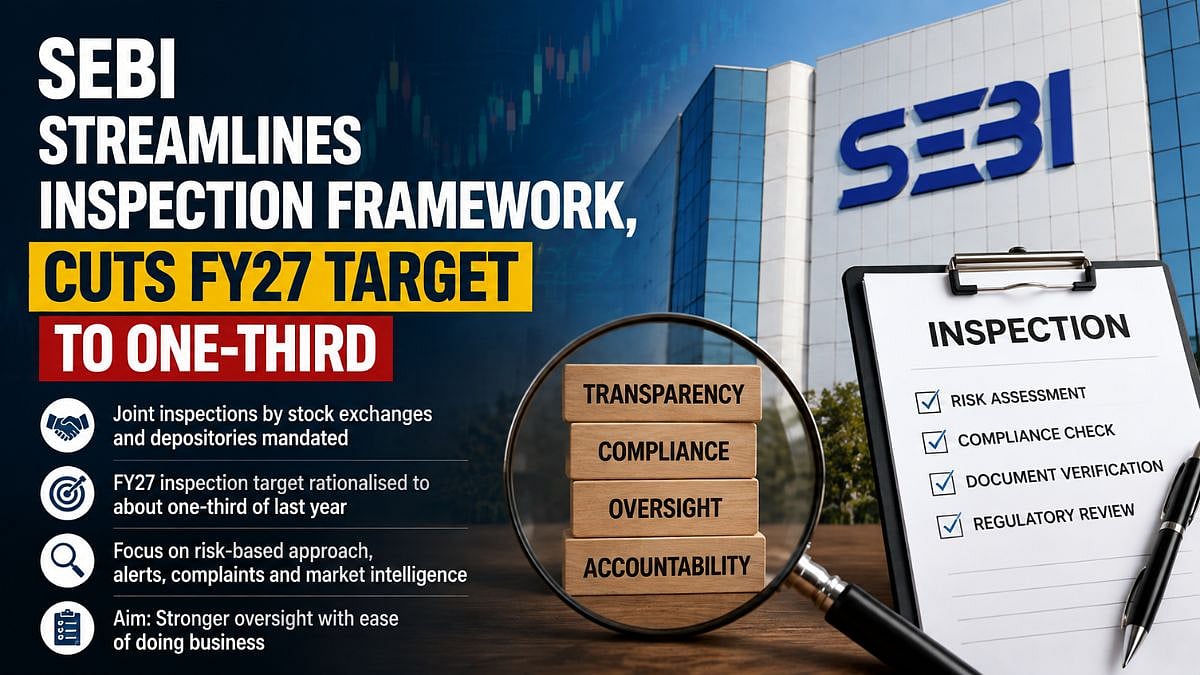
The Securities and Exchange Board of India (SEBI) has revamped its inspection framework for market intermediaries, effective from the financial year 2026-27. The new framework mandates joint inspections by stock exchanges and depositories, and reduces SEBI's inspection target for FY27 to about one-third of the previous year's level.
As part of the changes, SEBI has rationalised its inspection target, taking into account the regular inspections already carried out by stock exchanges and depositories. The regulator aims to strengthen regulatory oversight through a dynamic risk-based approach, while enhancing ease of doing business for intermediaries by reducing the frequency of inspection visits.
SEBI has also decided to discontinue repetitive annual comprehensive inspections of compliant entities, particularly Qualified Stock Brokers (QSBs). However, entities that repeatedly feature across risk parameters, carry high-risk scores, or trigger multiple alerts generated by exchanges will continue to receive priority for inspections.
Inspections of entities holding multiple intermediary registrations will be conducted jointly by different SEBI departments, wherever feasible, to minimise multiple inspection visits during the year. The regulator will place greater emphasis on alerts generated by exchanges, investor complaints, and social media inputs to identify potential violations.
The shortlisting of entities for inspections will now be undertaken on a quarterly basis, and inspections will also be initiated based on market intelligence and references received from SEBI's regional and local offices. These may cover issues such as technical glitches, cyber incidents, and matters relating to authorised persons of stock brokers.
According to SEBI, the revised inspection framework is intended to strengthen supervision while making the compliance process more efficient and less burdensome for market intermediaries. During 2025-26, SEBI and exchanges conducted 179 inspections of 106 brokers, while exchanges completed 973 inspections independently.
The move is expected to benefit market intermediaries by reducing the frequency of inspection visits and making the compliance process more efficient. It will also enable SEBI to focus on high-risk entities and strengthen regulatory oversight.
The revised inspection framework is a significant development in the Indian securities market, and is expected to have a positive impact on the ease of doing business for market intermediaries. It will also help to strengthen regulatory oversight and protect investor interests.
In recent years, SEBI has taken several steps to strengthen regulatory oversight and protect investor interests. The revised inspection framework is a part of these efforts, and is expected to contribute to the development of a more efficient and transparent securities market in India.
Overall, the revised inspection framework is a positive development for market intermediaries and investors, and is expected to contribute to the growth and development of the Indian securities market. It will also help to strengthen regulatory oversight and protect investor interests, which is essential for maintaining confidence in the market.
The move is also expected to reduce the regulatory burden on market intermediaries, and enable them to focus on their core business activities. It will also help to promote a culture of compliance and transparency in the securities market, which is essential for maintaining investor confidence.
In conclusion, the revised inspection framework is a significant development in the Indian securities market, and is expected to have a positive impact on the ease of doing business for market intermediaries. It will also help to strengthen regulatory oversight and protect investor interests, which is essential for maintaining confidence in the market.
Frequently asked questions
What is the main objective of SEBI's revised inspection framework?
The main objective is to strengthen regulatory oversight while making the compliance process more efficient and less burdensome for market intermediaries.
How will SEBI identify entities for inspections?
SEBI will identify entities based on alerts generated by exchanges, investor complaints, and social media inputs, as well as market intelligence and references from its regional and local offices.