MRVC Uses Special Soil Technique for Virar-Dahanu Quadrupling
MRVC adopts Prefabricated Vertical Drain method to tackle marshy land challenges. The technique speeds up soil settlement and reduces track deformation risk.
'%3E%3Crect%20width%3D'96'%20height%3D'96'%20fill%3D'%23B3261E'%2F%3E%3Ccircle%20cx%3D'30'%20cy%3D'24'%20r%3D'44'%20fill%3D'%23fff'%20opacity%3D'.12'%2F%3E%3Ccircle%20cx%3D'60'%20cy%3D'74'%20r%3D'40'%20fill%3D'%23000'%20opacity%3D'.10'%2F%3E%3C%2Fg%3E%3Cg%20fill%3D'%23fff'%3E%3Crect%20x%3D'29'%20y%3D'49'%20width%3D'8'%20height%3D'19'%20rx%3D'1'%2F%3E%3Crect%20x%3D'39'%20y%3D'40'%20width%3D'9'%20height%3D'28'%20rx%3D'1'%2F%3E%3Crect%20x%3D'50'%20y%3D'45'%20width%3D'8'%20height%3D'23'%20rx%3D'1'%2F%3E%3Crect%20x%3D'60'%20y%3D'53'%20width%3D'7'%20height%3D'15'%20rx%3D'1'%2F%3E%3Crect%20x%3D'41'%20y%3D'34'%20width%3D'5'%20height%3D'6'%2F%3E%3C%2Fg%3E%3C%2Fsvg%3E)
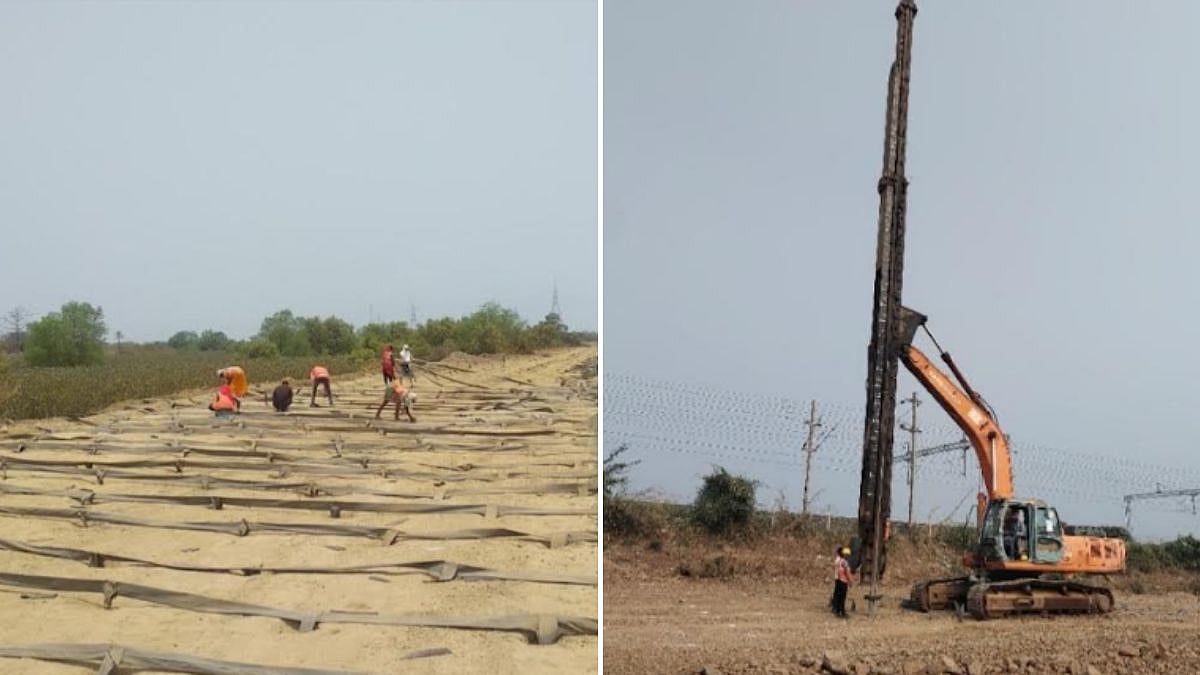
Mumbai Railway Vikas Corporation (MRVC) is using a special ground-improvement technique to overcome engineering challenges in the Virar-Dahanu Road quadrupling project. The project is facing issues due to marshy stretches and highly compressible black cotton soil.
The black cotton soil in these areas extends up to three to four metres below the existing ground and holds a large amount of water, settling very slowly when a heavy railway formation is built over it. To address this issue, MRVC is installing vertical drains to provide an easier path for the trapped water to escape, allowing the soil to consolidate faster.
The Prefabricated Vertical Drain (PVD) method involves inserting thin vertical drains made of polypropylene and covered with a geotextile filter into the ground using hydraulic machinery. The drains are placed at intervals of around 0.5 metre to 1.5 metres, depending on the soil condition and the required waiting period.
According to MRVC, the PVD technique can bring the time required to achieve around 90% settlement to less than six months, compared with several years under natural conditions. This method is recommended by the Research Designs and Standards Organisation (RDSO) under its latest earthwork guidelines.
The ground improvement work is part of the ₹3,578-crore Virar-Dahanu Road quadrupling project under MUTP-III, which has achieved 64% physical progress as of July 2026. The project will add two railway lines to the existing corridor and has completed significant earthwork, blanketing, and bridge construction.
The project's progress is notable, with around 30.35 lakh cubic metres of earthwork and 2.48 lakh cubic metres of blanketing completed. Four Road Under Bridges (RUBs), one Road Over Bridge (ROB), 13 major bridges, and 54 minor bridges have also been completed, along with around 34.7 km of drainage works.
The engineering challenge is particularly visible at Important Bridge 92 and Bridge 93, where major foundation and superstructure works are progressing. At Bridge 92, all 576 piles, 68 pile caps, and 68 piers have been completed, along with 264 girders and 132 deck slabs. At Bridge 93, 476 piles have been completed.
The use of the PVD technique is expected to not only speed up construction progress but also reduce future track maintenance and improve safety once trains begin operating. The project's completion will significantly enhance the railway infrastructure in the region, providing better connectivity and services to commuters.
The Virar-Dahanu Road quadrupling project is a crucial part of the Mumbai Urban Transport Project (MUTP-III), aimed at improving the city's railway network. The project's success will have a positive impact on the region's economy and quality of life, making it an essential infrastructure development for Mumbai.
Frequently asked questions
What is the PVD technique used by MRVC?
The PVD technique involves inserting thin vertical drains into the ground to speed up soil settlement and reduce track deformation risk.
What is the current progress of the Virar-Dahanu Road quadrupling project?
The project has achieved 64% physical progress as of July 2026.