Rupee Weakens 0.8% This Fiscal Year
Rupee breaches 96 versus dollar, RBI's forex boost fades. Currency weakens 0.8% this fiscal year.
'%3E%3Crect%20width%3D'96'%20height%3D'96'%20fill%3D'%230B6E4F'%2F%3E%3Ccircle%20cx%3D'30'%20cy%3D'24'%20r%3D'44'%20fill%3D'%23fff'%20opacity%3D'.12'%2F%3E%3Ccircle%20cx%3D'60'%20cy%3D'74'%20r%3D'40'%20fill%3D'%23000'%20opacity%3D'.10'%2F%3E%3C%2Fg%3E%3Cg%20fill%3D'none'%20stroke%3D'%23fff'%20stroke-width%3D'3.2'%20stroke-linecap%3D'round'%20stroke-linejoin%3D'round'%3E%3Cpolyline%20points%3D'31%2C59%2041%2C49%2049%2C54%2063%2C37'%2F%3E%3Cpolyline%20points%3D'55%2C37%2063%2C37%2063%2C45'%2F%3E%3C%2Fg%3E%3C%2Fsvg%3E)
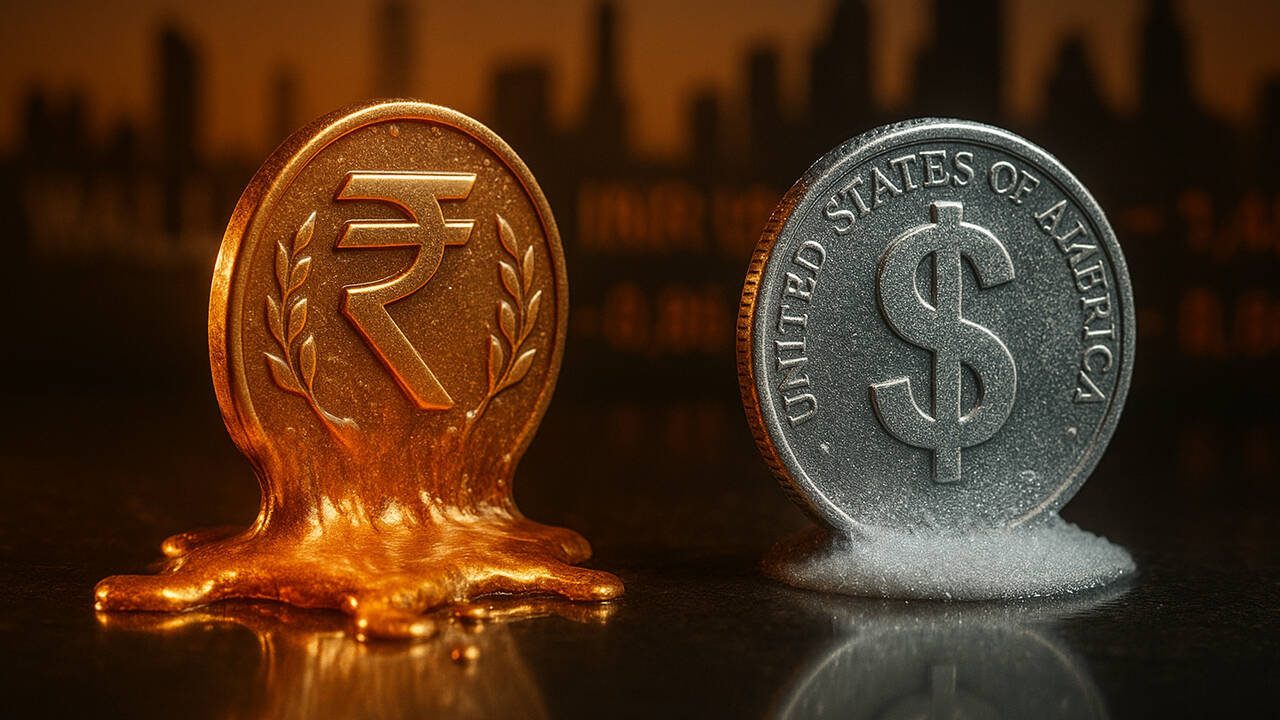
The Indian rupee has weakened by more than 0.8% since the start of the current fiscal year. This downward trend is a significant development in the country's currency market.
On Monday, the one-month forward premium on the rupee stood at 3.17%, indicating the market's expectations for the currency's future value. In contrast, the one-year forward premium was 2.83%, showing a decrease in the premium over the longer term.
The Reserve Bank of India (RBI) has been actively managing the country's foreign exchange reserves to stabilize the rupee. However, the impact of these efforts seems to be fading, as the currency has breached the 96 level against the US dollar.
The rupee's weakness can be attributed to various factors, including the country's trade deficit and the strength of the US dollar in the global market. The RBI's efforts to boost the forex reserves have helped to mitigate the decline, but the currency remains under pressure.
India's trade deficit has been widening due to the increase in imports, particularly of crude oil and other essential commodities. This has put pressure on the rupee, as the country needs to pay for these imports in foreign currency.
The strength of the US dollar has also contributed to the rupee's weakness. The US dollar has been gaining strength against most major currencies, including the rupee, due to the US Federal Reserve's monetary policy decisions.
The RBI has been using various tools to manage the rupee's value, including selling dollars from its foreign exchange reserves and intervening in the forward market. However, the effectiveness of these measures depends on various factors, including the overall economic conditions and the global market trends.
The rupee's weakness has significant implications for the Indian economy, particularly for importers and exporters. A weak rupee makes imports more expensive, which can lead to higher prices for consumers. On the other hand, a weak rupee can make exports more competitive, which can boost the country's export growth.
In conclusion, the rupee's weakness is a significant concern for the Indian economy. The RBI's efforts to stabilize the currency are ongoing, but the impact of these efforts is fading. The country's trade deficit and the strength of the US dollar are major factors contributing to the rupee's weakness.
The rupee's value will likely remain under pressure in the coming days, and the RBI will need to continue its efforts to stabilize the currency. The Indian government and the RBI will need to work together to address the underlying issues contributing to the rupee's weakness and to find a sustainable solution to stabilize the currency.