Shinde Sena Tells SC: 2018 Constitution Gave Extensive Powers To Party Chief
Eknath Shinde's Shiv Sena tells Supreme Court that 2018 constitution altered party's democratic structure. Senior advocate argues that amendments concentrated power in party chief's hands.
'%3E%3Crect%20width%3D'96'%20height%3D'96'%20fill%3D'%231A5276'%2F%3E%3Ccircle%20cx%3D'30'%20cy%3D'24'%20r%3D'44'%20fill%3D'%23fff'%20opacity%3D'.12'%2F%3E%3Ccircle%20cx%3D'60'%20cy%3D'74'%20r%3D'40'%20fill%3D'%23000'%20opacity%3D'.10'%2F%3E%3C%2Fg%3E%3Cg%20fill%3D'%23fff'%3E%3Cpath%20d%3D'M31%2041%20L48%2031%20L65%2041%20Z'%2F%3E%3Crect%20x%3D'33'%20y%3D'43'%20width%3D'4'%20height%3D'17'%2F%3E%3Crect%20x%3D'41'%20y%3D'43'%20width%3D'4'%20height%3D'17'%2F%3E%3Crect%20x%3D'51'%20y%3D'43'%20width%3D'4'%20height%3D'17'%2F%3E%3Crect%20x%3D'59'%20y%3D'43'%20width%3D'4'%20height%3D'17'%2F%3E%3Crect%20x%3D'30'%20y%3D'62'%20width%3D'36'%20height%3D'4'%20rx%3D'1'%2F%3E%3C%2Fg%3E%3C%2Fsvg%3E)
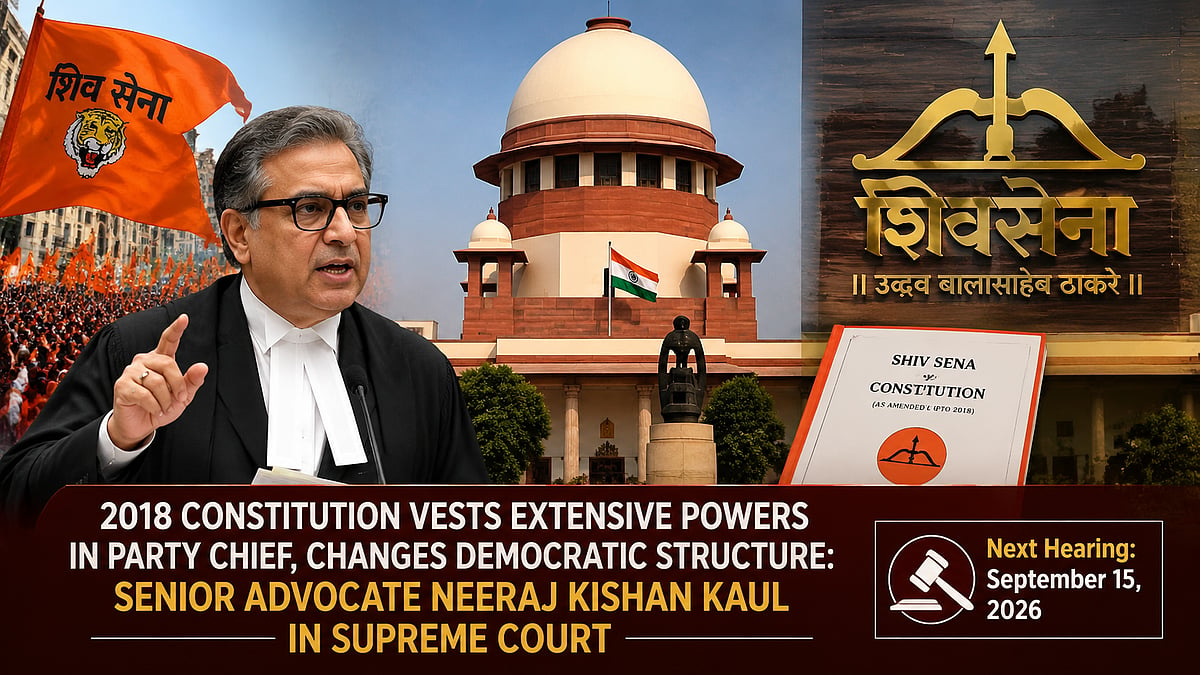
The Eknath Shinde-led Shiv Sena faction told the Supreme Court on Wednesday that the party's 2018 constitution had significantly altered its earlier democratic organisational structure.
Senior advocate Neeraj Kishan Kaul, representing the Shinde faction, argued that the 2018 amendments gave extensive powers to the party chief. He submitted that this move had concentrated power in the hands of one individual, effectively reversing the democratic process introduced in the party's 1999 constitution.
Kaul placed before the court the historical record of the Shiv Sena constitution and the Election Commission's interventions since 1997. He highlighted that the Election Commission had made it clear in 1997 that recognised political parties were required to have elected office-bearers and conduct periodic organisational elections.
At that time, Shiv Sena was the sole exception among 43 recognised national and state-level parties, as it had maintained that its constitution provided for nomination rather than election of office-bearers. The Election Commission rejected this position, holding that political parties enjoying recognition and exclusive election symbols were expected to maintain internal democracy.
Following the intervention, Shiv Sena conducted organisational elections in December 1997, electing a 14-member National Executive and constituting a three-member committee to recommend amendments and frame rules for internal elections. Although a resolution at the time provided for Balasaheb Thackeray to remain Shiv Sena Pramukh for life, the subsequent constitutional process resulted in the 1999 party constitution, which introduced a more structured organisational framework with elected elements.
Kaul argued that the 2018 amendments effectively reversed this democratic process, creating a 'power centre' around the party chief. He maintained that the dispute was not merely about paperwork or which faction had submitted particular documents, but about who had the authority to define a political party through its constitution, organisational structure, and office-bearers.
The senior advocate also rejected the contention that the existence of organisational bodies could establish internal democracy if their functioning depended upon the pleasure of one individual. The Supreme Court had previously questioned whether the amended constitution had transformed the party into a 'one-person structure.'
The case highlights the ongoing power struggle within the Shiv Sena party, with the Eknath Shinde faction and the Uddhav Thackeray faction vying for control. The Supreme Court's decision will have significant implications for the party's future and the democratic process within Indian political parties.
In the context of Indian politics, the case raises important questions about the role of internal democracy within political parties. The Election Commission's interventions since 1997 have emphasized the need for recognised political parties to maintain internal democracy, with elected office-bearers and periodic organisational elections.
The Shiv Sena party has a long history in Maharashtra, and its internal dynamics have significant implications for the state's politics. The party's 2018 constitution and the ongoing power struggle will likely have far-reaching consequences for the party's future and its relationship with other political parties in the state.
The Supreme Court's decision will be closely watched, as it will set a precedent for the democratic process within Indian political parties. The case highlights the need for transparency and accountability within political parties, ensuring that they remain true to their democratic principles.
In conclusion, the Eknath Shinde-led Shiv Sena faction's argument before the Supreme Court has significant implications for the party's future and the democratic process within Indian political parties. The case raises important questions about the role of internal democracy and the need for transparency and accountability within political parties.
Frequently asked questions
What is the main argument of the Eknath Shinde-led Shiv Sena faction before the Supreme Court?
The faction argues that the 2018 constitution gave extensive powers to the party chief, reversing the democratic process introduced in the 1999 constitution.
What was the Election Commission's stance on internal democracy in 1997?
The Election Commission emphasized the need for recognised political parties to have elected office-bearers and conduct periodic organisational elections, maintaining internal democracy.