Mumbai Parsis Revive Vulture Reintroduction Calls After Assam Release
Parsi community seeks to restore vultures at Tower of Silence, Mumbai's Malabar Hill cemetery.
'%3E%3Crect%20width%3D'96'%20height%3D'96'%20fill%3D'%23B3261E'%2F%3E%3Ccircle%20cx%3D'30'%20cy%3D'24'%20r%3D'44'%20fill%3D'%23fff'%20opacity%3D'.12'%2F%3E%3Ccircle%20cx%3D'60'%20cy%3D'74'%20r%3D'40'%20fill%3D'%23000'%20opacity%3D'.10'%2F%3E%3C%2Fg%3E%3Cg%20fill%3D'%23fff'%3E%3Crect%20x%3D'29'%20y%3D'49'%20width%3D'8'%20height%3D'19'%20rx%3D'1'%2F%3E%3Crect%20x%3D'39'%20y%3D'40'%20width%3D'9'%20height%3D'28'%20rx%3D'1'%2F%3E%3Crect%20x%3D'50'%20y%3D'45'%20width%3D'8'%20height%3D'23'%20rx%3D'1'%2F%3E%3Crect%20x%3D'60'%20y%3D'53'%20width%3D'7'%20height%3D'15'%20rx%3D'1'%2F%3E%3Crect%20x%3D'41'%20y%3D'34'%20width%3D'5'%20height%3D'6'%2F%3E%3C%2Fg%3E%3C%2Fsvg%3E)
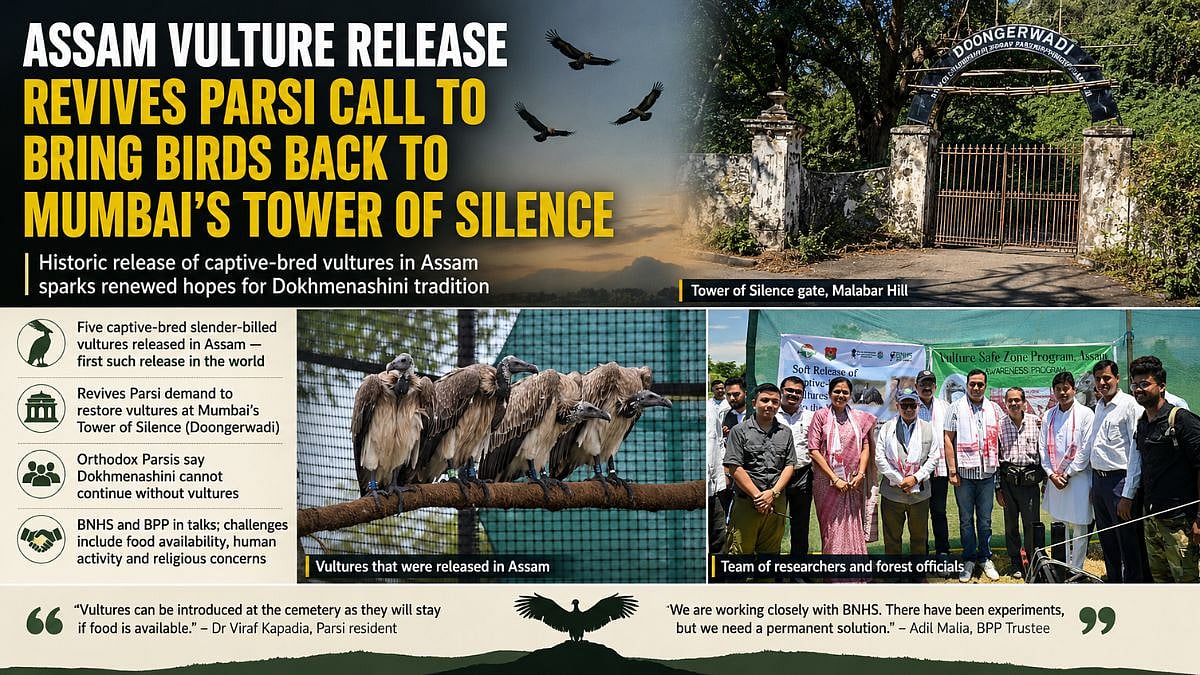
Mumbai’s Parsi-Zoroastrian community has renewed its call to reintroduce vultures at the Tower of Silence cemetery on Malabar Hill, following the release of five captive-bred slender-billed vultures into the wild in Assam.
The release, a joint initiative by the Assam Forest Department and the Bombay Natural History Society (BNHS), marked the first known introduction of captive-bred slender-billed vultures into the wild anywhere in the world.
Five white-rumped vultures were also released at the Jatayu Soft Release Centre in Tewaripal, Biswanath, using a scientific process known as ‘soft release’ after acclimatising for three months at a release aviary. Each bird has been fitted with a numbered blue leg ring and a back tag for monitoring.
India is home to nine species of vultures, but their populations have plummeted due to the use of veterinary diclofenac and other now-banned drugs. The Gyps vulture population has fallen by nearly 99 per cent over the past two decades.
This sharp decline has directly impacted the centuries-old dakhmas, or Towers of Silence, where the Parsi community traditionally practises Dokhmenashini (sky burial). Dr Viraf Kapadia, a resident of Nepean Sea Road, believes that vultures can be introduced at the cemetery as they will stay if food is available.
However, BNHS Director Kishore Rithe noted that discussions with the Bombay Parsi Punchayet (BPP), which manages the Doongerwadi site, have yet to yield a mutually acceptable plan. Rithe cited concerns about the availability of food and human movement in the area.
Adil Malia, a trustee of the BPP, expressed optimism about ongoing talks with the BNHS, stating that they are working closely together to find a permanent solution.
The reintroduction of vultures at the Tower of Silence would require a suitable environment, including a reliable food source and minimal human disturbance. The community is hopeful that a solution can be found, allowing them to continue their traditional practices.
The decline of vultures in India has significant cultural and ecological implications, and efforts to conserve and reintroduce these birds are crucial for maintaining the country's biodiversity.
The Parsi community's efforts to restore vultures at the Tower of Silence reflect their commitment to preserving their cultural heritage and traditional practices. As talks between the BPP and BNHS continue, the community remains hopeful that a solution can be found to reintroduce these iconic birds to their ancestral home.
The success of the vulture release in Assam has provided a glimmer of hope for the Parsi community, and they are eager to explore the possibility of reintroducing vultures at the Tower of Silence. With ongoing discussions and collaboration between the BPP and BNHS, a solution may be on the horizon, allowing the community to continue their traditional practices and preserve their cultural heritage.
Frequently asked questions
Why are vultures important to the Parsi community?
Vultures are essential for the Parsi community's traditional sky burial practice, Dokhmenashini.
What are the challenges in reintroducing vultures at the Tower of Silence?
The main challenges include providing a reliable food source and minimizing human disturbance in the area.