
RBI Governor Backs Rate Hold Amid Inflation Uncertainty
RBI keeps interest rate unchanged, awaits clarity on inflation trajectory.
'%3E%3Crect%20width%3D'96'%20height%3D'96'%20fill%3D'%230B6E4F'%2F%3E%3Ccircle%20cx%3D'30'%20cy%3D'24'%20r%3D'44'%20fill%3D'%23fff'%20opacity%3D'.12'%2F%3E%3Ccircle%20cx%3D'60'%20cy%3D'74'%20r%3D'40'%20fill%3D'%23000'%20opacity%3D'.10'%2F%3E%3C%2Fg%3E%3Cg%20fill%3D'none'%20stroke%3D'%23fff'%20stroke-width%3D'3.2'%20stroke-linecap%3D'round'%20stroke-linejoin%3D'round'%3E%3Cpolyline%20points%3D'31%2C59%2041%2C49%2049%2C54%2063%2C37'%2F%3E%3Cpolyline%20points%3D'55%2C37%2063%2C37%2063%2C45'%2F%3E%3C%2Fg%3E%3C%2Fsvg%3E)
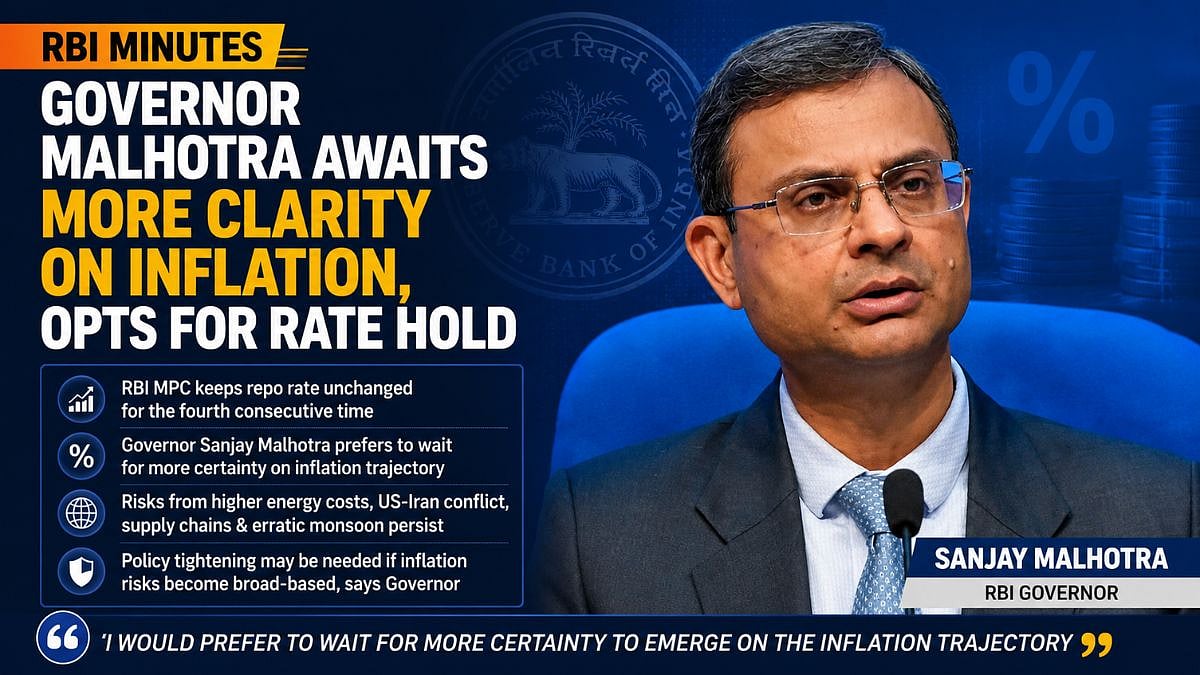
The Reserve Bank of India (RBI) has decided to maintain the existing interest rate, with Governor Sanjay Malhotra opting to wait for greater certainty on the inflation trajectory. This decision was made by the six-member Monetary Policy Committee (MPC) earlier this month.
According to the minutes of the meeting, the Governor-headed panel voted to keep the benchmark policy rate (repo) unchanged for a fourth consecutive time. The decision was made in light of the US-Iran conflict, which has triggered higher energy costs and raised concerns about broader inflationary pressures.
Despite the conflict in West Asia disrupting supply chains and an erratic monsoon, the Indian economy has performed better than expected in the first quarter of 2026-27. However, the Governor stressed the need to be watchful, as risks of higher food, fuel, and other input prices translating into a broad-based increase in inflation and de-anchoring of expectations persist.
The Governor stated that he would prefer to wait for more certainty to emerge on the inflation trajectory before recalibrating the policy rate. He also emphasized that monetary response to a supply-side shock is warranted when there are signs of it leading to a generalization of inflation, de-anchoring of inflation expectations, or persistent inflation.
Deputy Governor and MPC member Poonam Gupta also favored a wait-and-watch approach, citing persistent uncertainty due to global developments and weather-related risks. She suggested that waiting would allow for the weather-related uncertainties to fully settle and provide clarity on the global front.
The RBI's decision to maintain the interest rate is a cautious approach, as the central bank seeks to balance the need to control inflation with the need to support economic growth. The Indian economy has shown resilience in the face of global uncertainties, but the RBI remains vigilant, monitoring the inflation trajectory and ready to tighten policy if necessary.
The decision to keep the interest rate unchanged is significant, as it indicates that the RBI is prioritizing caution over aggressive monetary policy action. The central bank's approach will be closely watched, as it navigates the complex landscape of global economic uncertainty and domestic inflationary pressures.
In conclusion, the RBI's decision to maintain the interest rate reflects the central bank's commitment to prudent monetary policy and its desire to await greater clarity on the inflation trajectory before making any significant changes. This approach is likely to continue, as the RBI seeks to balance the need to control inflation with the need to support economic growth.
The RBI's cautious approach is also reflected in its statement that any evidence of risks materializing may need policy tightening. This suggests that the central bank is prepared to take action if necessary, but will do so in a measured and careful manner.
Overall, the RBI's decision to maintain the interest rate is a significant development, and one that will be closely watched by economists, policymakers, and market participants. As the Indian economy continues to navigate the challenges of global uncertainty and domestic inflationary pressures, the RBI's approach will be critical in shaping the country's economic trajectory.
The decision to keep the interest rate unchanged has implications for the broader economy, as it affects borrowing costs and investment decisions. The RBI's cautious approach is likely to influence market expectations and shape the direction of monetary policy in the coming months.
In the context of the Indian economy, the RBI's decision is significant, as it reflects the central bank's commitment to supporting economic growth while controlling inflation. The decision will be closely watched, as it has implications for the country's economic trajectory and the direction of monetary policy.
The RBI's approach is also significant in the context of global economic uncertainty, as it reflects the central bank's desire to prioritize caution and prudence in its monetary policy decisions. This approach is likely to continue, as the RBI navigates the complex landscape of global economic uncertainty and domestic inflationary pressures.
In conclusion, the RBI's decision to maintain the interest rate is a significant development, and one that will be closely watched by economists, policymakers, and market participants. The central bank's cautious approach reflects its commitment to prudent monetary policy and its desire to await greater clarity on the inflation trajectory before making any significant changes.
Frequently asked questions
Why did the RBI decide to keep the interest rate unchanged?
The RBI decided to keep the interest rate unchanged due to uncertainty about the inflation trajectory and the need to await greater clarity before making any significant changes.
What are the implications of the RBI's decision for the Indian economy?
The RBI's decision to keep the interest rate unchanged has implications for borrowing costs and investment decisions, and will influence market expectations and shape the direction of monetary policy in the coming months.