Hawk Spotted on Passenger's Turban in Mumbai Local Train
A hawk was seen calmly perching on a female Nihang passenger's turban. The incident occurred on a CST-Kalyan route train.
'%3E%3Crect%20width%3D'96'%20height%3D'96'%20fill%3D'%23B3261E'%2F%3E%3Ccircle%20cx%3D'30'%20cy%3D'24'%20r%3D'44'%20fill%3D'%23fff'%20opacity%3D'.12'%2F%3E%3Ccircle%20cx%3D'60'%20cy%3D'74'%20r%3D'40'%20fill%3D'%23000'%20opacity%3D'.10'%2F%3E%3C%2Fg%3E%3Cg%20fill%3D'%23fff'%3E%3Crect%20x%3D'29'%20y%3D'49'%20width%3D'8'%20height%3D'19'%20rx%3D'1'%2F%3E%3Crect%20x%3D'39'%20y%3D'40'%20width%3D'9'%20height%3D'28'%20rx%3D'1'%2F%3E%3Crect%20x%3D'50'%20y%3D'45'%20width%3D'8'%20height%3D'23'%20rx%3D'1'%2F%3E%3Crect%20x%3D'60'%20y%3D'53'%20width%3D'7'%20height%3D'15'%20rx%3D'1'%2F%3E%3Crect%20x%3D'41'%20y%3D'34'%20width%3D'5'%20height%3D'6'%2F%3E%3C%2Fg%3E%3C%2Fsvg%3E)
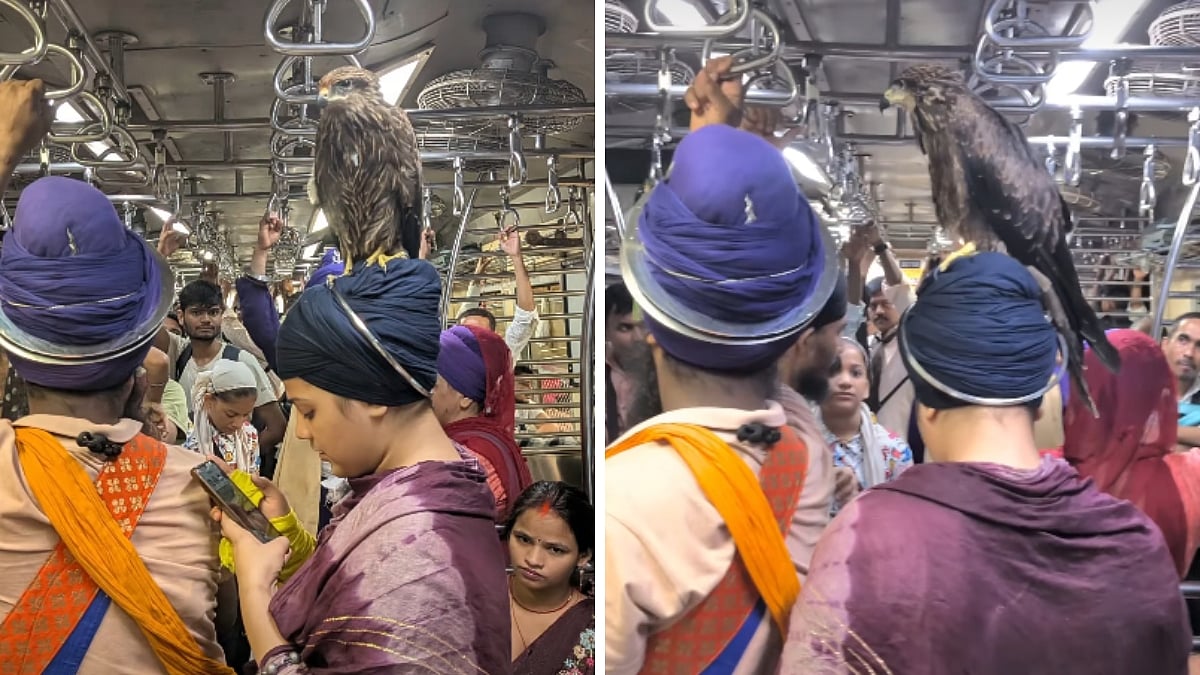
A surprising incident occurred on a Mumbai local train when a hawk was spotted inside a compartment, perched on the turban of a female Nihang Sikh passenger. The incident took place on August 15, 2026, aboard a train operating on the Chhatrapati Shivaji Maharaj Terminus (CST)-Kalyan route.
The unusual encounter was captured on video by a commuter and shared on Instagram by user Akshay Palav. The 40-second clip shows the hawk sitting steadily on the passenger's turban as the train moves through the city. Fellow commuters can be seen watching the unusual sight with fascination, with several passengers recording the moment on their mobile phones.
The video has garnered more than 3.74 lakh views, drawing widespread attention online. The unexpected encounter inside a packed Mumbai local has since become a talking point online, with the striking sight of the hawk perched peacefully on the passenger's turban leaving commuters amazed.
In Sikhism, the baaz (hawk or falcon) is a powerful symbol of royalty, sovereignty, courage, and the free spirit of the Khalsa. It is closely associated with Guru Gobind Singh Ji, who is affectionately remembered as Chittian Bajanvala, the “Master of the White Hawk.” The baaz therefore reflects the ideal of the saint-soldier, embodying both spiritual strength and fearless courage.
The significance of the hawk in Sikhism is also reflected in its association with royalty and rulers. During the time of the Sikh Gurus, keeping and flying a falcon was traditionally associated with royalty and rulers. Guru Gobind Singh Ji's association with the baaz symbolised sovereign authority and the principle of miri-piri, the integration of temporal responsibility with spiritual sovereignty, independent of Mughal rule.
The image of Guru Gobind Singh Ji with a white hawk perched on his hand is a powerful representation of the Guru's fearless spirit, independence, and warrior-saint ideal. This image has been depicted in traditional Sikh art, folklore, and historical accounts, and has become a symbol of the Guru's legacy.
The incident on the Mumbai local train has sparked interest in the significance of the hawk in Sikhism, and has become a talking point online. The video of the hawk perched on the passenger's turban has been widely shared and viewed, and has brought attention to the rich cultural and symbolic significance of the baaz in Sikhism.
In conclusion, the incident of the hawk spotted on a passenger's turban in a Mumbai local train is a unique and fascinating event that has sparked interest in the cultural and symbolic significance of the baaz in Sikhism. The incident has become a talking point online, and has brought attention to the rich cultural heritage of the Sikh community.
The incident also highlights the diversity and complexity of Mumbai's cultural landscape, where people from different backgrounds and faiths come together in public spaces like local trains. The fact that the hawk was able to perch peacefully on the passenger's turban, without causing any disturbance or harm, is a testament to the city's tolerant and accepting nature.
Overall, the incident of the hawk spotted on a passenger's turban in a Mumbai local train is a remarkable and thought-provoking event that has sparked interest in the cultural and symbolic significance of the baaz in Sikhism, and has highlighted the diversity and complexity of Mumbai's cultural landscape.
Frequently asked questions
What is the significance of the hawk in Sikhism?
The hawk is a powerful symbol of royalty, sovereignty, courage, and the free spirit of the Khalsa, closely associated with Guru Gobind Singh Ji.
Where did the incident of the hawk on the passenger's turban occur?
The incident occurred on a Mumbai local train operating on the CST-Kalyan route.