NASA Sends 3301 Bees to Space in 1984
Bees in space, NASA experiment, honeycomb built
'%3E%3Crect%20width%3D'96'%20height%3D'96'%20fill%3D'%23B3261E'%2F%3E%3Ccircle%20cx%3D'30'%20cy%3D'24'%20r%3D'44'%20fill%3D'%23fff'%20opacity%3D'.12'%2F%3E%3Ccircle%20cx%3D'60'%20cy%3D'74'%20r%3D'40'%20fill%3D'%23000'%20opacity%3D'.10'%2F%3E%3C%2Fg%3E%3Cg%20fill%3D'%23fff'%3E%3Crect%20x%3D'29'%20y%3D'49'%20width%3D'8'%20height%3D'19'%20rx%3D'1'%2F%3E%3Crect%20x%3D'39'%20y%3D'40'%20width%3D'9'%20height%3D'28'%20rx%3D'1'%2F%3E%3Crect%20x%3D'50'%20y%3D'45'%20width%3D'8'%20height%3D'23'%20rx%3D'1'%2F%3E%3Crect%20x%3D'60'%20y%3D'53'%20width%3D'7'%20height%3D'15'%20rx%3D'1'%2F%3E%3Crect%20x%3D'41'%20y%3D'34'%20width%3D'5'%20height%3D'6'%2F%3E%3C%2Fg%3E%3C%2Fsvg%3E)
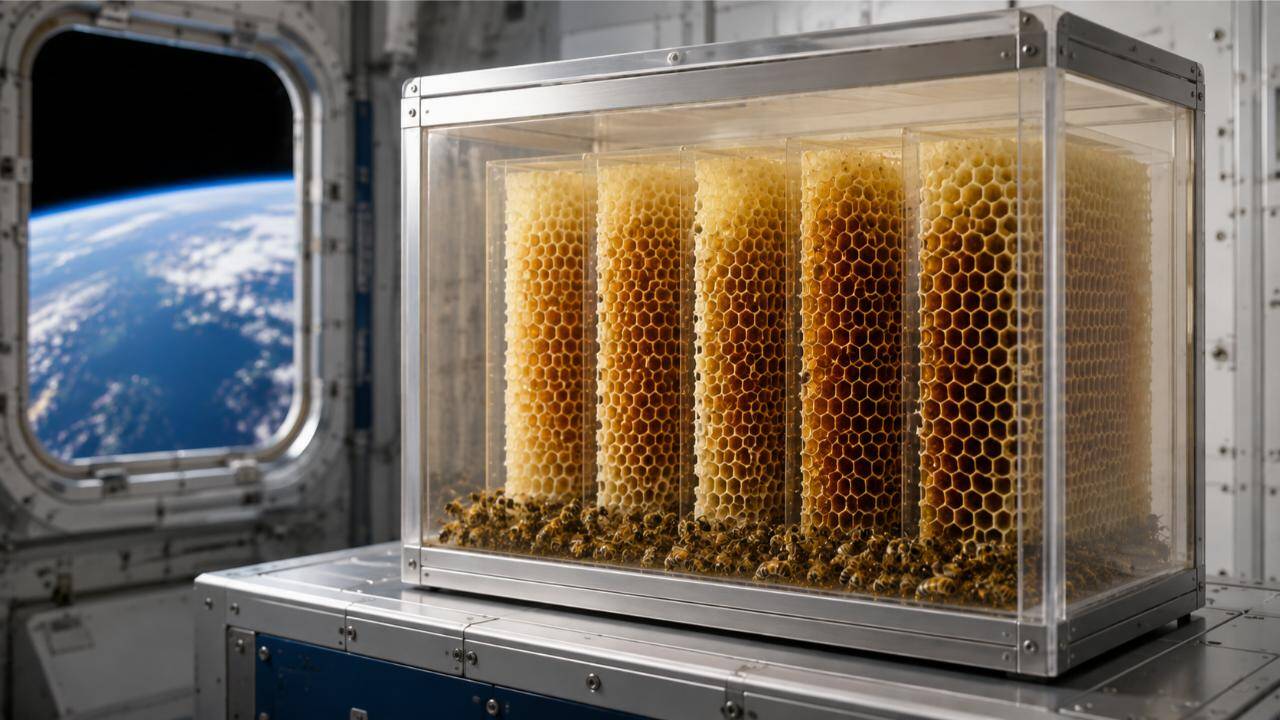
In a unique experiment, NASA sent 3,301 honeybees to space aboard the Space Shuttle Discovery in 1984. The mission aimed to study the behavior of bees in microgravity and determine if they could survive and build their famous honeycomb.
Initially, the bees faced difficulties adapting to the microgravity environment, with some crashing into walls. However, within days, they began to adjust and navigate their new surroundings.
By the end of the mission, the bees had not only adapted to the microgravity but also built approximately 200 cm of honeycomb. This was a significant achievement, demonstrating the bees' ability to thrive in space.
Most of the bees survived the mission, and the queen bee even laid eggs after returning to Earth. Although the eggs did not hatch, the experiment provided valuable insights into the behavior of bees in space.
The 1984 NASA experiment was a groundbreaking study that expanded our understanding of how living organisms adapt to microgravity environments. The findings of this experiment have contributed to the development of future space missions and the study of animal behavior in space.
The experiment also highlighted the remarkable ability of honeybees to adapt to new environments and build complex structures like honeycomb. The bees' ability to thrive in space has significant implications for future space missions, particularly those involving long-duration stays in microgravity.
In conclusion, the 1984 NASA experiment that sent 3,301 bees to space was a remarkable achievement that has contributed significantly to our understanding of animal behavior in microgravity environments. The experiment's findings have paved the way for future space missions and continue to inspire scientific research and discovery.
The success of the bees in building honeycomb in space demonstrates the incredible adaptability of living organisms and has significant implications for the future of space exploration. As scientists continue to study the behavior of animals in space, we can expect to gain a deeper understanding of the complex interactions between living organisms and their environments.
This knowledge will be crucial in planning and executing future space missions, particularly those involving long-duration stays in microgravity. The 1984 NASA experiment with honeybees has laid the foundation for a new era of scientific research and discovery in space, and its findings will continue to inspire and inform space exploration for generations to come.
Frequently asked questions
What was the purpose of sending bees to space in 1984
The purpose was to study the behavior of bees in microgravity and determine if they could survive and build honeycomb.
How many bees were sent to space in the 1984 NASA experiment
3,301 honeybees were sent to space aboard the Space Shuttle Discovery.