Supreme Court Orders Delhi Govt To Treat Protesters Injured By Pellet Guns
Delhi Govt must treat injured protesters, Supreme Court directs. Blanket ban on pellet guns unlikely.
'%3E%3Crect%20width%3D'96'%20height%3D'96'%20fill%3D'%231A5276'%2F%3E%3Ccircle%20cx%3D'30'%20cy%3D'24'%20r%3D'44'%20fill%3D'%23fff'%20opacity%3D'.12'%2F%3E%3Ccircle%20cx%3D'60'%20cy%3D'74'%20r%3D'40'%20fill%3D'%23000'%20opacity%3D'.10'%2F%3E%3C%2Fg%3E%3Cg%20fill%3D'%23fff'%3E%3Cpath%20d%3D'M31%2041%20L48%2031%20L65%2041%20Z'%2F%3E%3Crect%20x%3D'33'%20y%3D'43'%20width%3D'4'%20height%3D'17'%2F%3E%3Crect%20x%3D'41'%20y%3D'43'%20width%3D'4'%20height%3D'17'%2F%3E%3Crect%20x%3D'51'%20y%3D'43'%20width%3D'4'%20height%3D'17'%2F%3E%3Crect%20x%3D'59'%20y%3D'43'%20width%3D'4'%20height%3D'17'%2F%3E%3Crect%20x%3D'30'%20y%3D'62'%20width%3D'36'%20height%3D'4'%20rx%3D'1'%2F%3E%3C%2Fg%3E%3C%2Fsvg%3E)
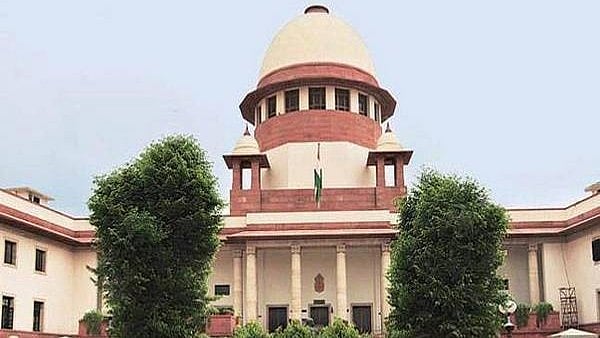
The Supreme Court has directed the Delhi Government to ensure proper medical treatment for protesters injured during the July 20 Sansad Chalo demonstration.
The Court's order comes in response to a public interest litigation filed by former IPS officer Yashovardhan Azad and two others, who alleged they suffered pellet injuries when the Rapid Action Force dispersed protesters at Jantar Mantar.
A Bench of Chief Justice of India Surya Kant, Justice Joymalya Bagchi, and Justice V Mohan was hearing the petition, which seeks a ban on the use of wholly or partly metallic pellet guns for dispersing civilian assemblies. The petitioners also sought compensation for those injured in the July 20 incident and rehabilitation for the victims.
The Court, however, indicated that a blanket ban on pellet guns cannot be considered unless the rules permitting their use are specifically challenged. Justice Bagchi pointed out that existing police regulations permit the use of pellet guns in exceptional circumstances.
The Chief Justice suggested that the petitioners may instead seek judicial guidelines governing the use of pellet guns rather than an outright ban. The Bench remarked that merely questioning the use of force in one incident would require examining whether law enforcement followed the prescribed graded response before resorting to pellet guns.
Advocate Vrinda Grover, appearing for the petitioners, clarified that the challenge was confined to metallic pellets and not to all less-lethal weapons. She submitted that metallic pellets had been recovered from the bodies of the injured petitioners after surgery.
Grover argued that she could not find any standing order issued by the Delhi Police permitting the use of pellet guns and had to rely on a 2016 document of the Bureau of Police Research and Development, obtained through the Right to Information Act. She urged the Court to direct the Union government to place any such standing order on record if it existed.
The Solicitor General Tushar Mehta assured the Bench that the Union government would comply with the Court's directions. The Court's order is a significant development in the case, as it highlights the need for proper medical treatment for the injured protesters.
The use of pellet guns has been a contentious issue in India, with many arguing that they are a form of excessive force. The Supreme Court's decision to seek a focus on the rules permitting the use of pellet guns rather than a blanket ban is a nuanced approach to the issue.
The Court's order also underscores the importance of ensuring that law enforcement agencies follow the prescribed graded response before resorting to pellet guns. This approach is likely to have significant implications for the use of force by law enforcement agencies in India.
In conclusion, the Supreme Court's order directing the Delhi Government to provide proper medical treatment to the injured protesters is a welcome development. The Court's approach to the issue of pellet guns is nuanced and highlights the need for a balanced approach to the use of force by law enforcement agencies.
Frequently asked questions
What is the Supreme Court's order on pellet gun use?
The Supreme Court has directed the Delhi Government to provide proper medical treatment to the injured protesters and has indicated that a blanket ban on pellet guns cannot be considered unless the rules permitting their use are specifically challenged.
What is the petitioners' challenge to pellet gun use?
The petitioners have challenged the use of wholly or partly metallic pellet guns for dispersing civilian assemblies, seeking a ban, compensation for those injured, and rehabilitation for the victims.