TV Channels Outshine Social Media Influence
Social media's power is exaggerated, TV channels have more impact
'%3E%3Crect%20width%3D'96'%20height%3D'96'%20fill%3D'%231A5276'%2F%3E%3Ccircle%20cx%3D'30'%20cy%3D'24'%20r%3D'44'%20fill%3D'%23fff'%20opacity%3D'.12'%2F%3E%3Ccircle%20cx%3D'60'%20cy%3D'74'%20r%3D'40'%20fill%3D'%23000'%20opacity%3D'.10'%2F%3E%3C%2Fg%3E%3Cg%20fill%3D'%23fff'%3E%3Cpath%20d%3D'M31%2041%20L48%2031%20L65%2041%20Z'%2F%3E%3Crect%20x%3D'33'%20y%3D'43'%20width%3D'4'%20height%3D'17'%2F%3E%3Crect%20x%3D'41'%20y%3D'43'%20width%3D'4'%20height%3D'17'%2F%3E%3Crect%20x%3D'51'%20y%3D'43'%20width%3D'4'%20height%3D'17'%2F%3E%3Crect%20x%3D'59'%20y%3D'43'%20width%3D'4'%20height%3D'17'%2F%3E%3Crect%20x%3D'30'%20y%3D'62'%20width%3D'36'%20height%3D'4'%20rx%3D'1'%2F%3E%3C%2Fg%3E%3C%2Fsvg%3E)
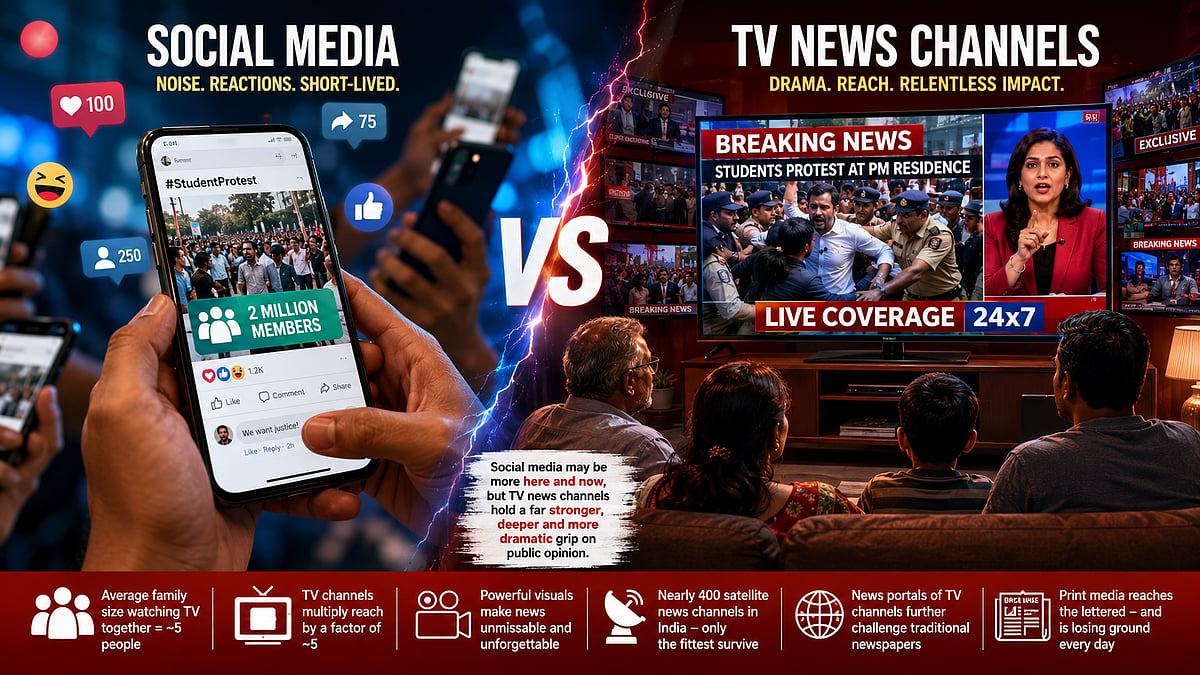
The recent resignation of Dharmendra Pradhan as Union Education Minister was attributed to the protests by the Cockroach Janta Party (CJP), which has 2 million members and 10 million followers on Instagram. However, the power of social media is often overstated. Online support is often passive and follows the herd mentality, with users mechanically liking posts without reading the content.
In contrast, television news channels have a more intrusive presence in people's lives, with a 12-hour presence in middle-class drawing rooms, hotels, bars, and airport lounges. They focus on emotional and sensational news, which can multiply their audience by a factor of five, given that an average of five people watch TV together at a given time.
TV channels are not shy about their role in pandering to and polarizing their audience. The rise of Arvind Kejriwal in politics was attributed to the saturation coverage his IAC movement received from TV channels. Similarly, Abhijit Dipke, the founder of CJP, received significant TV media attention, which helped him gain prominence.
The location of TV channels' headquarters also plays a role in determining the coverage they give to certain events. Since most Hindi and English news channels are headquartered in the National Capital Region (NCR), events that occur in Delhi receive more coverage. For example, two years ago, the massive tremors in Myanmar received less TV coverage than the mild tremors in neighboring Bangkok.
The power of TV channels lies in their ability to create a sense of urgency and drama around an event. They can make a story go viral by repeatedly airing it and creating a sense of anticipation around it. This can have a significant impact on public opinion and can even influence political decisions.
In the case of the CJP protests, TV channels played a significant role in amplifying their message and creating a sense of urgency around their demands. The protests were extensively covered by TV channels, which helped to create a sense of momentum around the movement.
The impact of TV channels on public opinion cannot be overstated. They have the power to shape public discourse and influence political decisions. While social media has its own strengths, TV channels remain a dominant force in shaping public opinion.
In conclusion, while social media has its own influence, TV channels have a more significant impact on public opinion. Their ability to create a sense of urgency and drama around an event, combined with their intrusive presence in people's lives, makes them a powerful force in shaping public discourse.
The significance of TV channels in Indian politics and public life is a testament to their enduring influence. As the media landscape continues to evolve, it will be interesting to see how TV channels adapt to the changing times and continue to shape public opinion.
The role of TV channels in amplifying the message of protests and movements is a critical one. They have the power to create a sense of momentum around a cause and influence public opinion. As such, they will continue to play a significant role in shaping Indian politics and public life.
In the end, the power of TV channels lies in their ability to shape public discourse and influence political decisions. While social media has its own strengths, TV channels remain a dominant force in Indian politics and public life.
Frequently asked questions
What is the role of TV channels in shaping public opinion?
TV channels have the power to shape public discourse and influence political decisions by creating a sense of urgency and drama around an event.
How do TV channels amplify the message of protests and movements?
TV channels amplify the message of protests and movements by extensively covering them and creating a sense of momentum around the cause.