Rahul Gandhi Slams Double Standards for Women
Rahul Gandhi criticizes double standards for women, freedom with conditions
'%3E%3Crect%20width%3D'96'%20height%3D'96'%20fill%3D'%231A5276'%2F%3E%3Ccircle%20cx%3D'30'%20cy%3D'24'%20r%3D'44'%20fill%3D'%23fff'%20opacity%3D'.12'%2F%3E%3Ccircle%20cx%3D'60'%20cy%3D'74'%20r%3D'40'%20fill%3D'%23000'%20opacity%3D'.10'%2F%3E%3C%2Fg%3E%3Cg%20fill%3D'%23fff'%3E%3Cpath%20d%3D'M31%2041%20L48%2031%20L65%2041%20Z'%2F%3E%3Crect%20x%3D'33'%20y%3D'43'%20width%3D'4'%20height%3D'17'%2F%3E%3Crect%20x%3D'41'%20y%3D'43'%20width%3D'4'%20height%3D'17'%2F%3E%3Crect%20x%3D'51'%20y%3D'43'%20width%3D'4'%20height%3D'17'%2F%3E%3Crect%20x%3D'59'%20y%3D'43'%20width%3D'4'%20height%3D'17'%2F%3E%3Crect%20x%3D'30'%20y%3D'62'%20width%3D'36'%20height%3D'4'%20rx%3D'1'%2F%3E%3C%2Fg%3E%3C%2Fsvg%3E)
Rahul Gandhi recently spoke out in Pune against the double standards applied to women in India, sparking a debate about cultural norms and freedom. His remarks came after Prime Minister Narendra Modi commented on the use of abusive language by young women protesters at Jantar Mantar, citing a 'cultural shock'. Gandhi argued that the same behavior is often overlooked or even admired when exhibited by men, but becomes a cultural crisis when displayed by women.
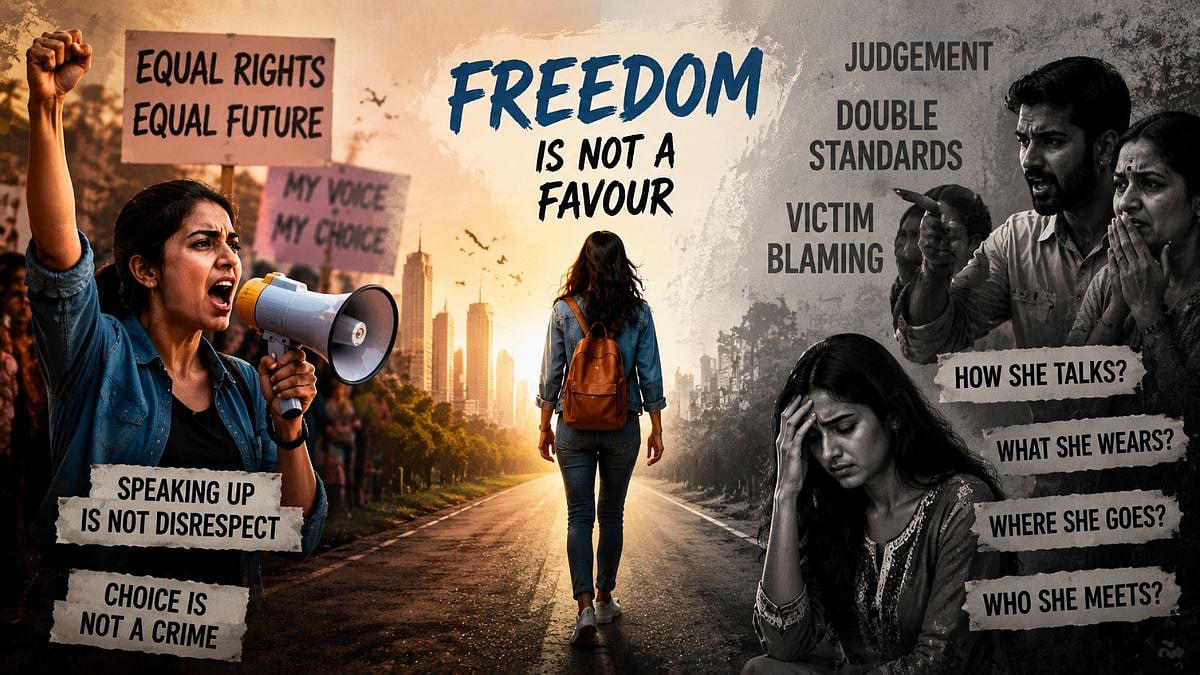
The issue at hand is not just about one protest or politician, but rather a deeper societal problem. India has established laws and institutions to support women's rights, but social permission for women to exercise their freedom remains conditional. Women are often judged for their choices, whether it's their speech, dress, career, or partner. This judgment can be particularly harsh when it comes to women in politics, where they are expected to explain their tone before their argument is even considered.
The double standard is evident in the way men and women are perceived in politics. Men who use profanity or aggressive language are often seen as confident or tough, while women who do the same are labeled as arrogant or difficult. This disparity is not limited to politics, but extends to social media, where women are often subject to personal attacks and character assassination.
Indian women are expected to fulfill multiple roles, including obedient daughter, accommodating wife, dutiful daughter-in-law, self-sacrificing mother, and competent professional. Each role comes with its own set of instructions, and rejecting these expectations can lead to accusations of selfishness. Even a woman's appearance is subject to scrutiny, with her clothes often being treated as a reflection of her character.
The media, particularly mainstream cinema, has also played a significant role in shaping societal expectations of women. For decades, popular films have portrayed the virtuous woman, sacrificial mother, and desirable heroine as ideals, while sexually assertive or defiant women are often punished or consumed. While there are exceptions, repetition has created a social expectation that women should conform to these norms.
The harshest penalty for women is often related to their sexuality. A man's sexual history is often seen as a sign of masculinity, while a woman's sexual history can be used to shame or discredit her. This double standard is a reflection of the deeper societal problem, where women's freedom is conditional and their choices are subject to judgment.
In conclusion, Rahul Gandhi's remarks highlight the need for a shift in societal attitudes towards women's freedom and autonomy. Women should be able to exercise their freedom without conditions, and their choices should be respected and valued. It is only by recognizing and challenging these double standards that we can create a more equitable society for women in India.
The issue of double standards for women is not just a matter of politics, but a reflection of the societal norms and expectations that govern women's lives. It is a reminder that women's freedom is not just a matter of laws and institutions, but also of social attitudes and expectations. As India continues to evolve and grow, it is essential that we address these double standards and work towards creating a more inclusive and equitable society for all.
The debate sparked by Rahul Gandhi's remarks is a step in the right direction, as it highlights the need for a more nuanced and informed discussion about women's freedom and autonomy. By recognizing and challenging these double standards, we can work towards creating a society where women are valued and respected for their choices, and where their freedom is not conditional.
In the end, the freedom of women in India is not just a matter of politics or social norms, but a fundamental human right. It is essential that we recognize and respect this right, and work towards creating a society where women can exercise their freedom without fear of judgment or reprisal.
Frequently asked questions
What did Rahul Gandhi say about women's freedom?
Rahul Gandhi criticized the double standards applied to women in India, arguing that women's freedom is conditional and subject to judgment.
What is the impact of societal expectations on women's lives?
Societal expectations govern women's lives, with women often being judged for their choices and expected to fulfill multiple roles.