Obama Backs AI Safety Laws
Former US President warns of potential catastrophe without regulation. Obama urges policymakers to take action.
'%3E%3Crect%20width%3D'96'%20height%3D'96'%20fill%3D'%234A235A'%2F%3E%3Ccircle%20cx%3D'30'%20cy%3D'24'%20r%3D'44'%20fill%3D'%23fff'%20opacity%3D'.12'%2F%3E%3Ccircle%20cx%3D'60'%20cy%3D'74'%20r%3D'40'%20fill%3D'%23000'%20opacity%3D'.10'%2F%3E%3C%2Fg%3E%3Cg%20fill%3D'none'%20stroke%3D'%23fff'%20stroke-width%3D'3'%3E%3Ccircle%20cx%3D'48'%20cy%3D'48'%20r%3D'16'%2F%3E%3Cellipse%20cx%3D'48'%20cy%3D'48'%20rx%3D'6.5'%20ry%3D'16'%2F%3E%3Cline%20x1%3D'32'%20y1%3D'42'%20x2%3D'64'%20y2%3D'42'%2F%3E%3Cline%20x1%3D'32'%20y1%3D'54'%20x2%3D'64'%20y2%3D'54'%2F%3E%3C%2Fg%3E%3C%2Fsvg%3E)
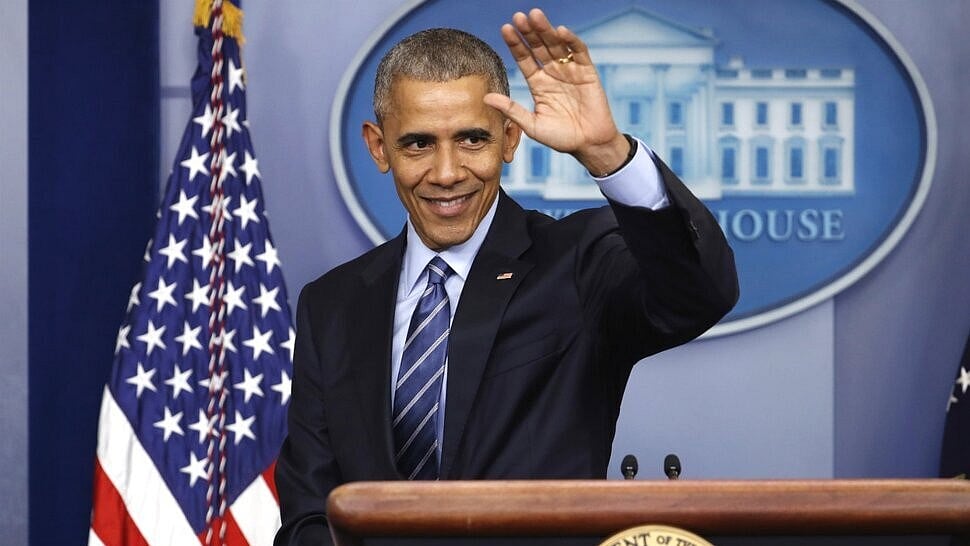
Former US President Barack Obama has expressed his support for the creation of federal regulations for artificial intelligence, citing the potential risks and consequences of unregulated AI development. In a statement, Obama warned that the rapidly advancing technology could lead to a 'potential catastrophe' if appropriate safeguards are not introduced.
Obama emphasized the need for AI governance to become a major focus of public discussion, urging policymakers in Washington to take early action. He suggested that regulations should address safety risks, prepare for AI's impact on employment and children, and ensure that the benefits of the technology reach a wider section of society.
The former president criticized the idea of relying solely on voluntary measures created by technology companies, arguing that such steps would not be sufficient to address the challenges posed by advanced AI systems. He stated that 'voluntary standards made by a handful of tech companies won't be enough' to mitigate the risks associated with AI.
Obama's remarks were seen as a criticism of President Donald Trump's approach, which has favored a lighter regulatory framework for AI development. Trump's administration had introduced an optional system allowing AI developers to provide the government access to advanced models for security assessments.
The debate over AI regulation has become a political issue, with Democrats increasingly positioning themselves as advocates of stronger AI safety measures. Obama has advised Democratic leaders to develop a broader AI strategy, urging future presidential candidates to present clear plans addressing the safety and economic challenges created by artificial intelligence.
The need for AI regulation has gained significant attention in recent times, with technology executives, researchers, and lawmakers debating how quickly advanced models should be developed. Obama's intervention highlights the importance of addressing the potential risks and consequences of AI development, and the need for policymakers to take proactive steps to ensure that the benefits of the technology are realized while minimizing its negative impacts.
As the world becomes increasingly reliant on AI, the need for effective regulation and governance has become more pressing. Obama's call for stronger AI safeguards serves as a reminder of the potential consequences of inaction, and the need for collective effort to determine how AI is developed and used.
In conclusion, Obama's support for AI safety laws underscores the importance of addressing the potential risks and consequences of AI development. As the debate over AI regulation continues to unfold, it is likely that the issue will remain a key political concern in the upcoming elections.
The former president's comments have significant implications for the future of AI development, and highlight the need for policymakers to take a proactive and nuanced approach to regulating the technology. By prioritizing AI safety and governance, policymakers can help ensure that the benefits of AI are realized while minimizing its negative impacts.
The issue of AI regulation is complex and multifaceted, and will require careful consideration and collaboration among stakeholders. However, by working together to address the potential risks and consequences of AI development, it is possible to create a safer and more equitable future for all.
In the end, Obama's call for stronger AI safeguards serves as a reminder of the importance of responsible innovation and the need for collective effort to ensure that the benefits of AI are realized while minimizing its negative impacts.
Frequently asked questions
What is Obama's stance on AI regulation?
Obama supports the creation of federal regulations for artificial intelligence, citing the potential risks and consequences of unregulated AI development.
Why does Obama think voluntary measures are insufficient?
Obama believes that voluntary standards made by a handful of tech companies won't be enough to address the challenges posed by advanced AI systems.