Delhi University Drops Delhi Sultanate Paper From PG Syllabus
Delhi University revises PG history syllabus, drops several papers. Changes affect Semester III courses.
'%3E%3Crect%20width%3D'96'%20height%3D'96'%20fill%3D'%231B5E20'%2F%3E%3Ccircle%20cx%3D'30'%20cy%3D'24'%20r%3D'44'%20fill%3D'%23fff'%20opacity%3D'.12'%2F%3E%3Ccircle%20cx%3D'60'%20cy%3D'74'%20r%3D'40'%20fill%3D'%23000'%20opacity%3D'.10'%2F%3E%3C%2Fg%3E%3Cg%3E%3Ccircle%20cx%3D'48'%20cy%3D'48'%20r%3D'15'%20fill%3D'%23fff'%2F%3E%3Cpath%20d%3D'M43%2034%20Q50%2048%2043%2062'%20fill%3D'none'%20stroke%3D'%238a94a6'%20stroke-width%3D'2.4'%2F%3E%3Cpath%20d%3D'M47%2033%20Q54%2048%2047%2063'%20fill%3D'none'%20stroke%3D'%238a94a6'%20stroke-width%3D'1.8'%20stroke-dasharray%3D'1.5%203'%2F%3E%3C%2Fg%3E%3C%2Fsvg%3E)
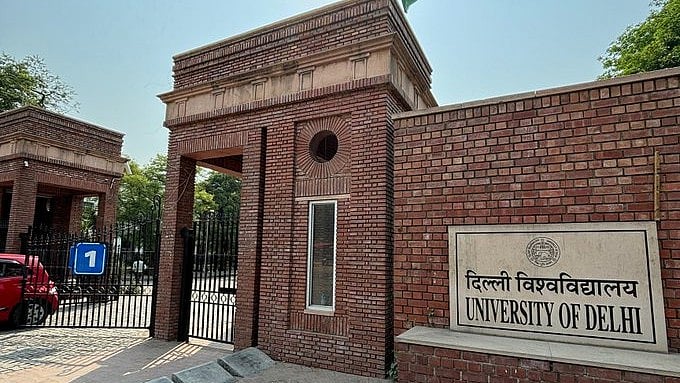
Delhi University has dropped the paper 'The Delhi Sultanate: Structures of Authority in Medieval North India (13th-14th Centuries)' from its newly notified postgraduate history syllabus. The paper, which was taught in Semester III, examined the formation of the Delhi Sultanate and its political, religious, and cultural developments.
The decision to drop the paper was made after a review of the syllabus by an expert committee. The committee, which comprises three external experts, the Head of the History Department, and two Academic Council members, was constituted by the vice-chancellor to review courses that required further examination.
Several other long-running history papers have also been omitted from the revised syllabus. These include 'History of North India, c. 1400-1550', 'Gender and Women in Early India: 1500 BCE to 1000 CE', 'Political Processes and Structure of Polities in Ancient India', and 'Religion and Society in Ancient Indian Literature'.
The 'History of North India, c. 1400-1550' paper focused on the period between the disintegration of the Delhi Sultanate and the emergence of the Mughal Empire. It examined Afghan political cultures, the distribution of political power, patronage, literary cultures, Sufism, and Bhakti, as well as debates around state formation and Islamisation.
The paper on 'Gender and Women in Early India' covered women across Brahmanical, Buddhist, Jain, and Tantric traditions, including marriage, family, property, women as rulers, patrons, and workers. 'Political Processes and Structure of Polities in Ancient India' examined the evolution of political institutions, including taxation, warfare, bureaucracy, land grants, queens, temples, merchant guilds, and local administration.
According to DU Dean of Academic Affairs K Ratnabali, the courses were not simply held back. The Academic Council gave the vice-chancellor the liberty to constitute an expert committee to review courses that required further examination. Changes made by the department after papers had been cleared by the Standing Committee included additions and deletions of papers, changes to units, and removal or replacement of readings.
The Expert Committee subsequently reviewed the revised syllabi and cleared those considered suitable for notification. DU has also indicated that some additional papers may be included after the review is completed.
The revision of the syllabus has raised questions about the impact on students and the academic community. The university has stated that the changes are intended to improve the quality of education and ensure that the syllabus is relevant and up-to-date.
The decision to drop the Delhi Sultanate paper and other history courses has significant implications for the study of history at Delhi University. The university's history department is one of the most prestigious in the country, and the changes to the syllabus will likely have a impact on the academic community.
In conclusion, the revision of the postgraduate history syllabus at Delhi University has resulted in the dropping of several papers, including the Delhi Sultanate paper. The changes are intended to improve the quality of education and ensure that the syllabus is relevant and up-to-date. However, the impact on students and the academic community remains to be seen.