Supreme Court Upholds Discharge Of RPF Personnel
RPF constables discharged for hiding pending cases, SC rules against them
'%3E%3Crect%20width%3D'96'%20height%3D'96'%20fill%3D'%23B3261E'%2F%3E%3Ccircle%20cx%3D'30'%20cy%3D'24'%20r%3D'44'%20fill%3D'%23fff'%20opacity%3D'.12'%2F%3E%3Ccircle%20cx%3D'60'%20cy%3D'74'%20r%3D'40'%20fill%3D'%23000'%20opacity%3D'.10'%2F%3E%3C%2Fg%3E%3Cg%20fill%3D'%23fff'%3E%3Crect%20x%3D'29'%20y%3D'49'%20width%3D'8'%20height%3D'19'%20rx%3D'1'%2F%3E%3Crect%20x%3D'39'%20y%3D'40'%20width%3D'9'%20height%3D'28'%20rx%3D'1'%2F%3E%3Crect%20x%3D'50'%20y%3D'45'%20width%3D'8'%20height%3D'23'%20rx%3D'1'%2F%3E%3Crect%20x%3D'60'%20y%3D'53'%20width%3D'7'%20height%3D'15'%20rx%3D'1'%2F%3E%3Crect%20x%3D'41'%20y%3D'34'%20width%3D'5'%20height%3D'6'%2F%3E%3C%2Fg%3E%3C%2Fsvg%3E)
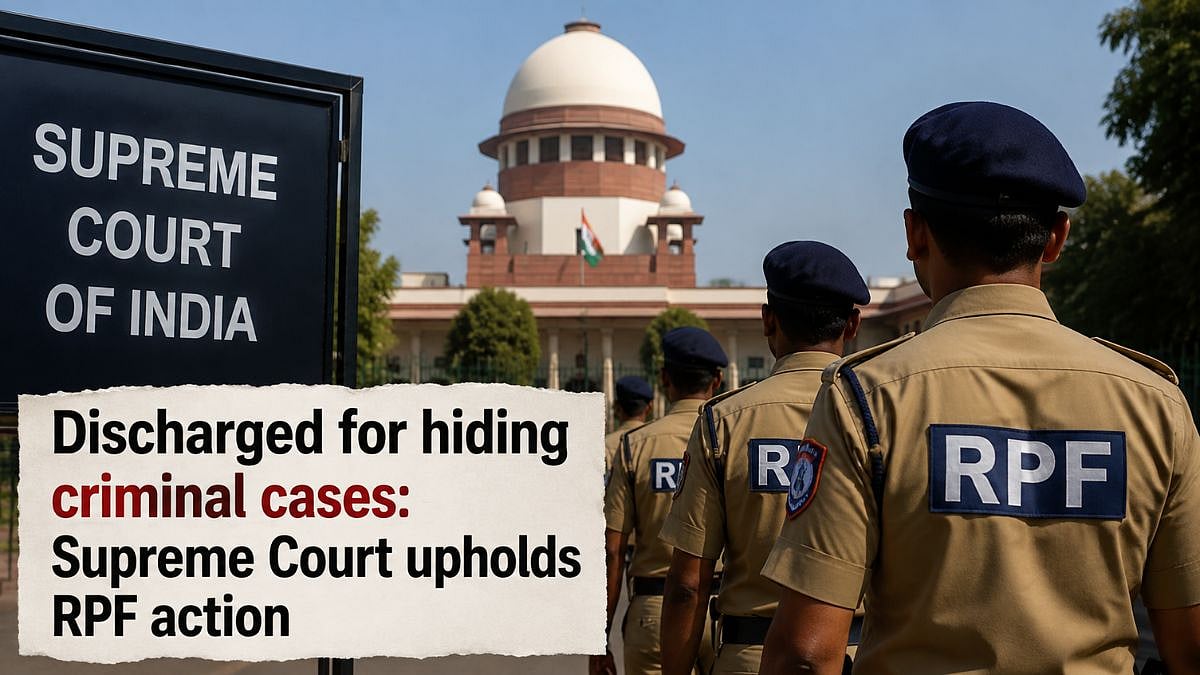
The Supreme Court has upheld the discharge of a group of Railway Protection Force (RPF) and Railway Protection Special Force (RPSF) constables who failed to disclose pending criminal cases during recruitment.
A Bench of Justices Pamidighantam Sri Narasimha and Alok Aradhe made this ruling, stating that an employee who suppresses such information can be discharged at any point. The court held that deliberate suppression of material information about criminal antecedents has a direct bearing on an employee's character and can justify termination.
The RPF Rules require candidates to provide complete information, including details of any pending criminal case, during the selection process. The rules make it clear that if the disclosure is not made, the candidate is liable to be discharged from service at any point of time.
The appellants had applied for recruitment as constables in the RPF and RPSF and cleared the written examination, physical and efficiency tests. However, during document verification and medical examination, they did not disclose the criminal cases pending against them.
The authorities discovered the pending criminal proceedings while the appellants were undergoing training and discharged them between June and October 2015. The Allahabad High Court upheld their discharge, following which the candidates approached the Supreme Court.
The Supreme Court affirmed the High Court judgment, noting that the appellants were aware of the Railway Protection Force Rules governing recruitment. The rules expressly provided for disqualification for suppression of factual information, but the appellants nevertheless proceeded with document verification and medical examination without disclosing the pending cases.
The Court relied on its decision in Avtar Singh v Union of India & Ors (2016), which dealt with deliberate suppression of multiple pending criminal cases. The Court observed that the facts of the present case fell under the instance referred in para 38.7 of the judgment in Avtar Singh, as the appellants had chosen not to indicate pendency of the criminal cases in the verification form.
The earlier ruling had also held that appointing a candidate who has suppressed material information can lead to serious consequences, including compromising the integrity of the force. The Supreme Court's decision underlines the importance of complete and truthful disclosure during the recruitment process, particularly for personnel joining a security force.
This ruling is significant as it emphasizes the need for transparency and honesty during the recruitment process. It also highlights the consequences of suppressing material information, which can lead to discharge from service at any point of time.
In conclusion, the Supreme Court's decision upholding the discharge of RPF personnel who hid pending criminal cases during recruitment is a significant one. It reinforces the importance of transparency and honesty during the recruitment process and emphasizes the consequences of suppressing material information.
Frequently asked questions
What is the significance of the Supreme Court's ruling on RPF personnel?
The ruling emphasizes the importance of transparency and honesty during the recruitment process and highlights the consequences of suppressing material information.
What are the consequences of suppressing material information during recruitment?
The consequences can lead to discharge from service at any point of time.