Mumbai Teen Creates Ant-Based Food Waste Digester
18-year-old Ananya Nagendra invents innovative food waste solution. Ants break down organic materials efficiently.
'%3E%3Crect%20width%3D'96'%20height%3D'96'%20fill%3D'%23B3261E'%2F%3E%3Ccircle%20cx%3D'30'%20cy%3D'24'%20r%3D'44'%20fill%3D'%23fff'%20opacity%3D'.12'%2F%3E%3Ccircle%20cx%3D'60'%20cy%3D'74'%20r%3D'40'%20fill%3D'%23000'%20opacity%3D'.10'%2F%3E%3C%2Fg%3E%3Cg%20fill%3D'%23fff'%3E%3Crect%20x%3D'29'%20y%3D'49'%20width%3D'8'%20height%3D'19'%20rx%3D'1'%2F%3E%3Crect%20x%3D'39'%20y%3D'40'%20width%3D'9'%20height%3D'28'%20rx%3D'1'%2F%3E%3Crect%20x%3D'50'%20y%3D'45'%20width%3D'8'%20height%3D'23'%20rx%3D'1'%2F%3E%3Crect%20x%3D'60'%20y%3D'53'%20width%3D'7'%20height%3D'15'%20rx%3D'1'%2F%3E%3Crect%20x%3D'41'%20y%3D'34'%20width%3D'5'%20height%3D'6'%2F%3E%3C%2Fg%3E%3C%2Fsvg%3E)
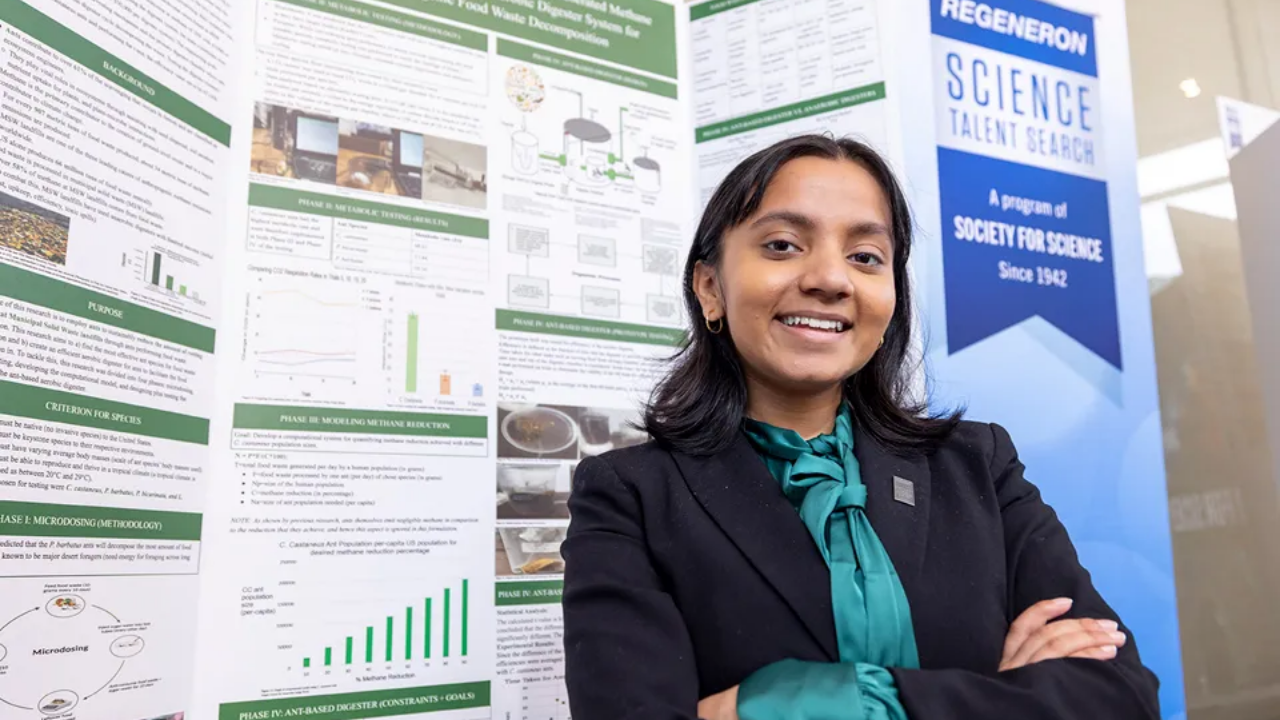
Ananya Nagendra, an 18-year-old student from Mumbai, has developed a groundbreaking ant-based digester to process food waste efficiently. This innovative system utilizes ants to break down organic materials, significantly reducing the amount of waste that ends up in landfills and subsequently decreasing methane emissions.
The digester uses a specific species of ant, Camponotus castaneus, which has been found to be particularly effective in consuming food waste. Experiments conducted by Ananya demonstrated that these ants were able to consume a substantial amount of waste, making them an ideal candidate for this purpose.
Ananya's prototype has achieved an impressive eighty-three percent efficiency in initial tests, showcasing the potential of this novel approach to managing discarded food materials. This research offers a unique biological solution to the growing problem of food waste management, which is a significant concern in urban areas like Mumbai.
Food waste is a major issue in India, with a substantial amount of waste being generated daily. The traditional methods of waste management, such as landfills, are not only inefficient but also harmful to the environment. Ananya's ant-based digester provides a sustainable and eco-friendly alternative to these methods.
The use of ants in waste management is a relatively new concept, and Ananya's research has the potential to pave the way for further innovation in this field. Her work demonstrates the importance of thinking outside the box and exploring unconventional solutions to real-world problems.
Ananya's achievement is not only a testament to her ingenuity and dedication but also a reminder of the impact that young people can have on their communities. Her research has the potential to make a significant difference in the way we manage food waste, and it will be exciting to see how her project develops in the future.
The success of Ananya's prototype has significant implications for the environment and public health. By reducing the amount of waste that ends up in landfills, we can decrease the production of methane, a potent greenhouse gas. This, in turn, can help mitigate the effects of climate change and create a healthier environment for future generations.
In conclusion, Ananya Nagendra's ant-based digester is a groundbreaking innovation that has the potential to revolutionize the way we manage food waste. Her research is a shining example of the power of creativity and determination, and it serves as a reminder that even the smallest ideas can have a significant impact on our world.
Frequently asked questions
What is the purpose of Ananya Nagendra's ant-based digester?
The purpose of Ananya's ant-based digester is to process food waste efficiently and reduce landfill methane.
What species of ant is used in the digester?
The digester uses Camponotus castaneus ants, which have been found to be effective in consuming food waste.