Indians, Pakistanis View Each Other As Biggest Threats
Pew survey reveals deep distrust between India and Pakistan, with China a key factor.
'%3E%3Crect%20width%3D'96'%20height%3D'96'%20fill%3D'%234A235A'%2F%3E%3Ccircle%20cx%3D'30'%20cy%3D'24'%20r%3D'44'%20fill%3D'%23fff'%20opacity%3D'.12'%2F%3E%3Ccircle%20cx%3D'60'%20cy%3D'74'%20r%3D'40'%20fill%3D'%23000'%20opacity%3D'.10'%2F%3E%3C%2Fg%3E%3Cg%20fill%3D'none'%20stroke%3D'%23fff'%20stroke-width%3D'3'%3E%3Ccircle%20cx%3D'48'%20cy%3D'48'%20r%3D'16'%2F%3E%3Cellipse%20cx%3D'48'%20cy%3D'48'%20rx%3D'6.5'%20ry%3D'16'%2F%3E%3Cline%20x1%3D'32'%20y1%3D'42'%20x2%3D'64'%20y2%3D'42'%2F%3E%3Cline%20x1%3D'32'%20y1%3D'54'%20x2%3D'64'%20y2%3D'54'%2F%3E%3C%2Fg%3E%3C%2Fsvg%3E)
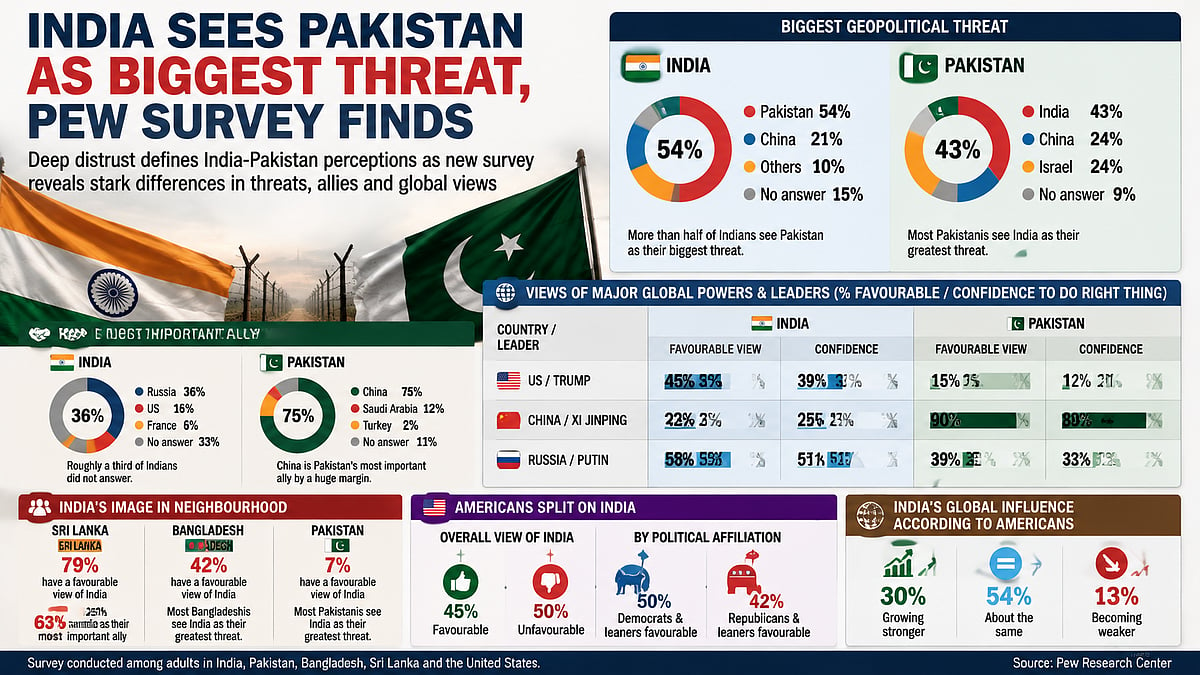
A recent Pew Research survey has found that more than half of Indians see Pakistan as their biggest geopolitical threat, while a large section of Pakistanis considers India its greatest threat. The survey, conducted among adults in four South Asian countries, highlights the deep distrust that continues to shape perceptions between the two neighbours.
According to the survey, 54% of adults in India named Pakistan as their greatest geopolitical threat, followed by China at 21%. In Pakistan, 43% named India as their greatest threat, while 24% each chose Israel and China. The results show how strongly regional rivalries continue to influence public opinion in South Asia.
The survey also reveals markedly different geopolitical preferences between Indians and Pakistanis. Pakistanis overwhelmingly identified China as their most important ally, with 75% choosing Beijing. In contrast, 36% of Indians named Russia as the country's most important ally, while 16% chose the US.
The divide between Indians and Pakistanis is also visible in their perceptions of global leaders. Only 12% of Pakistanis expressed confidence in US President Donald Trump to do the right thing in world affairs, while 83% expressed confidence in Chinese President Xi Jinping. Indians, meanwhile, held considerably more favourable views of Russia and its President Vladimir Putin than Pakistanis.
The survey also found that China received a relatively cool response in India, with only 23% of Indians viewing China favourably. In contrast, 90% of Pakistanis viewed China favourably. Views of the US were more positive in India, with 45% of Indians surveyed having a favourable opinion of the US.
The survey produced sharply varying results across the region, highlighting how differently India's role is perceived. India enjoyed particularly strong support in Sri Lanka, where 79% of those surveyed expressed a favourable view of the country. In contrast, only 7% of Pakistanis expressed a favourable view of India.
The contrast points to India's complex position in its immediate neighbourhood, where it is seen as a key partner by some and a major concern by others. The survey underscores the need for greater understanding and cooperation between India and its neighbours to address the region's geopolitical challenges.
The findings of the survey have significant implications for regional stability and cooperation. The deep distrust between Indians and Pakistanis, as well as their differing geopolitical preferences, highlights the need for sustained dialogue and engagement to build trust and confidence.
In conclusion, the Pew Research survey provides valuable insights into the geopolitical perceptions and preferences of Indians and Pakistanis. The findings underscore the complex and often fraught nature of regional relationships in South Asia, and highlight the need for greater cooperation and understanding to address the region's challenges.
The survey's results also have implications for India's foreign policy, particularly in its dealings with Pakistan and China. The findings suggest that India needs to engage more closely with its neighbours to build trust and confidence, and to address the region's geopolitical challenges.
Overall, the Pew Research survey provides a timely and important reminder of the need for greater cooperation and understanding in South Asia. By engaging more closely with its neighbours and addressing the region's geopolitical challenges, India can help to build a more stable and secure region, and promote greater cooperation and prosperity for all.
The survey's findings are a call to action for policymakers and leaders in the region to work towards building greater trust and cooperation. By doing so, they can help to address the region's challenges and promote a more stable and secure future for all.
In the end, the survey's results highlight the importance of sustained dialogue and engagement in building trust and confidence between nations. By working together and engaging in open and honest dialogue, India and its neighbours can help to build a more stable and secure region, and promote greater cooperation and prosperity for all.
Frequently asked questions
What percentage of Indians see Pakistan as their biggest threat?
54% of Indians surveyed see Pakistan as their biggest geopolitical threat.
Which country do Pakistanis see as their most important ally?
75% of Pakistanis surveyed identified China as their most important ally.