German Experiment Confirms Quantum Imaging Effect
Researchers in Germany confirm quantum imaging effect, Superconductors used, 20-year prediction validated
'%3E%3Crect%20width%3D'96'%20height%3D'96'%20fill%3D'%23B3261E'%2F%3E%3Ccircle%20cx%3D'30'%20cy%3D'24'%20r%3D'44'%20fill%3D'%23fff'%20opacity%3D'.12'%2F%3E%3Ccircle%20cx%3D'60'%20cy%3D'74'%20r%3D'40'%20fill%3D'%23000'%20opacity%3D'.10'%2F%3E%3C%2Fg%3E%3Cg%20fill%3D'%23fff'%3E%3Crect%20x%3D'29'%20y%3D'49'%20width%3D'8'%20height%3D'19'%20rx%3D'1'%2F%3E%3Crect%20x%3D'39'%20y%3D'40'%20width%3D'9'%20height%3D'28'%20rx%3D'1'%2F%3E%3Crect%20x%3D'50'%20y%3D'45'%20width%3D'8'%20height%3D'23'%20rx%3D'1'%2F%3E%3Crect%20x%3D'60'%20y%3D'53'%20width%3D'7'%20height%3D'15'%20rx%3D'1'%2F%3E%3Crect%20x%3D'41'%20y%3D'34'%20width%3D'5'%20height%3D'6'%2F%3E%3C%2Fg%3E%3C%2Fsvg%3E)
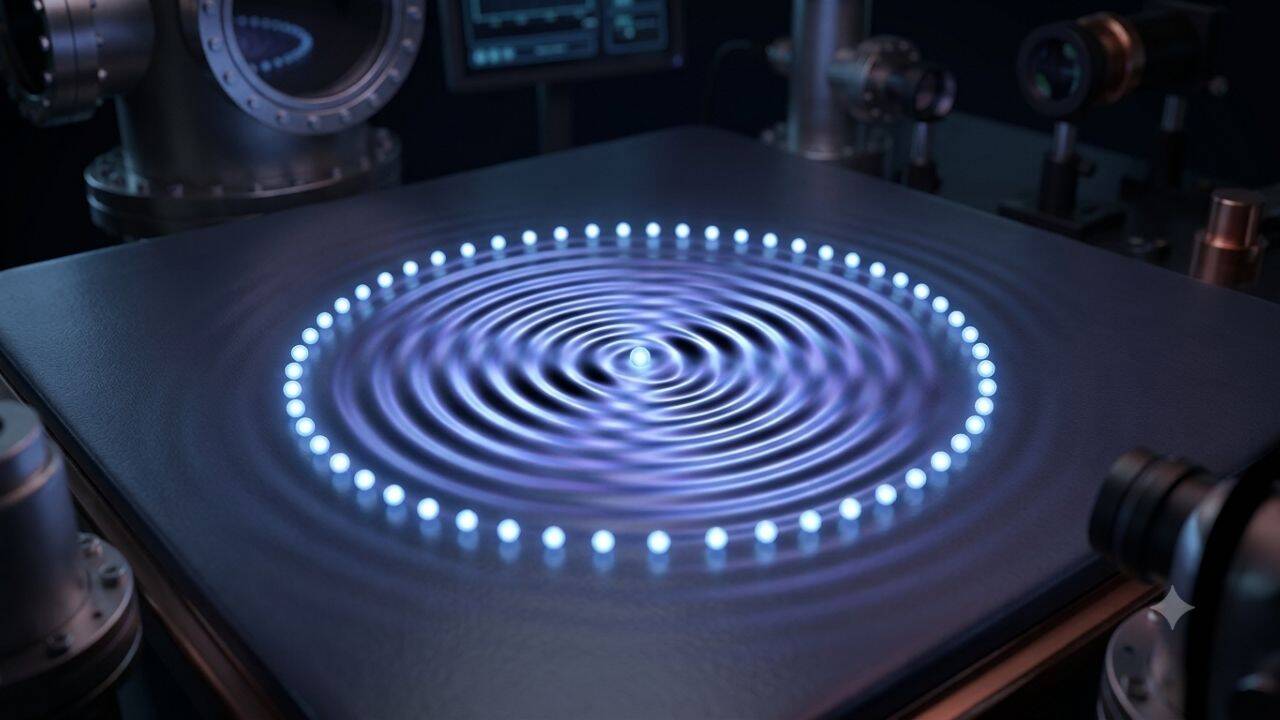
A groundbreaking experiment conducted by researchers in Germany has successfully demonstrated the quantum imaging effect, a phenomenon predicted by Dirk Morr of the University of Illinois Chicago two decades ago. Morr's theoretical model proposed that superconductors could be used to create high-resolution quantum images.
The German researchers, building on Morr's work, designed an experiment to test the validity of his prediction. Using superconductors, they were able to produce quantum images that closely matched Morr's theoretical expectations. This experimental confirmation provides strong evidence for the accuracy of Morr's model and opens up new possibilities for the development of quantum imaging technologies.
Morr's original proposal suggested that superconductors could be used to create high-resolution images by exploiting the unique properties of quantum mechanics. The idea was to use superconductors to manipulate the quantum states of particles, allowing for the creation of detailed images at the quantum level.
The German experiment used a sophisticated setup to create the quantum images, involving the careful manipulation of superconducting materials and the measurement of quantum states. The results of the experiment showed a high degree of correlation with Morr's theoretical predictions, providing strong evidence for the validity of his model.
The confirmation of Morr's prediction has significant implications for the development of quantum imaging technologies. Quantum imaging has the potential to revolutionize a wide range of fields, from medicine to materials science, by allowing for the creation of high-resolution images at the quantum level.
The use of superconductors in quantum imaging also opens up new possibilities for the development of advanced technologies, such as quantum computers and quantum sensors. The ability to manipulate quantum states using superconductors could lead to significant advances in these fields, enabling the creation of more powerful and efficient devices.
The experimental confirmation of Morr's prediction is a major breakthrough in the field of quantum imaging, and it is expected to have a significant impact on the development of new technologies in the coming years.
The success of the German experiment is a testament to the power of theoretical modeling and experimental verification in advancing our understanding of the quantum world. It also highlights the importance of international collaboration in scientific research, as researchers from different countries and institutions work together to advance our knowledge of the universe.
In conclusion, the confirmation of Morr's prediction is a major milestone in the development of quantum imaging technologies, and it is expected to have a significant impact on a wide range of fields in the coming years.
Frequently asked questions
What is quantum imaging and how does it work
Quantum imaging is a technique that uses the principles of quantum mechanics to create high-resolution images. It works by manipulating the quantum states of particles to create detailed images at the quantum level.
What are the potential applications of quantum imaging
Quantum imaging has the potential to revolutionize a wide range of fields, from medicine to materials science, by allowing for the creation of high-resolution images at the quantum level.