Rajasthan Launches GoI's Infant Health Programme Pilot
Rajasthan to pilot central government's infant health programme, providing high-quality healthcare to young children.
'%3E%3Crect%20width%3D'96'%20height%3D'96'%20fill%3D'%23B3261E'%2F%3E%3Ccircle%20cx%3D'30'%20cy%3D'24'%20r%3D'44'%20fill%3D'%23fff'%20opacity%3D'.12'%2F%3E%3Ccircle%20cx%3D'60'%20cy%3D'74'%20r%3D'40'%20fill%3D'%23000'%20opacity%3D'.10'%2F%3E%3C%2Fg%3E%3Cg%20fill%3D'%23fff'%3E%3Crect%20x%3D'29'%20y%3D'49'%20width%3D'8'%20height%3D'19'%20rx%3D'1'%2F%3E%3Crect%20x%3D'39'%20y%3D'40'%20width%3D'9'%20height%3D'28'%20rx%3D'1'%2F%3E%3Crect%20x%3D'50'%20y%3D'45'%20width%3D'8'%20height%3D'23'%20rx%3D'1'%2F%3E%3Crect%20x%3D'60'%20y%3D'53'%20width%3D'7'%20height%3D'15'%20rx%3D'1'%2F%3E%3Crect%20x%3D'41'%20y%3D'34'%20width%3D'5'%20height%3D'6'%2F%3E%3C%2Fg%3E%3C%2Fsvg%3E)
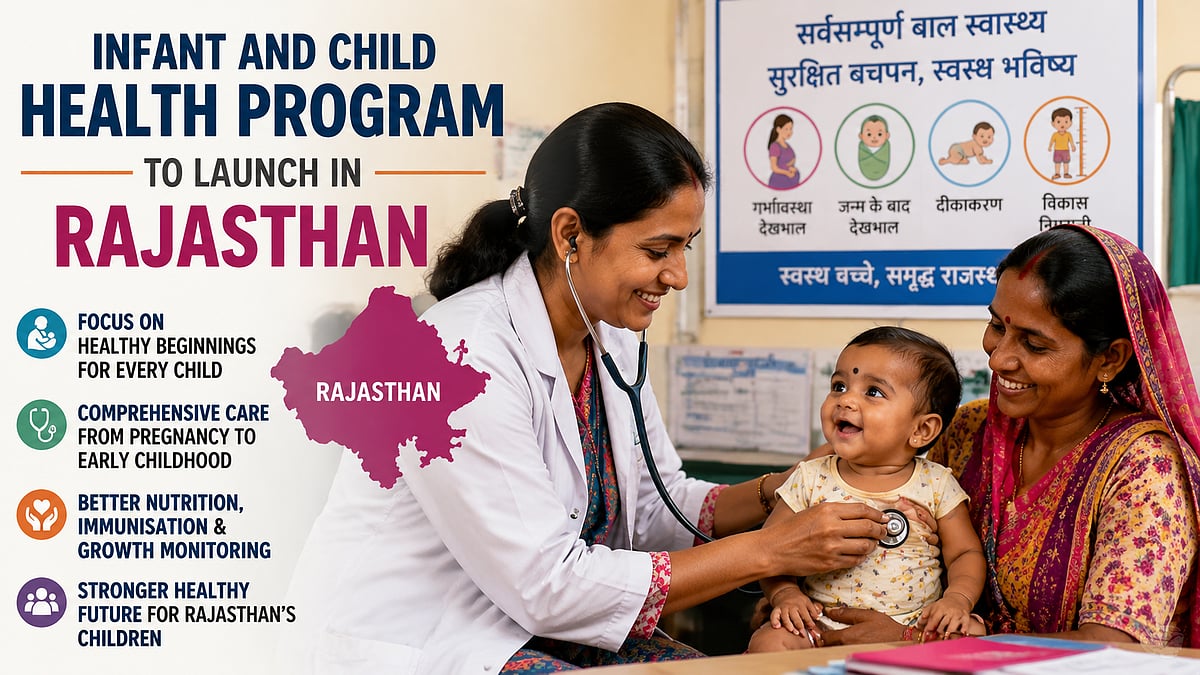
The central government's Comprehensive Infant and Child Health Programme, also known as 'Samekit Shishu Bal Swasthya Karyakram' (SSBSK), is set to be launched on a pilot basis in the Bharatpur and Alwar districts of Rajasthan.
This initiative aims to provide timely and high-quality healthcare services to children up to three years of age, ensuring their healthy development. According to Gayatri Rathore, Principal Secretary of Medical and Health, the programme will monitor the health, nutrition, and development of all children from birth to three years of age, identifying those who need more care or specialised treatment early on.
Under the programme, children will be categorised as either at-risk or normal, depending on their specific needs. At-risk children will receive regular home follow-ups and will be referred for treatment to the nearest health centre or hospital if required. The ultimate goal of the programme is to reduce the mortality rate of children under five years of age by facilitating health workers to identify issues and start treatment before a child's health deteriorates further.
To support this initiative, an app called the Shaishav App has been developed to help ASHA workers examine children and monitor their health status. Through this app, ASHA workers can log health data, identify children requiring immediate attention or medical intervention, and conduct post-hospitalisation follow-ups. Healthcare workers will also receive timely information and alerts directly through the app in case subsequent medical care is needed.
The pilot action plan of SSBSK, its assessment, and the roles of the centre, state, and partner organisations were discussed in a national workshop organised by the Ministry of Health and Family Welfare, Government of India, in Maharashtra recently. This programme is a significant step towards improving the health and wellbeing of young children in India.
The launch of this programme in Rajasthan is expected to have a positive impact on the health outcomes of children in the state. By providing high-quality healthcare services and monitoring the health and development of young children, the programme aims to reduce mortality rates and improve the overall health and wellbeing of children under five years of age.
The success of this pilot programme will be crucial in determining its potential for expansion to other parts of the country. If successful, the programme could be replicated in other states, leading to improved health outcomes for children across India.
In conclusion, the launch of the Comprehensive Infant and Child Health Programme in Rajasthan is a significant development in the country's efforts to improve the health and wellbeing of young children. The programme's focus on early intervention, regular monitoring, and timely treatment has the potential to make a significant impact on reducing mortality rates and improving health outcomes for children under five years of age.
The programme's use of technology, such as the Shaishav App, is also noteworthy. By leveraging technology to support healthcare workers and monitor the health status of children, the programme aims to improve the efficiency and effectiveness of healthcare services.
Overall, the launch of the Comprehensive Infant and Child Health Programme in Rajasthan is a positive step towards improving the health and wellbeing of young children in India. The programme's success will depend on its ability to provide high-quality healthcare services, monitor the health and development of young children, and reduce mortality rates. If successful, the programme could be a model for other states to follow, leading to improved health outcomes for children across the country.
The programme's impact will be closely watched, and its success will have significant implications for the health and wellbeing of children in India. As the programme rolls out in Rajasthan, it is expected to make a positive impact on the lives of thousands of young children, providing them with the healthcare services they need to thrive.
In the long term, the programme's success could lead to a reduction in mortality rates and an improvement in the overall health and wellbeing of children under five years of age. This, in turn, could have a positive impact on the country's demographic trends, leading to a healthier and more productive population.
The programme's focus on early intervention and regular monitoring is also expected to have a positive impact on the health outcomes of children. By identifying health issues early and providing timely treatment, the programme aims to reduce the risk of long-term health problems and improve the overall health and wellbeing of children.
In conclusion, the launch of the Comprehensive Infant and Child Health Programme in Rajasthan is a significant development in the country's efforts to improve the health and wellbeing of young children. The programme's success will depend on its ability to provide high-quality healthcare services, monitor the health and development of young children, and reduce mortality rates. If successful, the programme could be a model for other states to follow, leading to improved health outcomes for children across the country.
Frequently asked questions
What is the main objective of the Comprehensive Infant and Child Health Programme?
The main objective of the programme is to reduce the mortality rate of children under five years of age by providing timely and high-quality healthcare services.
Which districts in Rajasthan will pilot the programme?
The programme will be piloted in the Bharatpur and Alwar districts of Rajasthan.