Trump Rejects Iran's Compensation Plea, Issues Counter-Claims
US-Iran tensions rise as Trump rejects compensation plea, issues counter-claims.
'%3E%3Crect%20width%3D'96'%20height%3D'96'%20fill%3D'%234A235A'%2F%3E%3Ccircle%20cx%3D'30'%20cy%3D'24'%20r%3D'44'%20fill%3D'%23fff'%20opacity%3D'.12'%2F%3E%3Ccircle%20cx%3D'60'%20cy%3D'74'%20r%3D'40'%20fill%3D'%23000'%20opacity%3D'.10'%2F%3E%3C%2Fg%3E%3Cg%20fill%3D'none'%20stroke%3D'%23fff'%20stroke-width%3D'3'%3E%3Ccircle%20cx%3D'48'%20cy%3D'48'%20r%3D'16'%2F%3E%3Cellipse%20cx%3D'48'%20cy%3D'48'%20rx%3D'6.5'%20ry%3D'16'%2F%3E%3Cline%20x1%3D'32'%20y1%3D'42'%20x2%3D'64'%20y2%3D'42'%2F%3E%3Cline%20x1%3D'32'%20y1%3D'54'%20x2%3D'64'%20y2%3D'54'%2F%3E%3C%2Fg%3E%3C%2Fsvg%3E)
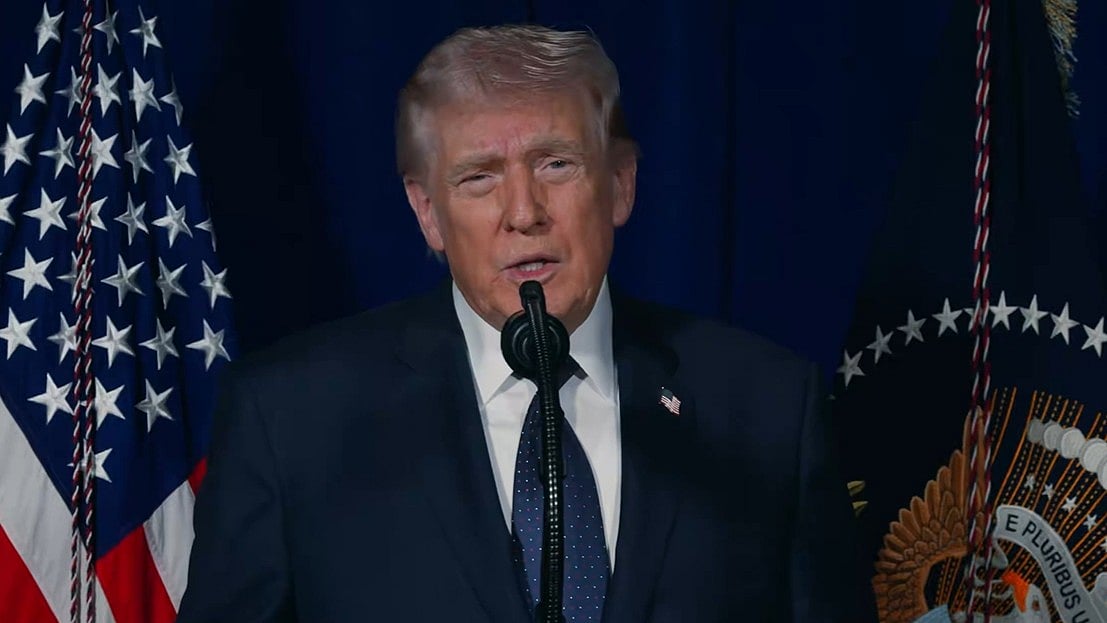
US President Donald Trump has rejected Iran's demand for financial compensation over damages incurred during the US-Israeli military operations in the country. Trump stated that Tehran must instead be held accountable for casualties resulting from its own actions.
The US President took to Truth Social to express his views, noting that Iranian representatives were seeking compensation for damage caused during the last five months of military conflict. Trump described Iran's demand as an 'interesting idea' and indicated that he would present a counter-demand during future diplomatic negotiations.
Trump stated that Tehran must face claims for financial restitution over casualties and injuries caused by attacks linked to Iran, including the 2000 USS Cole bombing and several other regional incidents. He also made specific reference to Iran's late military commander Qassem Soleimani, alleging that Tehran's leadership was involved in conflicts that led to thousands of fatalities.
The US President demanded compensation for the families of protesters who, he alleged, were killed by the Iranian regime over the past five decades. He further claimed that 52,000 people had lost their lives over the course of the last five months. Trump has instructed American negotiators to integrate these conditions into all upcoming diplomatic talks with Tehran.
The counter-demand follows Tehran linking war reparation claims to conditions for a possible reopening of the Strait of Hormuz, alongside the lifting of US sanctions and the end of naval blockades. The Strait of Hormuz is a strategically important waterway, and Iran's ability to disrupt commercial shipping through it has constrained American strategic options.
The situation has triggered mounting concerns across global markets, with sporadic missile and drone attacks severely impacting commercial maritime traffic. Although Trump has repeatedly claimed that the maritime corridor was open, commercial shipping activity across the region remained heavily disrupted.
The US-Iran tensions have significant implications for global stability and security. The conflict has the potential to escalate into a full-scale war, which would have devastating consequences for the region and the world. The international community is watching the situation closely, and diplomatic efforts are underway to resolve the crisis peacefully.
The US-Iran conflict is a complex issue with deep historical roots. The two countries have been at odds for decades, with tensions escalating in recent years. The conflict has significant implications for the region and the world, and a peaceful resolution is essential to prevent further escalation.
In conclusion, the US-Iran tensions have risen significantly, with Trump rejecting Iran's compensation plea and issuing counter-claims. The situation has significant implications for global stability and security, and diplomatic efforts are underway to resolve the crisis peacefully.
Frequently asked questions
What is the current state of US-Iran relations?
The US-Iran relations are currently tense, with the US rejecting Iran's compensation plea and issuing counter-claims.
What is the significance of the Strait of Hormuz?
The Strait of Hormuz is a strategically important waterway, and Iran's ability to disrupt commercial shipping through it has constrained American strategic options.