CJI Surya Kant Praises Justice Sanjay Karol's Empathy, Leadership
Justice Sanjay Karol retires, CJI hails his commitment to litigants, empathy and leadership.
'%3E%3Crect%20width%3D'96'%20height%3D'96'%20fill%3D'%231A5276'%2F%3E%3Ccircle%20cx%3D'30'%20cy%3D'24'%20r%3D'44'%20fill%3D'%23fff'%20opacity%3D'.12'%2F%3E%3Ccircle%20cx%3D'60'%20cy%3D'74'%20r%3D'40'%20fill%3D'%23000'%20opacity%3D'.10'%2F%3E%3C%2Fg%3E%3Cg%20fill%3D'%23fff'%3E%3Cpath%20d%3D'M31%2041%20L48%2031%20L65%2041%20Z'%2F%3E%3Crect%20x%3D'33'%20y%3D'43'%20width%3D'4'%20height%3D'17'%2F%3E%3Crect%20x%3D'41'%20y%3D'43'%20width%3D'4'%20height%3D'17'%2F%3E%3Crect%20x%3D'51'%20y%3D'43'%20width%3D'4'%20height%3D'17'%2F%3E%3Crect%20x%3D'59'%20y%3D'43'%20width%3D'4'%20height%3D'17'%2F%3E%3Crect%20x%3D'30'%20y%3D'62'%20width%3D'36'%20height%3D'4'%20rx%3D'1'%2F%3E%3C%2Fg%3E%3C%2Fsvg%3E)
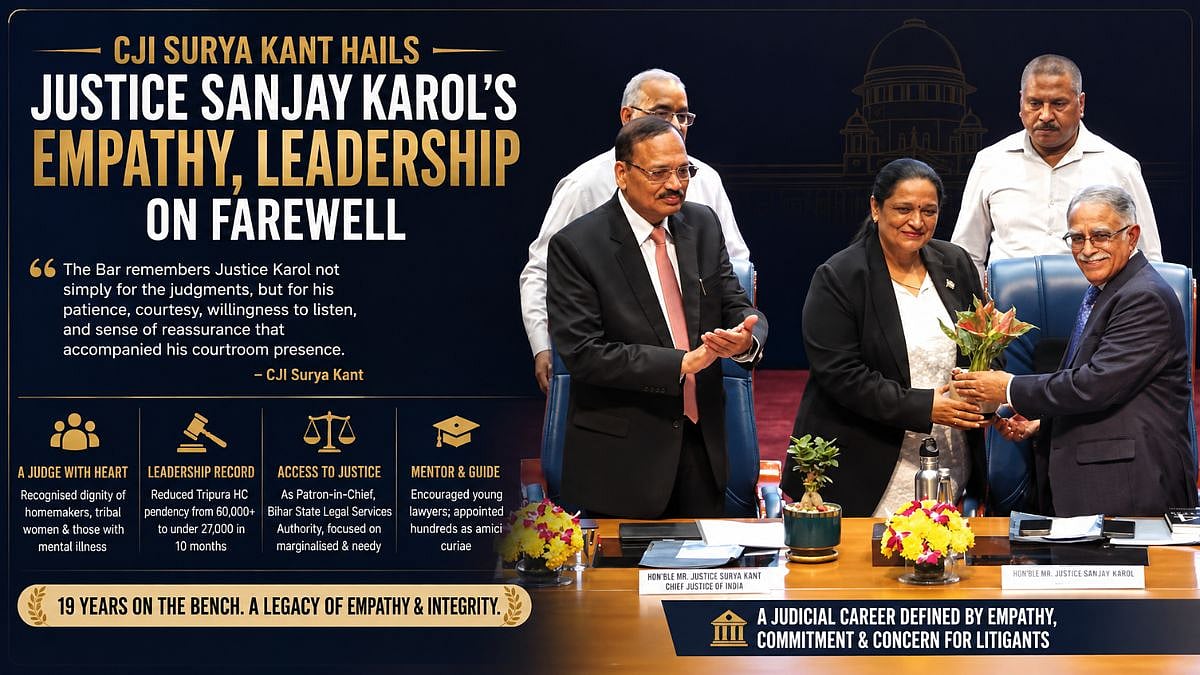
Chief Justice of India Surya Kant paid tribute to Justice Sanjay Karol on his last day in office, praising his judicial career marked by empathy, patience, and commitment to the law and litigants.
Justice Karol's long professional association with the Chief Justice of India began when he was a member of the Bar, later as a fellow advocate general, then as a colleague in Himachal Pradesh, and finally as a fellow Supreme Court judge.
The Supreme Court Bar Association (SCBA) held a farewell function in honour of Justice Sanjay Karol at the Supreme Court, where the Chief Justice of India recalled his impressive journey and the affection with which it has been spoken of.
The Chief Justice of India noted that Justice Karol's impact went beyond judgments and legal reasoning, and that his willingness to listen and recognise the human realities behind cases was a quality repeatedly associated with him.
Justice Karol's ability to listen was also reflected in his judicial work, where he gave legal visibility to overlooked realities such as the unpaid labour of a homemaker, the dignity of a tribal woman, or the needs of those living with mental illness.
The Chief Justice of India also highlighted Justice Karol's administrative record, particularly his tenure as Chief Justice of the Tripura High Court, where he brought pendency down from over 60,000 cases to under 27,000 within 10 months.
Justice Karol's work consistently placed dignity and access to justice at the centre of the judicial process, showing a judicial philosophy that treated the law as not isolated from the people it affected.
As Justice Karol retires, his legacy will be remembered for his commitment to litigants, empathy, and leadership, which have left a lasting impact on the judicial system.
The farewell function was a testament to the respect and admiration that Justice Karol has earned from his colleagues and the Bar, and his contributions to the judiciary will be deeply missed.
In the context of the Indian judiciary, Justice Karol's approach to justice has been a significant factor in shaping the judicial philosophy of the Supreme Court, and his commitment to dignity and access to justice has inspired many.
The significance of Justice Karol's retirement lies in the fact that it marks the end of an era, and his legacy will continue to inspire and guide future generations of judges and lawyers.
In conclusion, Justice Sanjay Karol's retirement is a significant event in the Indian judiciary, and his contributions to the judicial system will be remembered for years to come.