India to Introduce Plastic Currency Notes Soon
Polymer notes to be introduced, but launch date not decided.
'%3E%3Crect%20width%3D'96'%20height%3D'96'%20fill%3D'%231A5276'%2F%3E%3Ccircle%20cx%3D'30'%20cy%3D'24'%20r%3D'44'%20fill%3D'%23fff'%20opacity%3D'.12'%2F%3E%3Ccircle%20cx%3D'60'%20cy%3D'74'%20r%3D'40'%20fill%3D'%23000'%20opacity%3D'.10'%2F%3E%3C%2Fg%3E%3Cg%20fill%3D'%23fff'%3E%3Cpath%20d%3D'M31%2041%20L48%2031%20L65%2041%20Z'%2F%3E%3Crect%20x%3D'33'%20y%3D'43'%20width%3D'4'%20height%3D'17'%2F%3E%3Crect%20x%3D'41'%20y%3D'43'%20width%3D'4'%20height%3D'17'%2F%3E%3Crect%20x%3D'51'%20y%3D'43'%20width%3D'4'%20height%3D'17'%2F%3E%3Crect%20x%3D'59'%20y%3D'43'%20width%3D'4'%20height%3D'17'%2F%3E%3Crect%20x%3D'30'%20y%3D'62'%20width%3D'36'%20height%3D'4'%20rx%3D'1'%2F%3E%3C%2Fg%3E%3C%2Fsvg%3E)
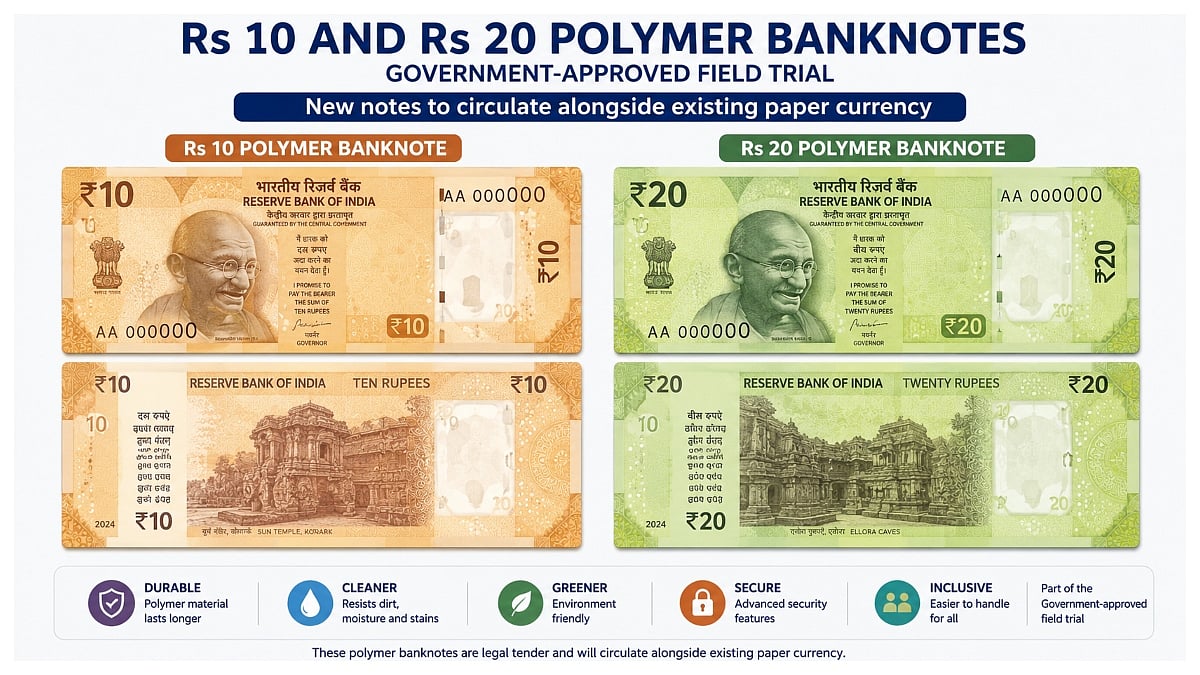
The Indian government has approved a proposal to introduce polymer currency notes, with the Reserve Bank of India (RBI) planning to introduce one billion pieces each of Rs 10 and Rs 20 polymer banknotes for field trials.
The decision was announced by Finance Minister Nirmala Sitharaman in response to a question in the Rajya Sabha. The notes will be introduced alongside the existing paper notes and will not immediately replace them.
The RBI plans to test the performance of the polymer notes under India's climate conditions and within the country's currency-handling infrastructure. The results of the trial will be studied before deciding whether to expand the programme or make changes to the notes.
The introduction of polymer notes is expected to take place at the beginning of the next financial year, according to RBI Governor Sanjay Malhotra. However, the exact launch date has not been decided, as procurement is still at an early stage.
Polymer banknotes are made from a flexible synthetic plastic material and have several advantages over traditional paper notes. They can last two to four times longer and are more resistant to water, dirt, and damage. They can also include transparent windows and advanced security features, making counterfeiting more difficult.
Several countries, including Australia, New Zealand, and Canada, have already introduced polymer currency notes. The use of polymer notes is expected to increase the durability and security of Indian currency.
The introduction of polymer notes is part of the RBI's efforts to improve the circulation of currency and reduce the need for frequent replacement of worn-out notes. With the circulation of cash topping ₹42 trillion, despite the growth of digital payments, the RBI is exploring ways to make currency more durable and secure.
The field trials of the polymer notes will help the RBI to assess their performance and make any necessary adjustments before introducing them on a larger scale. The introduction of polymer notes is expected to be a significant step forward in the management of Indian currency.
The RBI's decision to introduce polymer notes has been welcomed by experts, who believe that it will help to reduce the cost of replacing worn-out notes and improve the overall efficiency of the currency management system.
The introduction of polymer notes is a significant development in the Indian currency management system, and it will be interesting to see how it unfolds in the coming months.
In conclusion, the introduction of polymer currency notes in India is a step in the right direction, and it is expected to bring several benefits, including increased durability and security of currency. The field trials of the polymer notes will help the RBI to assess their performance and make any necessary adjustments before introducing them on a larger scale.
Frequently asked questions
What are polymer currency notes made of?
Polymer currency notes are made from a flexible synthetic plastic material.
When will polymer currency notes be introduced in India?
The exact launch date has not been decided, but it is expected to take place at the beginning of the next financial year.