Bombay HC Orders Maharashtra Doctors To End Strike
Maharashtra doctors must end strike, Bombay HC directs. Patients' lives at risk.
'%3E%3Crect%20width%3D'96'%20height%3D'96'%20fill%3D'%23B3261E'%2F%3E%3Ccircle%20cx%3D'30'%20cy%3D'24'%20r%3D'44'%20fill%3D'%23fff'%20opacity%3D'.12'%2F%3E%3Ccircle%20cx%3D'60'%20cy%3D'74'%20r%3D'40'%20fill%3D'%23000'%20opacity%3D'.10'%2F%3E%3C%2Fg%3E%3Cg%20fill%3D'%23fff'%3E%3Crect%20x%3D'29'%20y%3D'49'%20width%3D'8'%20height%3D'19'%20rx%3D'1'%2F%3E%3Crect%20x%3D'39'%20y%3D'40'%20width%3D'9'%20height%3D'28'%20rx%3D'1'%2F%3E%3Crect%20x%3D'50'%20y%3D'45'%20width%3D'8'%20height%3D'23'%20rx%3D'1'%2F%3E%3Crect%20x%3D'60'%20y%3D'53'%20width%3D'7'%20height%3D'15'%20rx%3D'1'%2F%3E%3Crect%20x%3D'41'%20y%3D'34'%20width%3D'5'%20height%3D'6'%2F%3E%3C%2Fg%3E%3C%2Fsvg%3E)
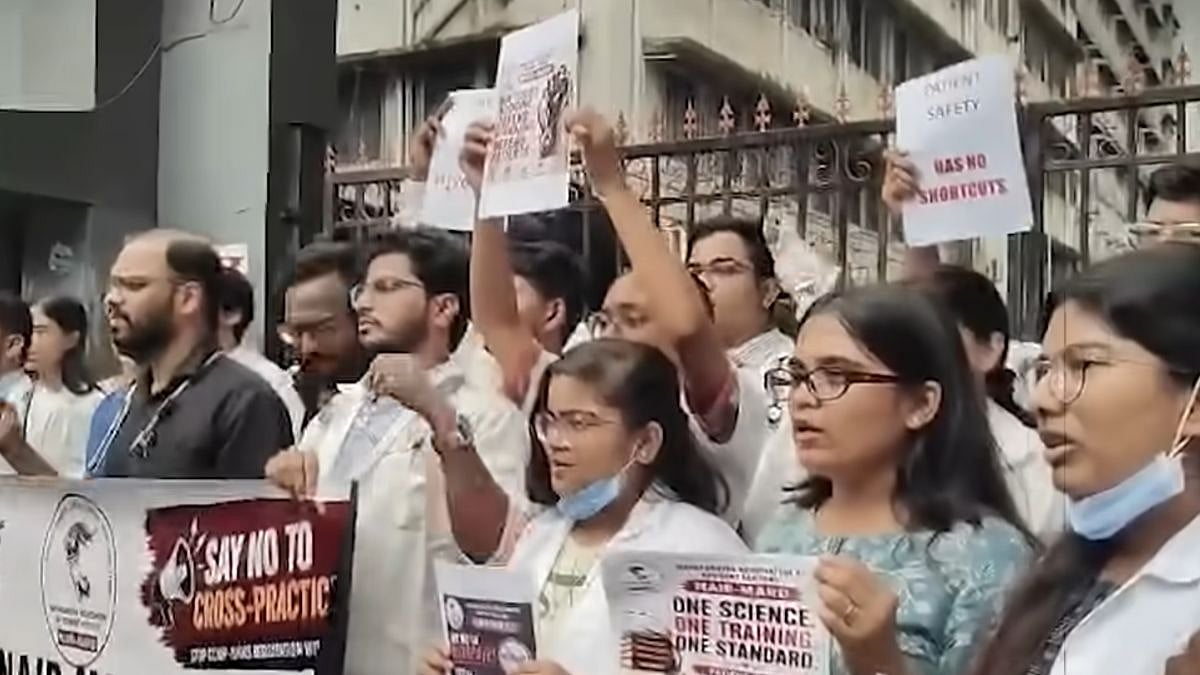
The Bombay High Court on Thursday ordered resident doctors across Maharashtra to immediately call off their strike against the state government's decision to register certain homoeopathy practitioners with the Maharashtra Medical Council (MMC).
The court took suo motu cognisance of the strike, expressing serious concern over its impact on patients. A bench of Acting Chief Justice Ravindra Ghuge and Justice Gautam Ankhad questioned how doctors could continue their agitation at the cost of patients' lives.
The court warned that salaries of protesting doctors could be stopped if they failed to resume work immediately. Following the court's observations, the Maharashtra Association of Resident Doctors (MARD) assured the bench that the strike would be withdrawn.
The bench asked why doctors were resorting to a strike at the cost of patients' lives, and whether they could bring back dead patients to life if they succeeded in their agitation. The court decided to keep the suo motu petition pending and said it intends to lay down a law to ensure that doctors do not resort to strikes in future.
The court observed that while every citizen has a legal right to protest, it cannot be exercised at the cost of patients' lives. The bench said it was worried about the health of thousands of patients and the residents of Maharashtra, and did not want a single person to lose their life because of the strike.
The court appointed senior advocate Vineet Naik and advocate Amogh Singh as amicus curiae to assist it in framing appropriate directions on the issue. The matter has been posted for further hearing on September 8.
The bench also noted that doctors had indicated they may suspend Intensive Care Unit (ICU) services if the dispute with the government continued. The court observed that if there is a strike in a factory, the worst consequence is financial loss, but in the case of doctors, if patients die, they cannot bring them back to life.
Advocate General Milind Sathe informed the court that a division bench had last year refused to stay the registration of eligible CCMP-qualified homoeopaths with the MMC, and that the main petition challenging the policy is still pending. The petition is scheduled to be listed for hearing later this month.
Sathe also submitted that the government had appealed to both the Indian Medical Association (IMA) and MARD to withdraw the strike. Referring to a 2017 High Court judgment in a public interest litigation, he said the court had then noted that at least 50 patients had died during an earlier resident doctors' strike and had issued directions against continuation of such protests.
The Bombay High Court's decision is significant, as it highlights the need to balance the right to protest with the need to protect patients' lives. The court's intention to lay down a law to prevent doctors from resorting to strikes in future is a welcome move, as it will help ensure that patients receive uninterrupted medical care.
In conclusion, the Bombay High Court's order to Maharashtra doctors to end their strike is a crucial step in protecting patients' lives. The court's decision will have far-reaching implications for the medical community and the state government, and will help ensure that patients receive the medical care they need without interruption.
The Maharashtra government's decision to register certain homoeopathy practitioners with the MMC has been a contentious issue, with the Indian Medical Association and MARD opposing the move. However, the Bombay High Court's decision makes it clear that patients' lives must take precedence over any dispute between doctors and the government.
The court's observation that doctors cannot bring back dead patients to life if they succeed in their agitation is a stark reminder of the consequences of a doctors' strike. The court's decision will help prevent such tragedies from occurring in the future, and will ensure that patients receive the medical care they need without interruption.
Overall, the Bombay High Court's order to Maharashtra doctors to end their strike is a significant development that will have far-reaching implications for the medical community and the state government. The court's decision will help protect patients' lives and ensure that they receive uninterrupted medical care.
The Bombay High Court's decision is a welcome move, as it will help prevent doctors from resorting to strikes in future. The court's intention to lay down a law to prevent such strikes is a crucial step in protecting patients' lives, and will help ensure that patients receive the medical care they need without interruption.
In the end, the Bombay High Court's order to Maharashtra doctors to end their strike is a significant development that will have far-reaching implications for the medical community and the state government. The court's decision will help protect patients' lives and ensure that they receive uninterrupted medical care, and will help prevent doctors from resorting to strikes in future.
Frequently asked questions
Why did the Bombay High Court order Maharashtra doctors to end their strike?
The court ordered the doctors to end their strike to protect patients' lives, as the strike was having a significant impact on medical care.
What will happen if doctors fail to resume work immediately?
The court warned that salaries of protesting doctors could be stopped if they fail to resume work immediately.