Bees Inspire Smarter Solar Panel Design
Bees' honeycombs inspire new solar panels. Efficient design improves energy output.
'%3E%3Crect%20width%3D'96'%20height%3D'96'%20fill%3D'%23B3261E'%2F%3E%3Ccircle%20cx%3D'30'%20cy%3D'24'%20r%3D'44'%20fill%3D'%23fff'%20opacity%3D'.12'%2F%3E%3Ccircle%20cx%3D'60'%20cy%3D'74'%20r%3D'40'%20fill%3D'%23000'%20opacity%3D'.10'%2F%3E%3C%2Fg%3E%3Cg%20fill%3D'%23fff'%3E%3Crect%20x%3D'29'%20y%3D'49'%20width%3D'8'%20height%3D'19'%20rx%3D'1'%2F%3E%3Crect%20x%3D'39'%20y%3D'40'%20width%3D'9'%20height%3D'28'%20rx%3D'1'%2F%3E%3Crect%20x%3D'50'%20y%3D'45'%20width%3D'8'%20height%3D'23'%20rx%3D'1'%2F%3E%3Crect%20x%3D'60'%20y%3D'53'%20width%3D'7'%20height%3D'15'%20rx%3D'1'%2F%3E%3Crect%20x%3D'41'%20y%3D'34'%20width%3D'5'%20height%3D'6'%2F%3E%3C%2Fg%3E%3C%2Fsvg%3E)
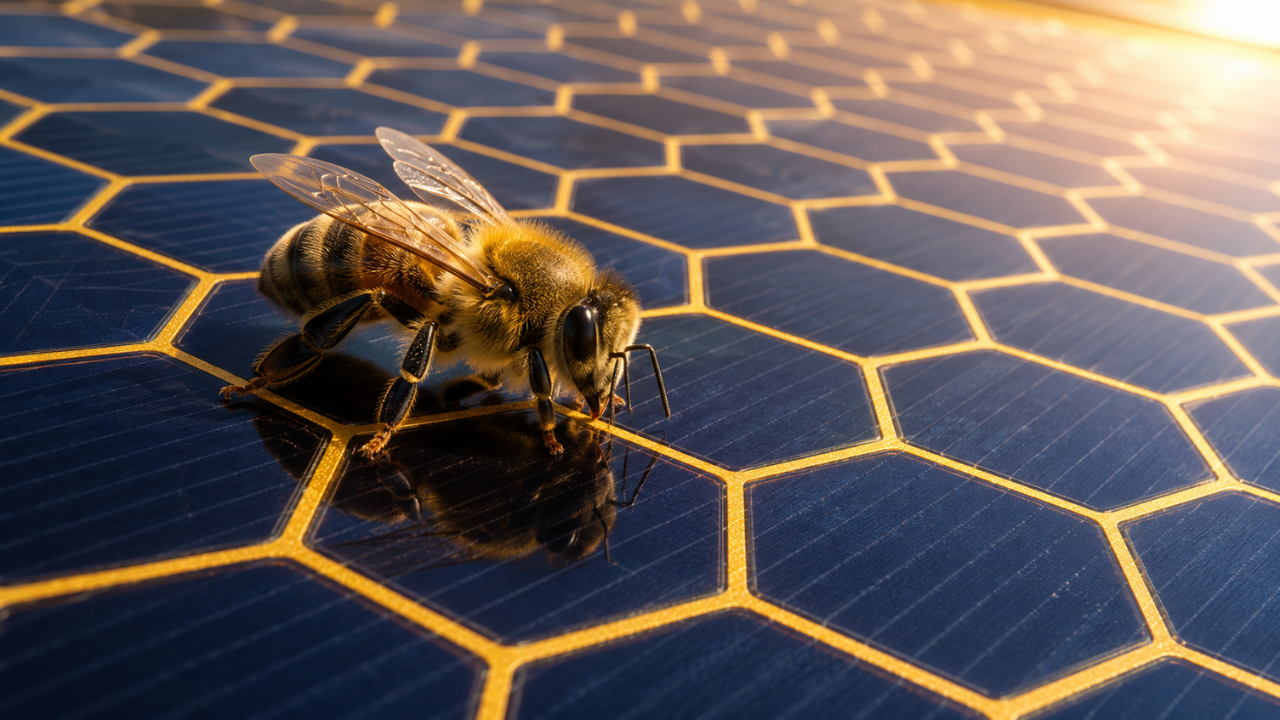
A team of researchers has developed a smarter solar panel design inspired by the honeycombs built by bees. The unique structure of the honeycombs, which have been perfected by bees over millions of years, has been found to have a significant impact on the efficiency of solar panels.
The researchers observed that the hexagonal pattern of the honeycombs allows for maximum exposure to sunlight while minimizing the amount of material used. This design principle has been applied to the development of new solar panels, which have shown improved energy output.
The honeycomb structure has been a subject of interest for scientists and engineers due to its unique properties. The hexagonal cells in the honeycomb provide exceptional strength while using minimal material. This design has been perfected by bees over millions of years, and it has now inspired a new generation of solar panels.
The new solar panel design uses a similar hexagonal pattern to increase the surface area exposed to sunlight. This allows for more efficient energy absorption and conversion, resulting in higher energy output. The design also reduces the amount of material used, making it more cost-effective and environmentally friendly.
The development of smarter solar panels is crucial for the transition to renewable energy sources. As the world shifts away from fossil fuels, the demand for efficient and sustainable energy solutions is increasing. The new solar panel design inspired by bees' honeycombs is a significant step towards achieving this goal.
The researchers behind the project believe that the unique design principle of the honeycombs can be applied to other fields as well. The hexagonal pattern can be used to improve the efficiency of various systems, from energy storage to aerospace engineering.
In conclusion, the smarter solar panel design inspired by bees' honeycombs is a remarkable example of how nature can inspire innovation. The unique structure of the honeycombs has been perfected over millions of years, and it has now been applied to the development of more efficient solar panels.
The significance of this development extends beyond the field of solar energy. It highlights the importance of biomimicry, the practice of using nature as a source of inspiration for innovation. By studying the natural world, scientists and engineers can develop new solutions to complex problems, leading to a more sustainable and efficient future.
As the world continues to transition to renewable energy sources, the development of smarter solar panels will play a crucial role. The new design inspired by bees' honeycombs is a significant step towards achieving this goal, and it has the potential to make a substantial impact on the environment and the economy.