Delhi CM: India Must Create AI, Not Just Use It
Delhi CM Rekha Gupta urges graduates to contribute to India's AI development. She emphasizes the need for India to shift from consuming to producing AI technology.
'%3E%3Crect%20width%3D'96'%20height%3D'96'%20fill%3D'%231A5276'%2F%3E%3Ccircle%20cx%3D'30'%20cy%3D'24'%20r%3D'44'%20fill%3D'%23fff'%20opacity%3D'.12'%2F%3E%3Ccircle%20cx%3D'60'%20cy%3D'74'%20r%3D'40'%20fill%3D'%23000'%20opacity%3D'.10'%2F%3E%3C%2Fg%3E%3Cg%20fill%3D'%23fff'%3E%3Cpath%20d%3D'M31%2041%20L48%2031%20L65%2041%20Z'%2F%3E%3Crect%20x%3D'33'%20y%3D'43'%20width%3D'4'%20height%3D'17'%2F%3E%3Crect%20x%3D'41'%20y%3D'43'%20width%3D'4'%20height%3D'17'%2F%3E%3Crect%20x%3D'51'%20y%3D'43'%20width%3D'4'%20height%3D'17'%2F%3E%3Crect%20x%3D'59'%20y%3D'43'%20width%3D'4'%20height%3D'17'%2F%3E%3Crect%20x%3D'30'%20y%3D'62'%20width%3D'36'%20height%3D'4'%20rx%3D'1'%2F%3E%3C%2Fg%3E%3C%2Fsvg%3E)
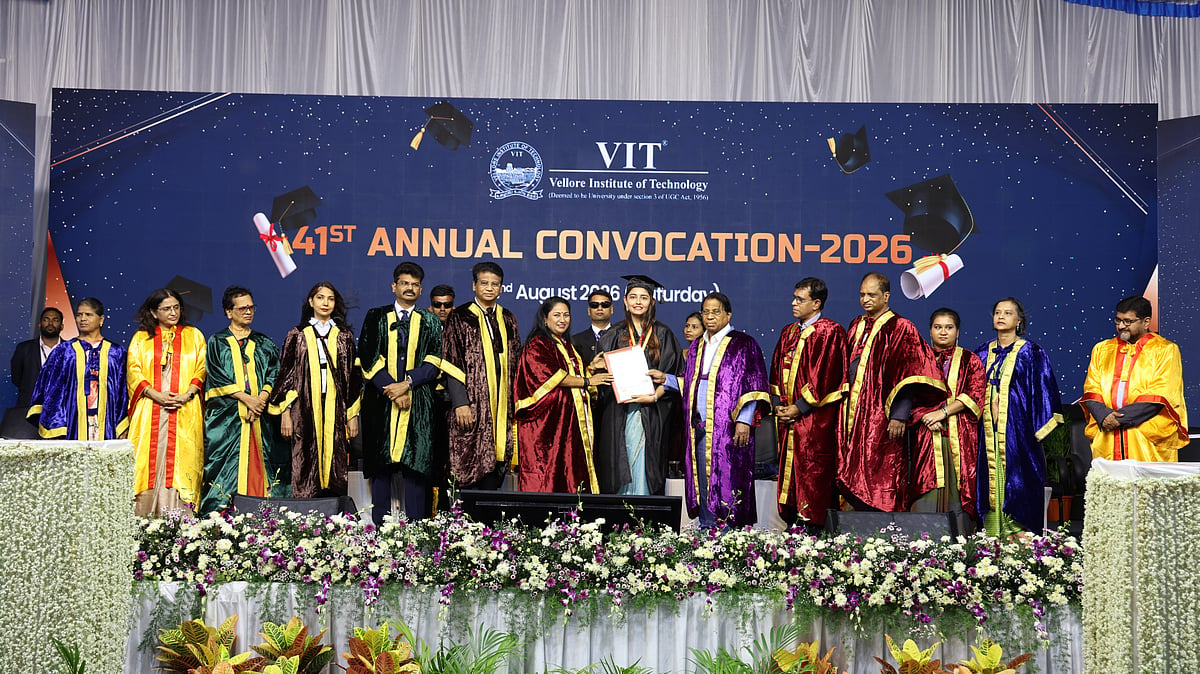
Delhi Chief Minister Rekha Gupta stated that India needs to transform itself into a creator of artificial intelligence rather than just a consumer of it. She made this statement while speaking as the chief guest at the 41st convocation of VIT University, Vellore.
Gupta conferred degree certificates on graduating students during the ceremony, which was presided over by VIT Chancellor G. Viswanathan. She emphasized the importance of collaboration between the government and graduates to solve pressing societal problems. Gupta cited Delhi's experience in finding solutions to challenges such as pollution, traffic congestion, and waste management by partnering with IIT institutions.
She urged the graduating students to take up similar roles once they enter the workforce, contributing to solutions for their cities and to innovation for the nation. Gupta encouraged the students to build India's own AI, rather than just being users of artificial intelligence. She pointed to the substantial investments made by the Union government under Prime Minister Narendra Modi through the 'India AI Mission,' which spans semiconductors, computing infrastructure, defence, space, drones, robotics, and biotechnology.
The aim, according to Gupta, is for India to move beyond consuming AI technology to producing it. This shift, she said, would be one of the greatest contributions graduates could make to their state and country. Gupta also spoke about resilience, telling students not to fear failure or let it cause stress, but instead to identify its causes, understand them, and work through them with determination.
In his address, VIT Chancellor G. Viswanathan highlighted the need for India to increase its Gross Enrolment Ratio in higher education, which currently stands at around 30 percent. The Union government's new education policy aims to raise this ratio to 50 percent. Viswanathan noted that India must compete with other Asian nations on this front, citing enrolment ratios of 90 percent in South Korea, 60 percent in Japan, over 60 percent in China, 40 percent in Malaysia, and 45 percent in Thailand.
Viswanathan also emphasized the importance of ensuring access to higher education for students from poor and middle-class backgrounds, which he said is a shared duty of state and central governments. He highlighted a stark imbalance in India's education system, with over 50 lakh engineering seats but a significant lag in medical education.
Gupta's emphasis on India's need to shift from consuming to producing AI technology is in line with the Union government's goals, which include 'Make in India,' 'Invest in India,' 'Design in India,' and 'Brand in India.' The world has recognized the talent of Indian engineers, but it must now also witness the strength of Indian technology itself.
The 'India AI Mission' is a significant step towards achieving this goal, with investments in semiconductors, computing infrastructure, defence, space, drones, robotics, and biotechnology. The mission aims to promote the development of AI in India, with a focus on creating a robust ecosystem for AI research, development, and deployment.
In conclusion, Gupta's statement highlights the need for India to take a proactive approach to AI development, rather than just being a consumer of AI technology. This shift has the potential to contribute significantly to India's growth and development, and it is essential for the country to invest in AI research, development, and deployment to achieve its goals.
The graduating students, with their skills and knowledge, have a critical role to play in this shift. By contributing to AI development and innovation, they can help India move beyond consuming AI technology to producing it, which would be a significant step towards achieving the country's goals.
As India continues to grow and develop, it is essential for the country to focus on creating a robust ecosystem for AI research, development, and deployment. This would enable India to take advantage of the opportunities presented by AI and to address the challenges associated with its development and deployment.
In the end, Gupta's statement emphasizes the need for India to take a proactive approach to AI development, with a focus on creating a robust ecosystem for AI research, development, and deployment. This shift has the potential to contribute significantly to India's growth and development, and it is essential for the country to invest in AI research, development, and deployment to achieve its goals.
Frequently asked questions
What is the 'India AI Mission'
The 'India AI Mission' is a initiative by the Union government to promote the development of AI in India, with a focus on creating a robust ecosystem for AI research, development, and deployment.
What is the current Gross Enrolment Ratio in higher education in India
The current Gross Enrolment Ratio in higher education in India is around 30 percent, which the Union government's new education policy aims to raise to 50 percent.