Railways Launch 10-Day Water Cooler Inspection Drive
Railways inspect water coolers after E. coli found. Safety drive starts now.
'%3E%3Crect%20width%3D'96'%20height%3D'96'%20fill%3D'%23B3261E'%2F%3E%3Ccircle%20cx%3D'30'%20cy%3D'24'%20r%3D'44'%20fill%3D'%23fff'%20opacity%3D'.12'%2F%3E%3Ccircle%20cx%3D'60'%20cy%3D'74'%20r%3D'40'%20fill%3D'%23000'%20opacity%3D'.10'%2F%3E%3C%2Fg%3E%3Cg%20fill%3D'%23fff'%3E%3Crect%20x%3D'29'%20y%3D'49'%20width%3D'8'%20height%3D'19'%20rx%3D'1'%2F%3E%3Crect%20x%3D'39'%20y%3D'40'%20width%3D'9'%20height%3D'28'%20rx%3D'1'%2F%3E%3Crect%20x%3D'50'%20y%3D'45'%20width%3D'8'%20height%3D'23'%20rx%3D'1'%2F%3E%3Crect%20x%3D'60'%20y%3D'53'%20width%3D'7'%20height%3D'15'%20rx%3D'1'%2F%3E%3Crect%20x%3D'41'%20y%3D'34'%20width%3D'5'%20height%3D'6'%2F%3E%3C%2Fg%3E%3C%2Fsvg%3E)
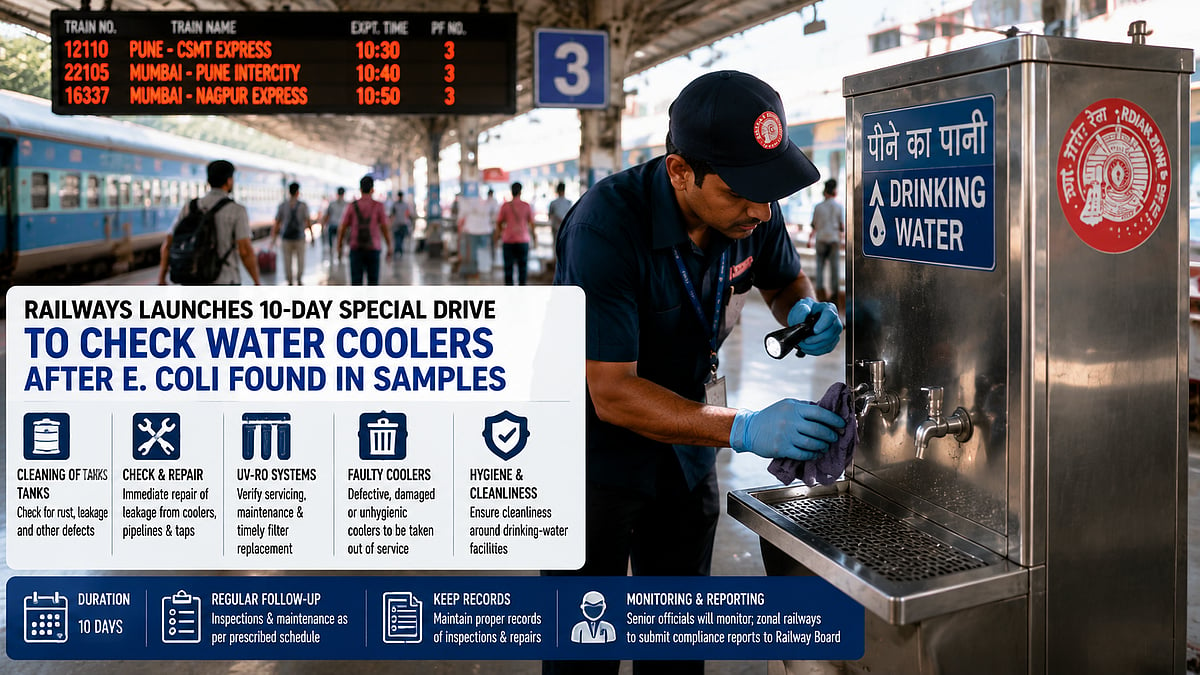
The Railway Board has launched a 10-day special inspection drive to check water coolers and UV-RO purification systems across the country. This move comes after a CAG audit found E. coli bacteria in drinking-water samples from water coolers at railway stations.
The CAG audit had found E. coli in samples from four Central Railway stations: Chhatrapati Shivaji Maharaj Terminus, Bhiwandi Road, Kalyan, and Lonavala. This raised concerns over the quality of drinking water available to passengers.
As part of the inspection drive, zonal railways have been asked to conduct a comprehensive inspection of water coolers. Officials will thoroughly clean water tanks and check them for rust, leakage, and other defects. The condition of lids and gaskets will also be examined to ensure that tanks remain properly sealed.
Any leakage from coolers, pipelines, or taps is to be repaired immediately. The functioning of UV and RO water purification systems will also be checked. Officials have been instructed to verify regular servicing, maintenance, and overhauling of the systems and ensure that filters are replaced within the prescribed period.
Defective, damaged, or unhygienic coolers will be taken out of service immediately. If a cooler is found to be beyond repair or in a severely deteriorated condition, it will be replaced with a new unit. The cleanliness of areas surrounding drinking-water facilities will also be checked, with officials instructed to ensure full compliance with hygiene standards.
The 10-day campaign will be followed by regular inspections and maintenance according to the prescribed schedule. Railways have also been asked to maintain proper records of inspections and repairs. Senior officials will monitor the implementation of the drive, while zonal railways have been directed to submit compliance reports to the Railway Board after completing the exercise.
The move comes as the Railways face increased scrutiny over basic passenger amenities following the CAG findings. The CAG's Report on Passenger Amenities and Sanitation at Railway Stations had flagged deficiencies in drinking-water quality and testing. The audit found that prescribed periodic inspections and water-quality tests were not consistently carried out at several stations.
The special inspection drive is a step towards ensuring the quality of drinking water available to passengers. With the Railways taking proactive measures to address the issue, passengers can expect improved amenities at railway stations.
The inspection drive is significant, given the large number of passengers who use railway stations every day. The presence of E. coli bacteria in drinking-water samples is a serious concern, and the Railways' move to inspect and maintain water coolers is a welcome step.
In conclusion, the Railway Board's decision to launch a 10-day special inspection drive to check water coolers and UV-RO purification systems is a positive move towards ensuring the quality of drinking water available to passengers. The drive is expected to improve passenger amenities at railway stations and address concerns over drinking-water quality.
The inspection drive will help to identify and rectify defects in water coolers and purification systems, ensuring that passengers have access to safe and clean drinking water. With the Railways taking proactive measures to address the issue, passengers can expect improved amenities at railway stations.
The move is also expected to improve the overall passenger experience at railway stations. With clean and safe drinking water available, passengers can expect a more comfortable and convenient travel experience.
In the long run, the inspection drive is expected to have a positive impact on the Railways' reputation and passenger satisfaction. By taking proactive measures to address concerns over drinking-water quality, the Railways can improve its image and provide better services to passengers.
Overall, the Railway Board's decision to launch a 10-day special inspection drive to check water coolers and UV-RO purification systems is a step in the right direction. The drive is expected to improve passenger amenities at railway stations and address concerns over drinking-water quality, making it a welcome move for passengers who use railway stations every day.
The inspection drive will also help to ensure that railway stations are clean and hygienic, providing a safe and comfortable environment for passengers. With the Railways taking proactive measures to address concerns over drinking-water quality, passengers can expect improved amenities and a better travel experience.
In conclusion, the Railway Board's decision to launch a 10-day special inspection drive to check water coolers and UV-RO purification systems is a positive move towards ensuring the quality of drinking water available to passengers. The drive is expected to improve passenger amenities at railway stations and address concerns over drinking-water quality, making it a welcome move for passengers who use railway stations every day.
Frequently asked questions
Why is the Railway Board launching a 10-day water cooler inspection drive?
The Railway Board is launching a 10-day water cooler inspection drive after a CAG audit found E. coli bacteria in drinking-water samples from water coolers at railway stations.
What will be checked during the inspection drive?
During the inspection drive, officials will check water coolers, UV-RO purification systems, and the cleanliness of areas surrounding drinking-water facilities.