India Tops APAC Data Centre Market Outside China
India's live IT capacity quadrupled, strong pipeline with 1.3GW under construction, and 3.2GW of projects secured land, power, and permits.
'%3E%3Crect%20width%3D'96'%20height%3D'96'%20fill%3D'%23B3261E'%2F%3E%3Ccircle%20cx%3D'30'%20cy%3D'24'%20r%3D'44'%20fill%3D'%23fff'%20opacity%3D'.12'%2F%3E%3Ccircle%20cx%3D'60'%20cy%3D'74'%20r%3D'40'%20fill%3D'%23000'%20opacity%3D'.10'%2F%3E%3C%2Fg%3E%3Cg%20fill%3D'%23fff'%3E%3Crect%20x%3D'29'%20y%3D'49'%20width%3D'8'%20height%3D'19'%20rx%3D'1'%2F%3E%3Crect%20x%3D'39'%20y%3D'40'%20width%3D'9'%20height%3D'28'%20rx%3D'1'%2F%3E%3Crect%20x%3D'50'%20y%3D'45'%20width%3D'8'%20height%3D'23'%20rx%3D'1'%2F%3E%3Crect%20x%3D'60'%20y%3D'53'%20width%3D'7'%20height%3D'15'%20rx%3D'1'%2F%3E%3Crect%20x%3D'41'%20y%3D'34'%20width%3D'5'%20height%3D'6'%2F%3E%3C%2Fg%3E%3C%2Fsvg%3E)
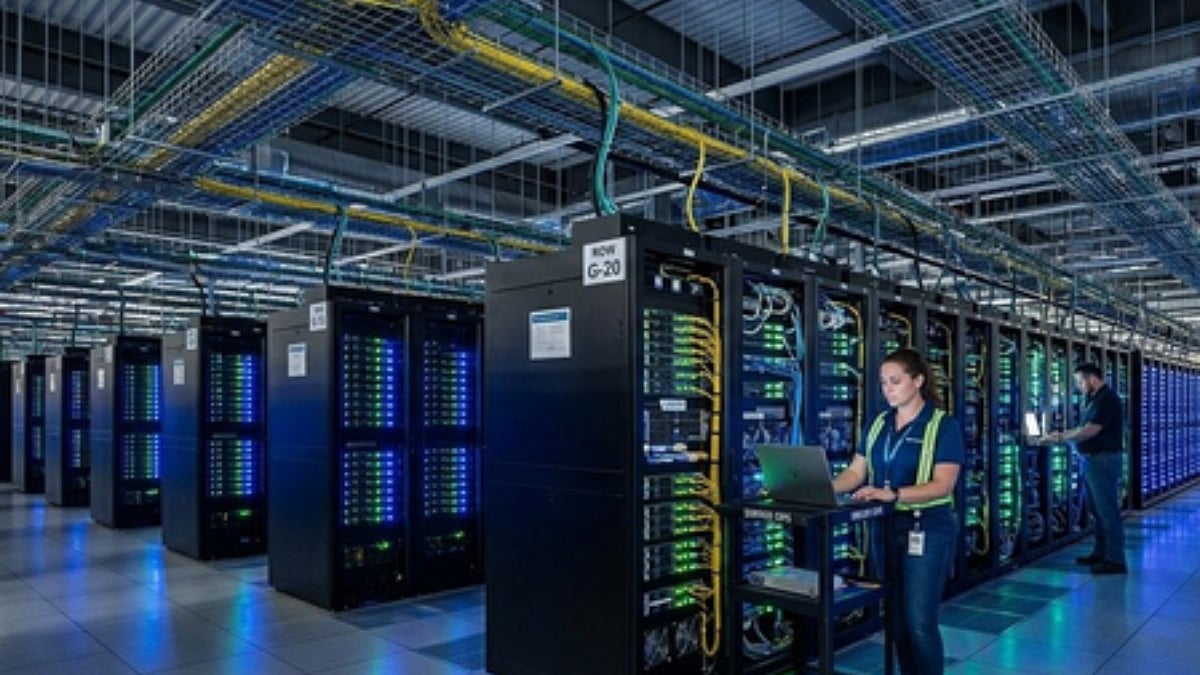
India has emerged as the top data centre market in the Asia-Pacific region, outside China, with its live IT capacity quadrupling over the past six years to 1.7 GW. This growth is attributed to the country's strong pipeline, with 1.3GW under construction and another 3.2GW of projects that have secured the necessary land, power, and permits for construction.
According to a report by Bloomberg New Energy Finance, India's strong scores on energy availability and fibre connectivity make it a preferred destination for building data centres in Asia-Pacific. Maharashtra remains India's dominant data centre market, accounting for 55 per cent of the total capacity in the country. It also has the largest pipeline of projects that have received necessary approvals to start construction.
The report further states that Andhra Pradesh, Gujarat, Karnataka, Tamil Nadu, Telangana, and Uttar Pradesh will play critical roles in the next phase of growth as companies announce large investments and projects in these states. Domestic conglomerates have committed $210 billion to data centre development in India, accounting for 45 per cent of the total announced investment.
Global hyperscalers such as Google, Amazon, and Microsoft are the next-largest investor group, with $84 billion announced. About 95 per cent of all announced investment is targeting large hyperscale AI campuses. BloombergNEF expects India's data centre electricity demand to grow more than eightfold to 91 terawatt-hours in 2035 from 11 terawatt-hours in 2025.
The growth in data centre electricity demand will be driven by the increasing power usage of under-construction hyperscale capacities coming online in the next 3-10 years. Many hyperscalers have net-zero targets for 2030, so their use of renewable electricity is also expected to rise. India's installed electricity generation capacity has grown at a 7.1 per cent compound annual rate since 2021 to keep up with rising demand.
The report highlights India's strategic advantages, including its talent pool and AI demand, which make it an attractive destination for data centre development. With its strong pipeline and growing demand, India is expected to remain a key player in the Asia-Pacific data centre market.
In terms of the impact on the Indian economy, the growth of the data centre market is expected to create new job opportunities and drive investment in the country. The Indian government has also been actively promoting the development of data centres, with several initiatives aimed at supporting the growth of the industry.
Overall, India's emergence as the top data centre market in the Asia-Pacific region, outside China, is a significant development that highlights the country's growing importance in the global technology landscape. With its strong pipeline, growing demand, and strategic advantages, India is well-positioned to remain a key player in the data centre market for years to come.
The growth of the data centre market in India is also expected to have a positive impact on the country's IT sector, with many companies looking to invest in the country's growing technology industry. As the demand for data centres continues to grow, India is expected to remain a key destination for companies looking to establish a presence in the Asia-Pacific region.
In conclusion, India's emergence as the top data centre market in the Asia-Pacific region, outside China, is a significant development that highlights the country's growing importance in the global technology landscape. With its strong pipeline, growing demand, and strategic advantages, India is well-positioned to remain a key player in the data centre market for years to come.
Frequently asked questions
What is India's current live IT capacity?
India's current live IT capacity is 1.7 GW.
Which state has the largest live IT base in India?
Maharashtra has the largest live IT base in India, accounting for 55 per cent of the total capacity in the country.