Supreme Court Quashes 2021 Green Clearance Office Memorandum
Supreme Court rules against post-facto environmental clearances, Centre must use statutory law.
'%3E%3Crect%20width%3D'96'%20height%3D'96'%20fill%3D'%231B5E20'%2F%3E%3Ccircle%20cx%3D'30'%20cy%3D'24'%20r%3D'44'%20fill%3D'%23fff'%20opacity%3D'.12'%2F%3E%3Ccircle%20cx%3D'60'%20cy%3D'74'%20r%3D'40'%20fill%3D'%23000'%20opacity%3D'.10'%2F%3E%3C%2Fg%3E%3Cg%3E%3Ccircle%20cx%3D'48'%20cy%3D'48'%20r%3D'15'%20fill%3D'%23fff'%2F%3E%3Cpath%20d%3D'M43%2034%20Q50%2048%2043%2062'%20fill%3D'none'%20stroke%3D'%238a94a6'%20stroke-width%3D'2.4'%2F%3E%3Cpath%20d%3D'M47%2033%20Q54%2048%2047%2063'%20fill%3D'none'%20stroke%3D'%238a94a6'%20stroke-width%3D'1.8'%20stroke-dasharray%3D'1.5%203'%2F%3E%3C%2Fg%3E%3C%2Fsvg%3E)
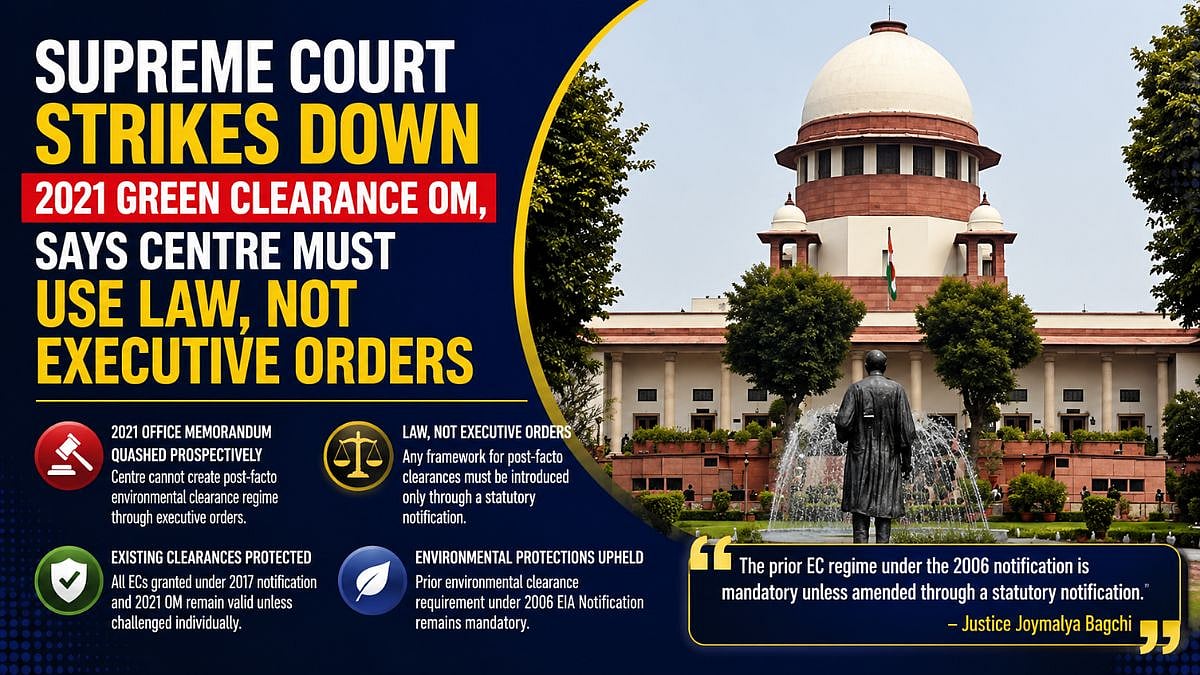
The Supreme Court has ruled that the Central government cannot grant post-facto environmental clearances through an administrative Office Memorandum (OM). On Wednesday, a Bench of Chief Justice Surya Kant, Justice Joymalya Bagchi, and Justice Vipul Pancholi quashed the Union government's July 7, 2021, Office Memorandum, which had laid down a standard operating procedure for granting environmental clearance to projects that had begun construction or operations without obtaining prior environmental clearance.
The Court held that the 2021 OM was ultra vires the Environment (Protection) Act, 1986, because it sought to substantially alter the environmental clearance regime created under the Environmental Impact Assessment (EIA) Notification, 2006, through an administrative order instead of a statutory notification. The prior EC regime under the 2006 notification is mandatory unless amended through a statutory notification.
The Bench observed that the 2006 EIA Notification makes prior environmental clearance mandatory before a project begins. Since the 2021 OM created a continuing mechanism for granting clearances after projects had already commenced, it effectively replaced delegated legislation through an executive instruction, which the Court said is legally impermissible.
The Court further held that the 2021 OM envisaged a 'perpetual amnesty scheme' for projects that violated the prior clearance requirement without laying down any intelligible basis for selecting cases that deserved such relief in the public interest. It ruled that the OM failed the constitutional test of proportionality and reasonableness and violated Articles 14 and 21 of the Constitution.
Consequently, it declared the 2021 OM unconstitutional and quashed it prospectively. However, the Court gave its ruling prospective effect and protected all environmental clearances already granted under the 2021 OM and the 2017 notification unless they are challenged individually in accordance with law.
The Court clarified that there is no absolute legal bar on granting post-facto environmental clearances. It said the Central government retains the power to introduce a narrowly tailored amnesty scheme in exceptional cases, provided it is done through a valid notification issued under Section 3 of the Environment (Protection) Act, 1986.
The Supreme Court's decision is significant as it emphasizes the importance of following statutory law in granting environmental clearances. The ruling is expected to have a major impact on the environmental clearance process in India, and it will be interesting to see how the Central government responds to the Court's decision.
The judgment is a victory for environmental activists who have been arguing that post-facto clearances are illegal and undermine the environmental impact assessment process. The Court's decision is also a reminder that the government must follow the law and cannot use executive orders to bypass statutory requirements.
In conclusion, the Supreme Court's ruling on the 2021 Green Clearance Office Memorandum is a significant development in the field of environmental law. The decision emphasizes the importance of following statutory law and ensures that the environmental clearance process is transparent and accountable.
The Court's decision will have far-reaching implications for the environment and the economy. It will ensure that projects are held to high environmental standards and that the government is accountable for its actions. The ruling is a major step forward in the protection of the environment and the promotion of sustainable development.
The Supreme Court's judgment is a testament to the importance of the judiciary in protecting the environment and upholding the rule of law. The decision is a reminder that the government must act in accordance with the law and that the judiciary will not hesitate to strike down illegal actions.
In the end, the Supreme Court's ruling on the 2021 Green Clearance Office Memorandum is a significant victory for the environment and the rule of law. It ensures that the environmental clearance process is transparent, accountable, and follows statutory law. The decision is a major step forward in the protection of the environment and the promotion of sustainable development.
Frequently asked questions
What is the significance of the Supreme Court's ruling on the 2021 Green Clearance Office Memorandum?
The ruling emphasizes the importance of following statutory law in granting environmental clearances and ensures that the environmental clearance process is transparent and accountable.
Can the Central government still grant post-facto environmental clearances?
Yes, the Central government retains the power to introduce a narrowly tailored amnesty scheme in exceptional cases, provided it is done through a valid notification issued under Section 3 of the Environment (Protection) Act, 1986.