MP High Court Releases NEYU Activists, Terms Bail Condition 'Onerous'
MP High Court frees NEYU activists, calls government-employee surety condition unfair. Activists were detained ahead of peaceful protest.
'%3E%3Crect%20width%3D'96'%20height%3D'96'%20fill%3D'%231A5276'%2F%3E%3Ccircle%20cx%3D'30'%20cy%3D'24'%20r%3D'44'%20fill%3D'%23fff'%20opacity%3D'.12'%2F%3E%3Ccircle%20cx%3D'60'%20cy%3D'74'%20r%3D'40'%20fill%3D'%23000'%20opacity%3D'.10'%2F%3E%3C%2Fg%3E%3Cg%20fill%3D'%23fff'%3E%3Cpath%20d%3D'M31%2041%20L48%2031%20L65%2041%20Z'%2F%3E%3Crect%20x%3D'33'%20y%3D'43'%20width%3D'4'%20height%3D'17'%2F%3E%3Crect%20x%3D'41'%20y%3D'43'%20width%3D'4'%20height%3D'17'%2F%3E%3Crect%20x%3D'51'%20y%3D'43'%20width%3D'4'%20height%3D'17'%2F%3E%3Crect%20x%3D'59'%20y%3D'43'%20width%3D'4'%20height%3D'17'%2F%3E%3Crect%20x%3D'30'%20y%3D'62'%20width%3D'36'%20height%3D'4'%20rx%3D'1'%2F%3E%3C%2Fg%3E%3C%2Fsvg%3E)

The Indore Bench of the Madhya Pradesh High Court has ordered the release of two members of the National Educated Youth Union (NEYU), citing that a police-imposed condition requiring a government employee to stand surety for their bail was excessively harsh.
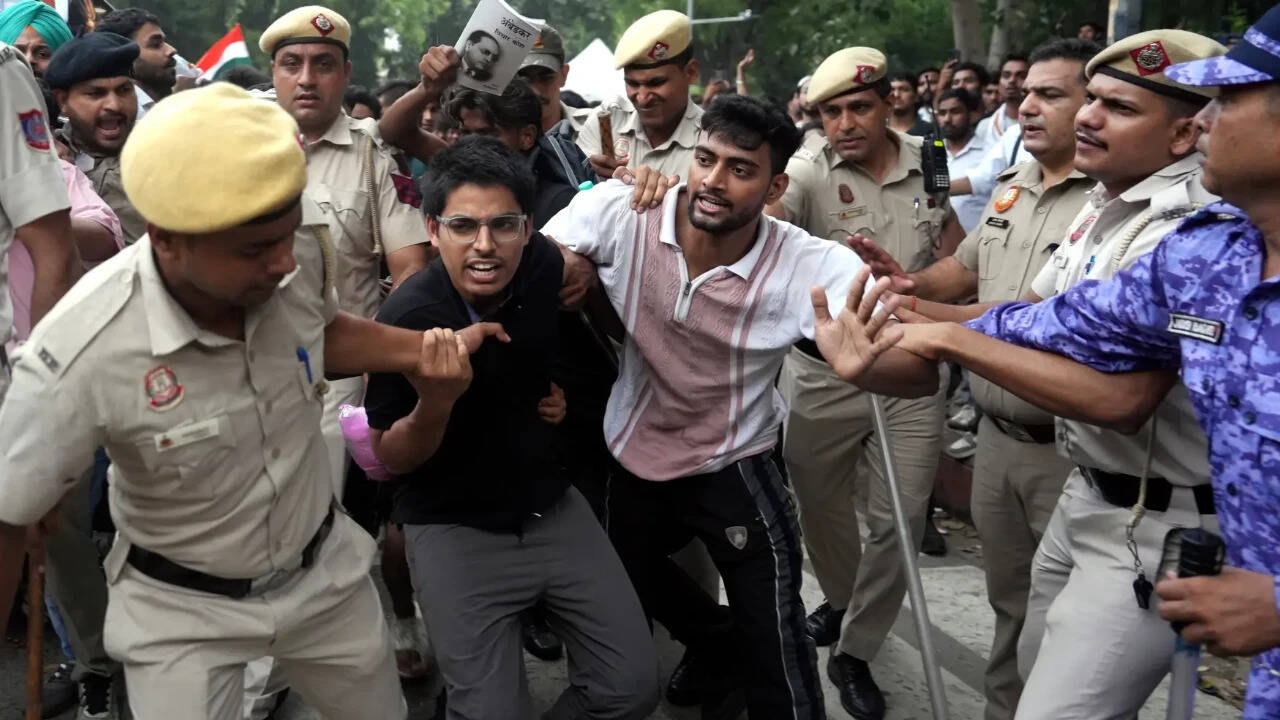
The court's decision came while hearing a habeas corpus petition filed by Ranjeet Jat, which alleged that NEYU members Radheshyam Jat and Surendra Yadav were illegally detained ahead of a peaceful protest planned in Indore on July 23. The protest was in support of students demonstrating at Jantar Mantar in New Delhi.
According to the petition, the activists had informed the police about the proposed procession but were detained instead of being granted permission. The State defended the detention, arguing that the two men had been proceeded against under Section 170 of the Bharatiya Nagarik Suraksha Sanhita (BNSS) and could secure their release by complying with the conditions imposed by the Assistant Commissioner of Police.
The State also cited their alleged involvement in violent protests in 2024 to justify the conditions. However, the High Court found one of the bail conditions to be unduly harsh, noting that requiring a government servant to furnish surety was impractical.
The court observed that few government employees would risk their jobs by standing surety for detainees, effectively depriving the petitioners of the benefit of bail. Relying on Supreme Court rulings discouraging excessively stringent bail conditions, the court observed that such requirements should be imposed only in exceptional circumstances and not as a matter of routine.
Allowing the petition, the High Court directed the release of both detainees on furnishing a personal bond of Rs 50,000 each with one solvent surety of the same amount. The court also directed them to comply with the conditions under Section 437(3) of the Code of Criminal Procedure and to appear before the trial court as required.
The decision highlights the importance of ensuring that bail conditions are fair and reasonable, and not imposed in a manner that effectively denies bail to detainees. The court's ruling is a significant development in the case, and is likely to have implications for similar cases in the future.
The National Educated Youth Union (NEYU) is an organization that has been involved in various protests and demonstrations in the past, and the detention of its members had sparked concerns about the freedom of speech and assembly. The High Court's decision is a welcome move, as it upholds the fundamental rights of citizens and ensures that the law is applied in a fair and just manner.
In conclusion, the MP High Court's decision to release the NEYU activists is a significant development that highlights the importance of ensuring that bail conditions are fair and reasonable. The court's ruling is a testament to the independence of the judiciary and its commitment to upholding the fundamental rights of citizens.
The case also raises important questions about the role of the police and the government in regulating protests and demonstrations. While the government has a responsibility to maintain law and order, it is equally important to ensure that citizens are able to exercise their right to free speech and assembly without fear of harassment or intimidation.
The MP High Court's decision is a significant step in the right direction, and is likely to have a positive impact on the rights of citizens in the state. It is a reminder that the judiciary plays a crucial role in ensuring that the government and the police do not overstep their bounds, and that citizens are able to exercise their fundamental rights without fear of reprisal.
The decision is also a testament to the importance of a free and independent judiciary, which is essential for ensuring that the rule of law is upheld and that citizens are able to access justice. The MP High Court's ruling is a significant development that is likely to have far-reaching implications for the rights of citizens in the state.
Frequently asked questions
What was the reason for the detention of NEYU activists?
The activists were detained ahead of a peaceful protest planned in Indore on July 23 in support of students demonstrating at Jantar Mantar in New Delhi.
What was the bail condition imposed by the police?
The police had imposed a condition requiring a government employee to stand surety for their bail, which was deemed onerous by the High Court.