IIT Mandi Orders Probe Into Casteist Poster
IIT Mandi investigates Bhagavad Gita poster, Director condemns caste discrimination
'%3E%3Crect%20width%3D'96'%20height%3D'96'%20fill%3D'%23B3261E'%2F%3E%3Ccircle%20cx%3D'30'%20cy%3D'24'%20r%3D'44'%20fill%3D'%23fff'%20opacity%3D'.12'%2F%3E%3Ccircle%20cx%3D'60'%20cy%3D'74'%20r%3D'40'%20fill%3D'%23000'%20opacity%3D'.10'%2F%3E%3C%2Fg%3E%3Cg%20fill%3D'%23fff'%3E%3Crect%20x%3D'29'%20y%3D'49'%20width%3D'8'%20height%3D'19'%20rx%3D'1'%2F%3E%3Crect%20x%3D'39'%20y%3D'40'%20width%3D'9'%20height%3D'28'%20rx%3D'1'%2F%3E%3Crect%20x%3D'50'%20y%3D'45'%20width%3D'8'%20height%3D'23'%20rx%3D'1'%2F%3E%3Crect%20x%3D'60'%20y%3D'53'%20width%3D'7'%20height%3D'15'%20rx%3D'1'%2F%3E%3Crect%20x%3D'41'%20y%3D'34'%20width%3D'5'%20height%3D'6'%2F%3E%3C%2Fg%3E%3C%2Fsvg%3E)
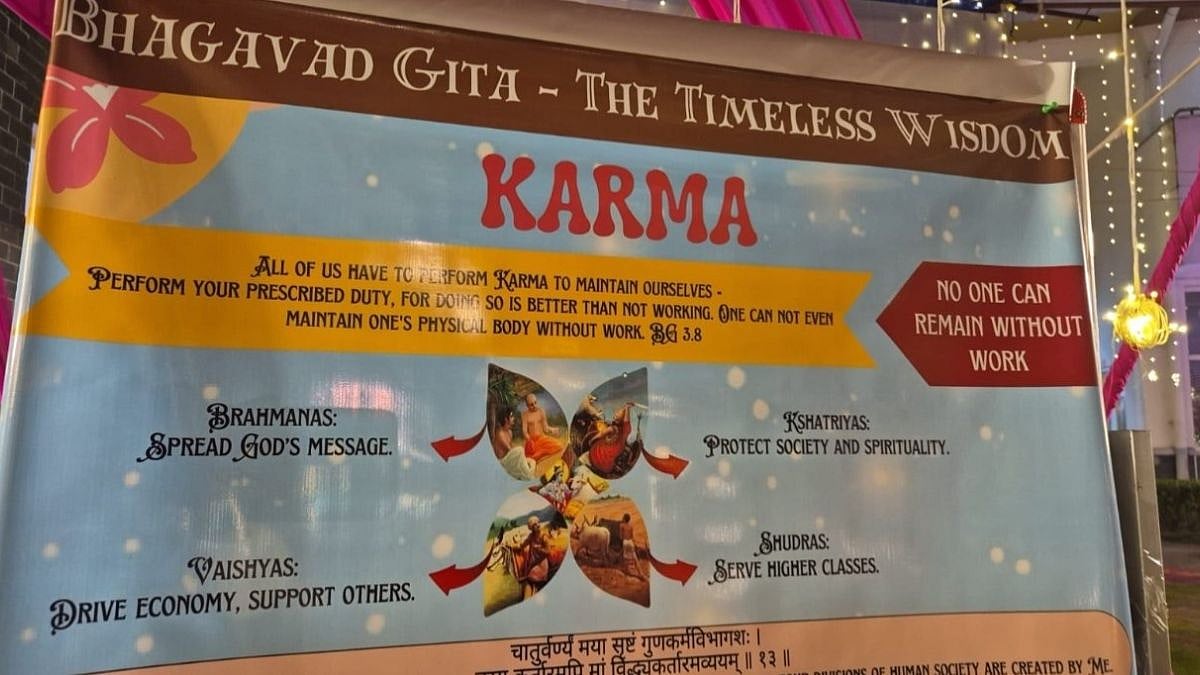
A controversy has erupted at the Indian Institute of Technology (IIT) Mandi over a Bhagavad Gita-themed poster that was displayed on campus during Janmashtami celebrations. The poster, which was titled 'Bhagavad Gita - The Timeless Wisdom', divided society into four categories - Brahmanas, Kshatriyas, Vaishyas, and Shudras - and described the role of Shudras as 'serving higher classes'.
The Director of IIT Mandi, Laxmidhar Behera, has ordered an inquiry into the matter and condemned the display of casteist ideas on campus. Behera, who has a longstanding association with the teaching of the Bhagavad Gita and the International Society for Krishna Consciousness (ISKCON), said that the poster was prepared as part of a student-led event and did not reflect the views of the institute.
Behera has instituted an enquiry committee comprising faculty members and representatives from different social categories, including Scheduled Castes and Other Backward Classes, to look into the matter. In an email to the IIT Mandi community, Behera expressed his shock and disappointment at the incident and stressed that the institute stood against caste discrimination.
The incident has sparked outrage on social media, with many condemning the display of casteist ideas on campus. The controversy has also raised questions about the interpretation of the Bhagavad Gita and its relevance to modern society.
IIT Mandi has a diverse student body and is committed to upholding the values of equality, social justice, and scientific temper. The institute has a zero-tolerance policy towards caste-based discrimination and has taken steps to promote social harmony on campus.
The enquiry committee is expected to submit its report soon, and the institute will take necessary action against those responsible for the poster. The incident has highlighted the need for greater awareness and sensitivity towards social issues on campus.
The Director's prompt response to the incident has been appreciated by the student community, and the institute is working to ensure that such incidents do not happen in the future. The incident has also sparked a debate about the role of educational institutions in promoting social harmony and combating caste-based discrimination.
In conclusion, the controversy over the Bhagavad Gita poster at IIT Mandi has highlighted the need for greater awareness and sensitivity towards social issues on campus. The institute's prompt response to the incident and its commitment to upholding the values of equality and social justice are commendable.
The incident has also raised questions about the interpretation of the Bhagavad Gita and its relevance to modern society. It is essential to promote a nuanced understanding of the scripture and its teachings, and to ensure that they are not used to perpetuate caste-based discrimination.
Overall, the incident at IIT Mandi is a reminder of the need for educational institutions to promote social harmony and combat caste-based discrimination. It is essential to create a safe and inclusive environment on campus, where students from all backgrounds can feel welcome and respected.
Frequently asked questions
What was the controversy at IIT Mandi?
A Bhagavad Gita-themed poster was displayed on campus, dividing society into four categories and describing the role of Shudras as 'serving higher classes'.
What action has been taken by the institute?
The Director has ordered an inquiry into the matter, condemned the display of casteist ideas, and formed an enquiry committee to look into the incident.